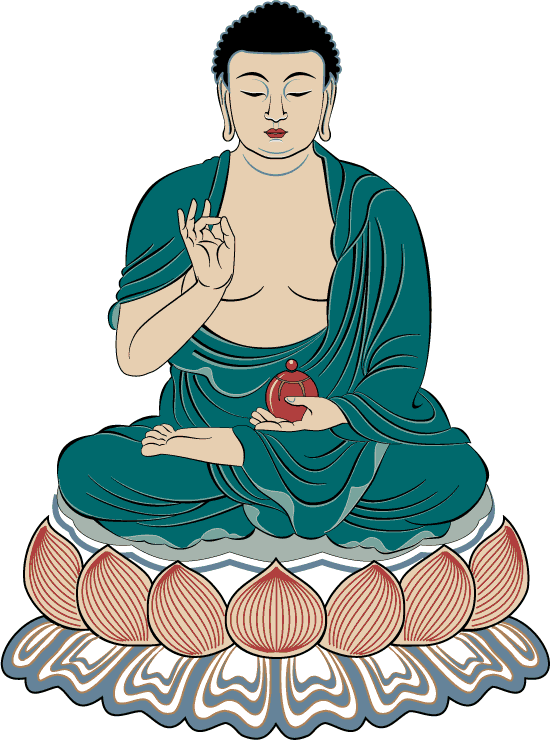
Manual of Buddhist terms and teachings. The Buddhist
Dictionary is the central source of information to supplement the texts
in the Theravada Archive.
a
worship
See puja.
abhabbagamana
Incapable of progress. "Those creatures hindered by
their evil acts (kamma), by the result of their evil acts (vipaka), or who are devoid of faith (saddha), energy and knowledge, and are unable to walk the straight path and
achieve perfection by doing beneficial things; of all those
is said to be incapable of progress." (Pug. 13).
According to the commentary, the "evil deeds" denote the five abominable
deeds with immediate effect (anantarika kamma), while the 'defilements' refer to the 'misconceptions that
setting destinations' (niyata miccha ditthi). See ditthi.
abhassara devas
The gods of radiant splendor. See deva.
abhassara
The radiant ones.
abhibhayatana
##work out##. The eight 'stages of mastery' are powers acquired
be by means of the kasina exercises (see kasina). More explanation follows. See also D16.
abhidhamma pitaka
Basket of the Higher Leather. Third division of the Pali canon. See A tour of the Ti Pitaka.
abhidhamma
See abhidhamma pitaka.
abhidjna
Unlimited insight.
abhijjha visamalobha
Desire and unjust greed. One of the defilements of the mind.
See upakkilesa. See also M007.
abhijjha
Desire. Synonyms are: lobha; tanha; raga; kama.
abhinibbatti
Term for rebirth.
abhiñña
The 6 higher powers or super-worldly kinds of knowledge. These exist
of 5 worldly (lokiya) powers attainable through the highest perfection in mental concentration
(samadhi), and one superworldly (lokuttara) power through insight (vipassana), that that is, the extinguishing of all
encroachments (asavakkhaya; see asava), in other words: realization of Arahatship or Holiness. This
are: 1) magical powers (iddhi vidha); 2) divine ear (dibba sota); 3) penetrating the minds of others (ceto pariya ñana); 4) being able to remember previous births (pubbe niva sanussati); 5) divine eye (dibba cakkhu); 6) the extinguishing of all influxes (asavakkhaya). The standard text that we encounter in all four sutta collections,
for example in D34; M004; M006; M077; A03-099; A05-023; S15-009 and Pug.
271, 239 is as follows:
- "Now, monks, the monk enjoys various magical powers (iddhi vidha), such as that he has been one person, he becomes many, and after he many
has been, he becomes one person again. He appears and disappears. Without
to be hindered, he passes through walls and mountains, just as he passes through the
air goes. He dives into the earth and comes out again, just like
like in the water. He walks on water without sinking, just like him
walks on earth. With his legs crossed he floats through the air, just like
like a bird on its wings. With his hand he touches the sun and the
moon on, this so mighty, so mighty. Until even the Brahma world is
he masters his body."
- "With the divine ear (dibba sota) he hears sounds, celestial and human, far and near."
- "He recognizes the minds of other beings (parassa ceto pariya ñana), of other persons, by imbuing them with his own mind .
He recognizes the greedy mind (lobha) as the greedy and the non-greedy as the non-greedy; he
recognizes the hating spirit (dosa) as the hating and the not hating as the not hating; he recognizes the
deluded mind (moha) as the deluded and the deluded as the delusional;
he recognizes the narrowed mind (sankhitta) as the narrowed and the non
constricted as the not constricted; he recognizes the distracted mind (vikkhitta)
as the derivative and the non-derivative as the non-derivative; he recognizes
the evolved mind (mahaggata) as the evolved and the uneducated
if the undeveloped; the surpassing spirit (sauttara) and the unsurpassable
(anuttara), the concentrated mind (samahita) and the unconcentrated (asmahita),
the liberated mind (vimutta) and the unliberated (avimutta)."
- "He remembers many previous existences (pubbe niva sanussati),
such as one birth, two, three, four and five births (...) one hundred thousand
births; he remembers many formations and dissolutions of worlds:
'There I was, such a name I had (...) and disappearing from there I went somewhere
otherwise an existence within (...) and vanishing from there I appeared again
here.' Thus he remembers, always associated with the characteristics and particulars,
many previous existences."
- "With the divine eye (dibba cakkhu = yatha kammupaga ñana or cutupapata
ñana), see the pure, beings disappear and reappear, low
and noble, beautiful and ugly; he sees how beings appear again according to
their deeds (see kamma): 'Indeed, these beings committed evil deeds in regard to bodily
actions, words and thoughts, they offended the nobles in mind,
had wicked opinions, and according to their wicked opinions,
they acted. After the decomposition of their bodies, after death, appeared
they in lower worlds, in painful realms of existence, in the world of
suffering, in hell. Other beings, however, are endowed with good deeds
(...) appeared in a happy sphere of existence, in a heavenly world."
- "By extinguishing all afflictions (asavakkhaya), even in this life he attains liberation of mind, liberation
by wisdom, after he himself has understood and realized it."
4-6 Often appears under the name of the 'triple knowledge' (te vijja). However, these are not necessary conditions to achieve Arahatship.
Fish. 11-13 gives a detailed explanation of the 5 worldly higher
powers, along with the methods of how to acquire them.
abhiññaya
Lighting.
abhiññeyya
Recognize.
abhisamaya
True realization.
abhivadana
Someone who is straight forward, who is straight forward. the truth is him
dear, the truth always comes first. This term is therefore
a reference to the Arahat.
accanta dussilyam
Complete lack of discipline and virtue. What is meant here
is the lack of discipline of monks. The extreme lack of discipline
and virtue, according to the traditional commentaries, is caused
by 13 serious imperfections (garukapatti). ##work out##
See Dhp162 for more explanation and related information.
acchariya manussa
A name assigned to the Buddha. See names for the buddha.
accutam thanam
The immutable place. This is another word for Nibbana -- the immortal. Everything changes, but this rule does not apply to
Nibbana because Nibbana is the unconditioned. Unlike samsara,
existence of phenomena, Nibbana is eternal (dhuva), pleasant (subha), and happy (sukha).
See Dhp166; Dhp225 for more information about Nibbana.
eightfold path
See ariya atthangika magga.
aciram vata
Very soon, without a doubt. See Dhp041 for more explanation and related information.
adassana
Not understanding. Synonym: avijja; aññana; moha.
adhicitta sikkha
The training in higher mentality. See sikkha.
Adhikakka
River Adhikakka. No explanation.
adhimokkha
'Decision', 'determination', 'decision', 'determination' is a
of the interacting mental factors (cetasika) and belongs to the group of mental formations (sankhara kkhandha). It means the freedom of mind of the 'faltering state' between
the two causes "is it?", or "isn't it?" In M111
it is meant by other related mental factors. See cetasika; Table II.
adhipañña dhamma vipassana
'Contemplation of insight into phenomena which is the higher wisdom
is', is one of the 18 kinds of insight-knowledge. See vipassana.
adhipañña sikkha
Higher training in wisdom. See sikkha.
adhipati paccaya
'Overriding Condition' is one of 24 conditions. See paccaya.
adhisila sikkha
Higher training in morality. See sikkha.
adhitthana paramita
The perfection of determination. See paramita.
adhyatma ayatana
The six inner sense bases. See ayatana.
adiccabandhu
A name assigned to the Buddha. See names for the buddha.
adinava nupassana
'Contemplation of danger', is one of the 18 kinds of insight-knowledge.
See vipassana.
adinava
Danger. See e.g. M011. ##work out##.
adinnadana veramani
Abstinence from stealing.
adinnadana
Steal.
adosa
'Absence of hate', is one of the 3 karmic moral roots. In ethical
phrase it means kindness of mind towards a
object or purity of mind. It also becomes 'without ill will' or peace
of spirit (avyapada) and loving-kindness (metta). For more explanation, see mula.
See cetasika; Table II.
adukkha m asukha vedana
Literally: 'Neither pleasant nor unpleasant feeling', equals 'neutral
feeling or equanimity' (upekkha vedana). See vedana.
agati
The '4 wrong paths' are: the path of greed (chanda), of hatred ( dosa), of delusion (moha), and of cowardice (bhaya ). "One who is freed from 4 evil impulses is no longer able
to the wrong path of greed, hatred, delusion and cowardice
to take." (A. 4:17; A. 9:7).
aham sattha anuttaro
A name assigned to the Buddha. See names for the buddha.
ahara paccaya
'Food condition' is one of the 24 conditions. See paccaya.
ahara
'Eat', 'food', is used in a concrete sense for material food
hence this belongs to the derived group of physicality (see pañca upadana kkhandha, enumeration 1).
In a figurative sense as 'foundation' or 'condition', food is one of
the 24 terms (paccaya) and is used to denote 4 kinds of food that are materially
or can be mental:
- Material food (kabalinkarahara).
- Sensual and mental (phassa).
- Mental act of will (mano sañcetana).
- Consciousness (viññana).
"1. Material food nourishes the eightfold physicality that a
nourishing essence has as its 8th factor (i.e. the firmness,
the liquid, heat, movement, color, fragrance, the tasteable and the nourishing
essence; see rupa kalapa). 2. Sensory and mental impression is a prerequisite for the 3 species
of feeling; (pleasant, unpleasant and neutral feeling, see paticcasamuppada no. 6). 3. Mental act of will (kamma) nourishes rebirth (see paticcasamuppada no. 2). 4. Consciousness nourishes mind and body (nama rupa, see paticcasamuppada no. 4) at the time of conception (okkanti)." (Vis. 11).
Literature (across the 4 feeds): M009 and Com., M038; S12-063; S12-064;
The Four Nutriments of Life, selected texts and Com. (Wheel 105-106).
ahare patikkula sañña
Reflecting on the disgustingness of food. See bhavana.
ahetuka citta
See hetu.
ahetuka ditthi
The fatalistic 'non-causality view' of existence; by
believe that there is no causality. See ditthi.
ahetuka ditthi
'The view of non-causality' (of existence). See ditthi.
ahetuka patisandhika
See patisandhi.
ahetuka
'Without root'. See hetu.
ahicchatta
See Naga.
ahimsa
Nonviolence.
ahimsaya ratio
Finding positive joy in nonviolence, finding joy in cultivating
of loving kindness.
A very special feature of the Buddha's teachings is the cardinal
premise that it is necessary to be kind towards
all living beings. The practice of loving-kindness (metta), which ensures nonviolence, is widespread among Buddhists.
In his admonition to Rahula, the Buddha said: "Develop, Rahula, the meditation of loving
kindness (metta); for by this ill will is dispelled. -- Develop, Rahula, the meditation
of compassion (karuna); for by this torment and cruelty are dispelled."
See Dhp296-301 for more on loving-kindness.
ahirika anottappa
'Lack of moral shame and awe' are two of the 4 unwholesome factors
associated with karmic unwholesome states of consciousness, the other two
are restlessness (uddhacca) and delusion (moha). Against this are the moral factors hiri and ottappa. See cetasika; Table II.
"There are two ominous things, namely, lack of moral
shame and awe", etc. (A. 2:6). "Don't be ashamed of what
one should be ashamed; not be ashamed of evil, unwholesome things:
this is called lack of moral shame." (Pug. 59) "Not
fear what one should fear (...) this becomes lack of moral awe
called." (Pug. 60).
See also the individual description of ahirika and anottappa.
ahirika
'Lack of moral shame'. When one is about to do an evil deed
perform, no sense of shame arises in him who shamelessly
is, like: "It would be very wrong if I did this", or
"some people will know this about me". No one is ashamed
which one should be ashamed of. It's one of those mental factors
which are inseparable from immoral consciousness (akusala sadharana cetasika). See cetasika; Table II. Opposite this is the moral factor hiri.
See also the description under ahirika anottappa.
aho sukham
"Oh, what luck!" This was what the Reverend Maha Kappina was constantly saying in the Jetavana while he was speaking during the day. or night rest. The monks heard
tell him so many times a day that they told the Buddha. The
Buddha replied to them: "My son Kappina, has the taste of
tasted the Dhamma, and lives with a pure mind; it is out of delight that he
exclaims these words, which refer to Nibbana."
ajara
Without old age (or decay), i.e. Nibbana. See Dhp166; Dhp225 for more information about Nibbana.
ajata
Without birth, i.e. Nibbana. See Dhp166; Dhp225 for more information about Nibbana.
ajatakasa
Endless space. See akasa.
ajiva
Maintenance.
Ajivaka
Ajivaka. See sects in India.
ajjhattam
'In yourself'. A reference to the individual, not to 'the self'. See
S22-059.
akanittha devas
The gods who are no lesser (anagami). See deva.
akanittha
'The Great Ones', that is, 'the Highest Gods', the inhabitants of the fifth
and highest heaven of the Pure Abodes (Suddhavasa).
akaravati saddha dassanamulika
'Well thought out and rooted in understanding.' Such must be the faith of a
Buddhist. See saddha.
akasa dhatu
Confined space. See akasa.
akasa
'Space', according to the commentary, is of two kinds: 1) bounded space
(paricchinnakasa or paricchedakasa); 2) endless space (anantakasa), that is, outer space.
1) Bounded space, called akasa dhatu (space element), belongs to the group, which is derived from the group
of physicality (see the enumeration at pañca upadana kkhandha; Dhs 638) and the sixfold classification of elements, see dhatu; M112; M115; M140. It is also a kasina (see there) meditation object. It is described as follows:
"The space element has the characteristic of demarcated shape. Her function
is to indicate the limits of form. It reveals itself when the stipulations
in shape; whether her revelation consists of being untouched (by the 4
large elements), and in caves and crevices or openings. Its direct cause
is the defined shape. It is because of the space element that someone from
material demarcated things can say: 'this is above, this is below, this
is round'." (Vis. 14:63).
2) Endless space is shown in Asl. called ajatakasa, 'unconnected',
that is, unobstructed or empty space. It is the object of the 1st
immaterial meditative deepening (see jhana) namely, the sphere of unlimited space (akasanañcayatana). According to the Abhidhamma philosophy, endless space has no objective
reality (it is purely conceptual), which is indicated by the fact
that it does not fall within the beneficial trinity (kusalatika), which the
encompass the whole of reality. Later Buddhist Schools Beheld
this as one of the many unconditioned or uncreated states (asankhata
dhamma) -- a view rejected in Kath. Theravada Buddhism
recognizes only Nibbana as an unconditioned element (asankhata dhatu,
see mr. 1084).
akasanañcayatana
The atmosphere of infinite space. See jhana.
akasanañcayatanupaga devas
The gods of infinite space. See deva.
akiñcaññayatana
The atmosphere of nothingness. See jhana.
akiñcaññayatanupaga devas
The gods of the sphere of nothingness. See deva.
akinncañña ceto vimutti
Liberation of the mind about the accompaniments. See ceto vimutti.
akiriya ditthi
The 'view of the ineffective of action'; believe that actions
have no effect. See ditthi.
akuppa ceto vimutti
Immobile liberation of the mind. See ceto vimutti.
akusala citta
Unwholesome consciousness.
akusala kamma patha
The tenfold unwholesome courses of action. See kamma patha.
akusala sadharana cetasika
'Common immoral mental factors associated with all unwholesome acts of will.'
4 in number: 1. lack of moral shame (ahirika); 2. lack of moral awe (anottappa); 3. restlessness (uddhacca); 4. glamor (moha). See cetasika; Table II.
The corresponding term in the field of beneficial consciousness is sobhana sadharana cetasika.
akusala
'Unwholesome', 'immoral', are all acts of will (kamma cetana, see cetana< /A>) and consciousness and the mental factors that go along
with it, which accompanied either by greed (lobha), hatred (dosa), or mere delusion ( moha); and all these phenomena are causes of unfavorable kamma effects (kamma vipaka) and contain the seeds of unfortunate destinies of rebirths.
Refer to paticcasamuppada 1; cetasika; kamma patha; mula; kamma; Table I and Table II.
alobha
Absence of greed, is one of the 3 karmic moral roots. Literal:
'no interest of the mind when it beholds an object'. It will be
also called 'the element of renunciation' (nekkhamma dhatu) and freedom (anabhijjha) . For more explanation, see mula.
See cetasika; Table II.
aloka kasina
Light-kasina.
aloka sañña
The perception of light. The recurring canonical passage reads: "Here
the monk beholds the perception of light. He fixes his mind on
the sighting of the day; both by day and by night, and as by night,
as well as during the day. In this way he develops, with a clear and cloudless
mind, a state of mind that is full of clarity."
It is one of the methods of overcoming confusion, by
the Buddha recommended for Maha Moggallana (A. 7: 58). Similar to D. 33, it extends to the development of
'knowledge and vision' (see visuddhi), and is said to be helpful for the acquisition of the
'divine eye', see abhiñña.
amahaggata citta
The undeveloped mind. The ordinary worldly consciousness usually in
people live. That is the consciousness of the sense sphere (kama loka or kamavacara). One can of course live in this sphere while his/her spiritual
development of a higher or lower level. Depending on that development
he/she is reborn in the sphere according to his/her development.
This can be clearly seen, for example, in the many different characters
of people here in the sense realm (kamavacara).
amara
Immortal i.e. Nibbana. See Dhp166; Dhp225 for more information about Nibbana.
amata
Immortality. See amara.
amatam padam
The Immortal State or the Deathless, i.e. Nibbana.
amatassa data
A name assigned to the Buddha. See names for the buddha.
amisa puja
See puja.
amisadana
Material gift, visible gift.
amoha
'Absence of delusion' or 'knowing things as they are', is
one of the 3 karmic moral roots. It is also called knowledge (ñana), wisdom (pañña), true knowledge (< A href="wbke.htm#vijja">vijja) and
correct understanding (samma ditthi). For more explanation. See mula.
See cetasika; Table II.
an upadi sesa nibbana
'Nibbana without the groups remaining'. See Nibbana.
anabhijjha
Freedom. See alobha.
anagami magga
The path of the no longer returning.
anagami phala
The fruits of the path of the no longer returning.
anagami
'The non-returning one', is a noble disciple (ariya puggala) of the 3rd
stage of holiness. There are 5 classes of Non Returning, such as
that is said in, for example, Pug. 42-46: "By disappearing
of the 5 lower bands (orambhagiya samyojana, see saññojana), a being appears in a higher world (among the devas of the Pure
Abide, Suddhavasa) and without the return of that world (to the sense world) reached
he Nibbana."
- "He can -- immediately after he appears there (in the Pure
stay) -- or when he is not yet in the second half of his life
is, to attain the sacred path to overcome the higher bonds (uddhambhagiya samyojana). Such a being is called: 'one who has the Nibbana
achieved in the first half of his life (antara parinibbayi)'."
- "Or, when he is in the second half of his life, or at the moment
of dying reaches the sacred path to conquer the higher bonds.
Such a being is called: 'one who attained Nibbana after being in
the second half of his life is (upahacca parinibbayi)'."
- "Or, through effort he attains the sacred path to the higher bands
to win. Such a being is called: 'one who attained Nibbana
by effort (sasankhara parinibbayi)'."
- "Or, he reached the sacred path of the higher bands without effort
to win. Such a being is called: 'one who attained Nibbana
without effort (asankara parinibbayi)'."
Note
- 'Without effort' does not mean that no effort has been made.
However, now this person has reached a stage where he is completely unforced,
artlessly, 'going further into the stream'.
- "Or, after the disappearance from the sky of the Aviha gods, appears
he in the world of the carefree gods (atappa devas). After disappearing
from there, he appears in the world of the gods 'who are beautiful to
see' (sudassa devas); from there, he appears in the world of the
gods 'who see the beautiful' (sudassi devas); from there, he appears
in the world of the highest gods (akanittha devas). Reached from there
he the sacred path to conquer the higher bonds. Such a creature becomes
called: 'one who goes upstream to the highest gods (uddhamsota aka nittha gami)'."
See ariya puggala/ariya; saññojana.
ananda bodhi tree
Tree who placed Anathapindika so that people could pay reverence to the Buddha when
he wasn't around. Because the organization -- with regard to
planting the tree -- was in the hands of Ananda, the tree became 'the Ananda Bodhi tree called '.
Along the main path of the Jetavana there are foundations of several structures with a tree growing there
and often identified as the Ananda Bodhi tree. According to the explanation of the Jatakas, people came to pay reverence to the Buddha, and if they did not
home, they hung flowers and garlands on the door of the Fragrance
Room (Gandhakuti). When Anathapindika heard of this, he asked the Buddha how the people paid him their respect
could show when he was absent, and the Buddha suggested that
could be done by placing the offering near a Bodhi tree. Thus, a fruit from the Bodhi tree of Bodh Gaya (Uruvela) was taken and planted in the Jetavana with great ceremony. Because the
It was Ananda who took on the organization, the tree became known
as the 'Ananda Bodhi tree'. Anathapindika asked King Pasenadi to plant the tree, but the king said it was his land and that
the credit went to Anathapindika. Anyway, the Jetavana has been swallowed by the jungle for almost a thousand years, and because there is no
archaeological evidence is that indicated where the Ananda Bodhi tree really is
stood, the identification with the original tree is highly questionable.
The notes to the Jataka say that the tree was planted next to the main entrance
of the Jetavana, believed to be somewhere in the vicinity
of the Burmese temple. Place: Savatthi (modern Sahet-Mahet), India.
ananganassa
The person without defilements (anganas). Anganas are defilements that
originated from passion (raga), hatred (dosa) and ignorance (moha). These are described as anangas (literally: open spaces, playgrounds)
because evil can play around here (has the free space) without inhibition.
At the time of the Buddha, 'defilements' were also described as
anganas. In an etymological sense, ananga also means, the capacity to
to spoil a person who is soiled with defilements. In some contexts
implies angana 'filth'. An individual who is without defilements,
is therefore referred to as pineapple.
anaññaposi
Literally: 'Who does not support another'.
anantakasa
Endless space. See akasa.
anantara paccaya
'Relationship condition' is one of the 24 conditions. See paccaya.
anantarika kamma
The 'five heinous acts with immediate effect' are: 1. patricide;
2. matricide; 3. kill a Arahat; 4. wound a Buddha; 5. create a schism (rupture) in
the Sangha (see Dhp163). In A. 5:29 it reads:
"There are five kinds of short-tempered and sickly people who
destined for the lower worlds, namely: the patricide, (...)"
etc. Concerning the 5th, see A. 10:35; A. 10:38. With reference to the first
crime, in D22 it is said that if king Ajatasattu is not his father, king Bimbisara, he would have become a streamer (sotapatti).
anapana sati
Pay attention to the inhalation and exhalation. Ana = inhalation; apana = exhalation. On
the end of a rainy season retreat (vassa), the Buddha was so pleased with the progress of the group of monks
who had gathered there, that he encouraged them to make their retreat with
to be extended by one month. On the full moon day that celebrated the end of this
month of this retreat, the Buddha presented for the first
times his famous instructions for mindful breathing
(anapana sati), which can be found in the Anapana Sati Sutta M118.
anatam
'The artless', is another name for Nibbana.
anatta nupassana
'Contemplation of 'without-self', is one of the 18 kinds of insight-knowledge.
See vipassana.
anatta vadi
A name assigned to the Buddha. See names for the buddha.
anatta
Without-self, ego-less, without a soul. Using in the Theravada Archive
we also called 'not-self' or 'no-self'. On the Articles page, search for Without a self or soul article(s). Further: ti lakkhana; pañca upadana kkhandha; ditthi; cattari ariya sacca; S22-059.
anattani attavipallasa
'Seeing a self in the self-less'. See vipallasa.
anattata
Selflessness. See anatta.
anavahatacetaso
Here reference is made to the person whose mind remains unaffected (by
desire, hate, etc.). When the mind is perfectly intact, it can have this quality
to use for spiritual progress.
See Dhp038-039 for more explanation and related information.
anavassuta cittassa
The untouched mind. Here reference is made to the mind of one who
unaffected by passion. This implies the polluting influx
of defilements through the sensory responses (i.e., the responses to images,
sounds, smells, etc.).
See Dhp038-039 for more explanation and related information.
anavatthitacittassa
This represents a person with a fickle or unstable mind. The
ordinary people all have minds that are unstable. Their mind is
not steadfast and as a result there is a lack of proper concentration
(samadhi). A person with such a mind finds it difficult to make progress on the
Path of Liberation.
See Dhp038-039 for more explanation and related information.
aneñja
Unperturbedness, refers to the immaterial sphere (arupavacara, see avacara). Please refer to M106.
angana
See ananganassa.
anguttara nikaya
Ascending Collections. See A tour of the Ti Pitaka.
anicca nupassana
'Contemplation of impermanence', is one of the 18 kinds of insight-knowledge.
See vipassana.
anicca sañña
See sañña.
anicca
Ephemeral. See ti lakkhana; Dhp277-279.
aniccata
Impermanence. See ti lakkhana.
animitta ceto vimutti
'Liberation of the mind from the condition of existence', or 'signless'
state of mind'. See ceto vimutti.
animitta cetosamadhi
In the Com. of the Digha Nikaya this term is explained by reference
towards the attainment of the fruits of Arahatship (phalasamapatti) in which the Buddha is absorbed by Nibbanic experiences and no
pays attention to external objects or everyday feelings. See D16
animitta nupassana
'Contemplation of the unconditioned' or 'the signless', is one of
the 18 kinds of insight-knowledge. See vipassana.
anissito
Independent.
aññamañña paccaya
'Repeat condition' is one of 24 conditions. See paccaya.
aññana
'Not-knowing'. Synonym: avijja; adassana; moha.
aññatavindriya
The power of he who knows. See indriya.
aññaya
'Freed from knowing'. See Dhp096 for more explanation and related information.
annice niccavipallasa
Seeing the imperishable in the perishable.
aññindriya
The power of the highest knowledge. See indriya.
Anoma
River the Anoma.
- At this river Kanthaka died of sorrow.
anottappa
Moral fearlessness. Lack of moral awe, not fear what feared
should be, be nonchalant about consequences and no one
have self-blame like: "That was foolish of me, I'm wrong
done", etc., and accusations of others, punishment, by for example
heads of government here in the present world or in the next form of existence
not taking seriously. It's one of those mental factors that are inseparable
being connected with immoral consciousness (akusala sadharana cetasika). See cetasika; Table II. Opposite this is the moral factor ottappa. See cetasika; Table II.
See also ahirika anottappa.
antaka
'The terminator of all', i.e. death. This is another designation
for Mara.
antakena
Literally: 'the terminator', the king of death
antakenadhipannassa natthi ñatisu tanata
If a person is seized by death, no one, even his relatives can
not, offer him protection against it. See Dhp288-289 for more explanation and related information.
antara parinibbayi
'One who has attained the Nibbana in the first half of life' is one of the 5 Not
returnees. See anagami.
antarayam na bujjhati
Doesn't see the danger that he could die. See Dhp286 for more explanation and related information.
anuloma javana
Moment of adjustment. See javana; javana citta.
anuloma
Forward direction (depending on origin).
anumodana
A speech of thanks.
anupadinna dhamma
States not gripped by craving and wrong vision.
anupubbi katha
'Gradual instruction' or 'constructed speech' given by the Buddha
when it was necessary to first prepare the mind of the listener
before speaking to him about the advanced Teaching of the Four Noble Truths.
The standard passage as for example in D03; D14; M056 is as follows:
"Then the Blessed One gave him a gradual instruction, that is,
he spoke of generosity (dana), of moral conduct (sila) and of the heavens (sagga); he explained the danger, the vanity, and the depravity of sensual
pleasure, and on the benefits of renunciation. When the Blessed One perceived
that the mind of the listener was ready, pliable, free from obstacles,
touched and clear, then he declared to him that exalted Doctrine which
so characteristic of the Buddhas (Buddhanam samukkamsika desana), namely:
the suffering, the cause, the cessation and the path."
anurakkana padhana
The effort of growing. See padhana.
anurodhapativirodha
'Like and dislike' means to react with the attraction of
passion and with the aversion to hatred.
anusasana
Warning. See ovadeyya; anusseyya.
anusaseyya
See ovadeyya; anusseyya.
anusaya
Latent tendencies. The 7 'tendencies', inclinations, or tendencies are: sensory
desire (kama raga, see samyojana), resentment (patigha), speculative opinion (ditthi), skeptical doubt ( vicikiccha), conceit (mana), craving for continuation of existence (bhava raga< /A>), ignorance (avijja). (D. 33; A. 7: 11; A. 7: 12).
"These things are called 'tendencies' because, because of their persistence,
they threaten time and again to be the conditions for the emergence of ever
again new sensory greed, etc." (Vis. 22:60).
The Buddha teaches that the defilements are in three layers in the mind
are located:
- The most basic is the level of the latent tendencies (anusaya), where a defilement just lies dormant without any activity.
- The second level is the stage of manifestation (pariyutthana), where a defilement, through the influence of a stimulus, bubbles up in
the form of unwholesome thoughts, emotions, and acts of will.
- Then, on the third level, the defilement goes into a pure mental manifestation
past, to an unwholesome act by body or speech, in motion
to put. Therefore, this level is called the exceedance stage (vitikamma).
Yam. 7, first establishes in which beings which tendencies are present,
and what tendencies, and towards what, and in what sphere they exist.
Then she declares their victory, their penetration,
etc. Refer to Guide 6; 7. According to the Kath. keep different
ancient Buddhist schools erroneously hold the view that the
anusayas, such as these, are merely latent, and therefore karmically neutral
qualities, which, however, is contrary to the Theravada thought. Consult
Guide 5; 88; 108; 139.
anussati
Memories; reflections; meditation; contemplation. The 6 reflections
which are often described in the suttas (e.g. in A. 6:10; A.
6:25; D. 33) are:
- Reflection of the Buddha (buddhanussati);
- Reflection of the Dhamma (dhammanussati);
- contemplation of the community of noble disciples (sanganussati);
- Reflection of Morality (silanussati);
- Reflection of Generosity (caganussati);
- reflection of celestial beings (devatanussati);In A. 1:21 and A. 1:27 4 more reflections are added:
- the remembrance of death (maranasati, see there);
- the mindfulness of the body (kayagatasati, see there);
- the mindfulness of breathing (anapana sati, see there);
- the reflection on peace (upasamanussati, see there).
The first 6 reflections are fully explained in Vis. 12; the last
4 in Fish. 8.
##expand## Example text is added here from: (A. 3: 70;
A.6:10; A.11:12). See also bhavana; Dhp296-301 for the description of meditating on the virtues of the Buddha.
anuttara citta
The unbeatable spirit.
anuttara samma sambodhi
Literally: 'Incomparable perfect lighting'. This is the state that
achieved by a Universal Buddha (Samma Sambuddha). See also samma sambodhi.
anuttaram dhammacakkam
Setting the mighty Wheel of Truth in motion.
apacayana
Respect.
apadana
Life Stories of Disciples. See A tour of the Ti Pitaka.
apanihita nupassana
'Contemplation of the passionless', is one of the 18 kinds of insight-knowledge.
See vipassana.
aparapariy vedaniya kamma
Kamma maturing in another life. See kamma.
apatti
Violation of the rules.
apaya
The lower worlds. These are: 1) the animal kingdom (tiracchana yoni); 2) the spirit world (peta loka); 3) the demon world (asura nikaya); 4) the hells (niraya).
apo dhatu
The 'water element' or 'coherence' is one of the 4 major elements.
See dhatu.
apo
See pathavi dhatu; dhatu.
appamada
Perseverance, diligence, mindfulness. Literally: 'The absence of inattention'.
The word occurs in the Buddha's last admonition of being
disciples: "Vayadhamma sankhara, appamadena sampadetha." (All
compound things must perish again. Achieve determined by
mind your own liberation.) With these words that convey the essence
of his Teachings, the Blessed One urged his monks for the
last time while he lay on his deathbed in Kusiñara.
appamadarato
Find joy in mindfulness. See Dhp031 for more explanation and related information.
appamana ceto vimutti
Unlimited liberation of the mind. See ceto vimutti.
appamana subha devas
The gods of unlimited glory. See deva.
appamanabha devas
The gods of unlimited splendor See deva.
appamañña
'Borderless states', is another name for brahma vihara, see there.
appana samadhi
'Acquired concentration' or 'complete concentration', is the concentration present
during the meditative deepening (see jhana), while proximity-concentration or access-concentration (upacara samadhi< /A>) only approaches the 1st jhana without acquiring
it. See samadhi.
appaticchanna dukkhata
Suffering brought about by many trials and tribulations, of which
the causes of its occurrence are visible.
appicchata
Satisfaction.
appiyehisampayoga
Be joined to the unpleasant.
araham
A name assigned to the Buddha. See names for the buddha.
arahat
An enlightened person; one who has attained the highest degree of holiness.
The liberation of the mind is the same as that of a Buddha, but there
is a difference. The Buddha is also an Arahat, but an Arahat is not necessarily a Buddha. The difference
is that the Buddha has no teacher to show him the way to Arahatship
has, but he is a discoverer of that way; the Arahat, who is a disciple
of the Buddha, has attained enlightenment by his own power,
but with the help of the teachings of a Buddha. See also saññojana; ariya puggala/ariya; khinasava.
arahatschap
See arahatta.
arahatta magga
The path of the perfect. See ariya puggala/ariya.
arahatta phala
The fruits of the path of the perfect. See ariya puggala/ariya.
arahatta
Arahatship, enlightenment. See arahat; ariya puggala/ariya.
arakkha sampada
The accomplishment of vigilance. See A08-054; kalyanamittata; samma jivikata; utthana sampada.
arammana paccaya
'Object condition' is one of 24 conditions. See paccaya.
arammanupanijjhana
Accurate meditative object research.
arati
Aversion to the holy life. One of the armies of Mara.
ariya atthangika magga
Noble Eightfold Path. The Buddhist path is described in detail here
for study and practice. For the Four Noble Truths, see Cattari Ariya Sacca.
Table of contents Ariya Atthangika Magga
Definition info
Introduction
Understanding gives rise to virtue
Virtue gives rise to mental training
Concentration leads to wisdom and wisdom leads to liberation
THE GROUP OF WISDOM
1. Correct understanding
2. Right Thoughts
THE GROUP OF MORALITY
3. Correct Speech
Abstinence from telling lies
Abstinence from speaking defamatory language
Abstinence from speaking harsh words
Abstinence from nonsensical talk
4. Acting Right
Abstinence from killing
Abstinence from taking what is not given
Abstinence from sexual misconduct
5. Right Livelihood
THE GROUP OF CONCENTRATION
6. Proper effort
7. Right Mindfulness
Awareness of the body
Mindfulness of feelings
Mindfulness of the mind
Mindfulness of mental objects
8. Correct concentration
The development of wisdom
The interacting factors of the path
Trends
The three main delusions
Without a self or soul (2)
The Four Overworldly Paths
Cutting the Ten Bands
Clear instructions for practicing the Eightfold Path
The definition of Ariya Atthangika Magga contains every factor of the Noble Eightfold Path described in detail. The description of each factor of the path goes
preceded by the definition given by the Buddha himself. Because the
path is the training system that leads to the goal, which is the elimination of suffering, is the definition
extended with clear instructions for the practice of the path. This makes it possible for everyone to easily
practice what the Buddha really taught. You can
often go to temples or talk about buddhism, but you won't
bring you closer to the goal. The Buddha was a practical man, someone
who always emphasized and highly valued the practice of the Dhamma. In D16 he made that unequivocally clear,
see the section How the Tathagata is honoured.
What belongs to this definition
You can recognize the individual definitions in the Dictionary by the
formatting as it appears with each defined term (as above
by ARIYA ATTHANGIKA MAGGA). So what belongs to this definition is everything
up to the area where you encounter that same markup again. The individual
sections and factors of the Eightfold Path, are for clarity
displayed in a specific format.
References
As everywhere in the Theravada Archive, links are placed between the text
to request information. Refer to those links too. Furthermore, sometimes a block See also is included as below:
See also
In the block See also additional references are made to important related information.
This often concerns references for which there are no references in the text
are made; in some cases, however, a reference (which does
occurs in the text) is emphasized here by repeating it.
The path consists of three groups that support each other. The one group
can't live without the other. It's like a pot on three legs: if you
removes one leg, the pot falls over. In this way also exists the Eightfold
Path of three main parts which are the conditions to develop the whole path,
namely: 1. wisdom (pañña); 2. morality (sila); 3. concentration (samadhi). These three divisions together comprise the eight factors of the path, and by
every factor of the path that is cultivated becomes the development of
the other factors supported.
Each factor of the Eightfold Path cannot be completed in one go
be practiced, because one factor of the path complements the other, more stable
and deepen. When a factor has been developed, it gives rise to
to develop another factor, but without developing the
one factor, there will and cannot be the development of the other.
So it is with the three groups or divisions of the path. It's a process
that grows gradually by continuing to cultivate the entire path.
As the ripples on a beach grow stronger with each wave, so
with practice, each factor of the path becomes stronger and stronger,
path will eventually be fully developed.
As a cardinal starting point, one should understand that actions have consequences
to have. Evil, immoral acts bear bitter fruit and are
therefore disadvantageous; good, moral acts, bear sweet fruit, beneficial
So. To make a decision to train in the path to liberation,
this knowledge is a prerequisite. What thoughts/intentions does someone have?
depends on his understanding: is one possessed by greed,
hatred and torment, then there is no room for right understanding and this
person does not commit to living a moral life. When
self-interest is given priority over morality, it is self-evident
that others are harmed by this and suffer damage as a result. In
Greed does not give rise to virtue, morality. An
greedy person will, in extreme cases, 'go through thick and thin'
to provide for his livelihood. This person becomes
quick to anger when something is not obtained what he desired and he is
ruthless towards others. On the other hand, is there an absence of
greed, an intense renunciation of selfishness, then there is a wider understanding
with regard to all that is and lives. This is the concept in which kindness
and compassion houses and what is the prerequisite for true morality. Understanding
is the cardinal starting point for the practice and the backbone of the
Buddhist Teachings.
Right thoughts and right understanding therefore complement each other and form together
the group of wisdom. In the first stage of wisdom, one will
lead a more virtuous life, the second group of the Eightfold Path.
This is 'the first light of wisdom', the occasion needed to
to walk and cultivate. Such an understanding of course also ensures
for a more tolerant and harmonious society.
When one knows from personal experience that a virtuous life is auspicious
and brings good luck and benefit, will require serious training in a virtuous
start life. This virtuous life helps one to keep the mind constant
to focus on a good object causing the concentration of better quality
is becoming. (For wrong actions you also need concentration,
but this one is of poor quality.) Virtue can be seen
as the workplace of a mind that is developing in the right direction.
It is like a farmer who tills his land to obtain a
good harvest.
Slowly but surely, an ever deeper understanding is emerging that virtue
cannot come from a polluted and confused mind, but that it
a requirement is to have clarity of mind. Only if the ground
well prepared, one can make gains in the training of concentration,
the third group of the Eightfold Path. Through the training in concentration
the mind is less easily distracted and comes more to wholeness (growth)
so that attention can be better kept on an object.
Because attention can be better kept on an object, a
deeper understanding of the true nature of things. Although the first group of wisdom
in the beginning had the function of inciting someone to train, gets
they now have a much deeper meaning: the three characters of existence (ti
lakkhana) are now more clearly seen and understood, hence also the Vier
Noble Truths (cattari ariya sacca) and the five aggregates of sutures (pañca upadana kkhandha< /A>). This true wisdom (samma pañña) is ultimately the liberating factor because in it things are seen
as they really are. An oft-quoted saying of the Buddha
reads as follows:
"The instructed noble disciple, monks, who sees it thus, craves
not by material form, feeling, perception, mental factors and consciousness[1]. By passionlessness he is detached, by renunciation he is liberated;
in liberation the realization arises that he is liberated, and he understands: 'Birth
is destroyed, the holy life is lived (magga brahmacariya), what had to be done is done ( katam karniyam), nothing more comes to any state of existence (naparam itthattaya)[2].""
"And what, monks, is right understanding (samma ditthi)? Understanding what suffering is; understand the cause of suffering; understand
what is the cessation of suffering; understand the path that leads to
the cessation of suffering. This is correct understanding." (D22)
Straight, pure or correct understanding is the backbone of Buddhism because
without understanding the other stages of the Eightfold Path not developed
could be. In the Teaching of the Buddha, proper understanding is described as follows:
- Understanding what suffering is (dukkhe ñana).
- Understanding the cause of suffering (dukkhasamudaye ñana).
- Understanding the cessation of suffering (dukkhanirodhe ñana).
- Understanding the path that leads to the cessation of suffering (dukkhanirodhagamini patipadaya ñana).
Right understanding (samma ditthi) is a clear understanding of the true nature of existence that has three main features
has (ti lakkhana)
- Ephemerality, impermanence or transience (aniccata). Everything flows and is in a constantly changing state.
- Unsatisfactory, suffering (dukkha). There is no phenomenon in which real satisfaction can be found,
because whatever it is we cling to, eventually we will
must suffer through the ephemeral aspect that in the true nature of all
things are hidden. That is the root cause of all frustrations, conflicts
and suffer. Clinging to something is asking for trouble, whatever it is
is.
- Everything is unstable, unreal and without any solid core, egoless, changeable,
self-less (anatta). There is nothing that can exist on its own. Many religions are looking for
to or speaks of a 'self' or a 'soul' but the Buddha teaches
that there is no such thing. However, this does not mean that for a Buddhist
is not a goal. The goal is Nibbana, the unconditioned, the uncreated, the unbecome. That means
nor that Nibbana is nothing, but it does not come from anything else
would it not be the unconditioned.
If you look closely at these three characters of existence, the five aggregates
encompassing all of existence (pañca kkhandha) are fully understood. Only then is it possible to learn the Four Noble Truths
(cattari ariya sacca) because the light of understanding the three characters
sheds an all-pervading light on the essence of all existence
and the Four Noble Truths which is essential. They are universal truths.
Before you fully understand the Noble Truths, you must first go through
lower levels of understanding.
When the first stage of right understanding (samma ditthi) is attained, one clearly sees that good actions have good consequences.
and that bad actions have bad consequences. This is the law
from kamma. He who does not see that will not endeavor to do bad things
avoid and develop good things. On the other hand, someone with
a deeper understanding make an effort to do as much good as possible. The
Dhammapada states that unequivocally:
"Have to do good and refrain from thinking evil;
if one is slow in doing good, thinking still creates
pleasure in evil."
But whoever is largely free from lust, sensual desire,
will exhort himself to a virtuous life. Such is the first light,
the first phase of correct understanding, an impetus for practical training
in moral conduct, the second division of the path. Whether you know the law of kamma
clearly in front of you is partly dependent on your vision but also on
your experiences in virtue. He who has no experience in virtue,
don't know how the fruits taste either. Own experience is always necessary to
understand things at their core. In the second phase, when a radical
has begun to cultivate the whole path, right understanding will
are of a much deeper level than in the first phase, and at the highest
level there is a clear understanding of the Four Noble Truths (cattari ariya sacca).
See also
- Refer to the references under ditthi.
"And what, monks, are right thoughts (samma sankappa)? Thoughts that are free from lust; thoughts free from evil
want; thoughts free from torment. These are right thoughts.�
(D22)
Right thoughts are threefold:
- Thoughts of forsaking selfishness (nekkhamma sankappa).
- Thoughts of benevolence, loving kindness (avyapada sankappa).
- Thoughts of nonviolence, harmony or compassion (avihimsa sankappa).
The opposites of right thoughts are:
- Thoughts of sense desires (kama sankappa).
- Thoughts of ill will (vyapada sankappa).
- Thoughts of violence, torment (vihimsa sankappa).
The word 'sankappa' literally means 'thoughts' and therefore correctly
this word is therefore more often used in Buddhist literature than 'intentions'.
However, cultivating the right thoughts has the function of
develop intentions. It might not be that hard for yourself
to state that if one is possessed with selfish thoughts, he
more unfriendly and violent in life. desire, selfishness,
sensual desire, is deeply intertwined with ignorance, a lack of
right understanding because the 'feeder' is hatred (a feeling); when you are very angry
there is no real understanding but unintelligence, you cannot think properly.
A person of selfish character does not value a moral life
because the priority is on possessions, status, power, appearances, etc.
Clinging to one's own opinions, which narrows the mind to mere
own world, plays a prominent role in this. nothing goes sparingly
such a person through thick and thin to satisfy himself in all sorts of things.
Right speech, right action, and right livelihood is
meaningless to such people. Loving kindness is missing here
and a compassionate heart. It is impossible for greedy people to
to be kind at all times.
Driven by selfishness, people become ruthless immoral beings who
nothing to be ashamed of or shrink from. When greedy people do something
can't get or lose something they wanted, they get angry,
ignite them in rage. These spheres of greed are the roots, the
feeders of endless hatred. And when the greed is deep, it stings
ruthless with it at the same time on the head. In this way, selfish
thoughts always fuel for the other two bad thoughts and forms
they are a source of suffering for those who maintain them.
Contrary to the wrong thoughts, one who practices in
forsaking selfishness, not getting angry when he can't do something
to get. Because there is contentment, there is forbearance and tolerance.
This person values ��morality more because there is understanding (first
factor) regarding actions and consequences. Only a heart full of compassion
(karuna) for all living beings can really see and understand that. It is
a heart that is not selfishly fixated on itself causing chasms
be created; this heart is one that can survey the whole and take into account
likes others while also being able to stand up for himself. And a
man with such a heart does not intend to possess as much as possible,
and is not in pursuit of titles, honors and powers, opinions and views.
A truly sweet man is full of goodness and because of deep-seated compassion
he cannot keep goodness to himself. When a flower opens,
can you smell it in the environment? That's why his life is filled with goodness
and true universal loving-kindness (metta). This person does not exploit anyone because he does not suck, but radiates loveliness
and softens the roughest hearts among creatures and his heartfelt desire is constant:
"May all beings be happy and free from suffering!"
This way we see that someone with the right thoughts has very different intentions,
than one with impure thoughts, and that is precisely the purpose of
cultivating right thoughts. Right thoughts, right intentions.
Understanding the function of right thoughts not only
for an awareness for what you do all this for, but also makes the training
so meaningful and inevitably blissful.
In the speech on the 'two kinds of thoughts' (Dvedhavitakka Sutta,
M019) the Buddha explained in detail how before his enlightenment he
experienced dual thoughts. Thoughts of sensory desires (kama sankappa), ill will (vyapada sankappa) and torment (vihimsa sankappa) he placed in one category, while he thoughts of renunciation (nekkhamma sankappa), benevolence/loving-kindness (avyapada sankappa/metta and compassion (karuna) in a different category. When thoughts of sensual desires,
ill will, and torment welled up in him, he knew that he was there himself
and tormented others; that they would block intuitive wisdom;
caused pain, and not lead to Nibbana. So he reflected on his thoughts and kept fighting for himself
free from such thoughts. When thoughts of renunciation,
loving-kindness, and compassion welling up in him, he knew that
he tormented neither himself nor others with it; that they intuitive wisdom
would develop; did not cause pain to themselves and others, and
lead to Nibbana.
When one's mind is possessed with lust, anger and torment,
it is very difficult to understand things as they really are (dhamma). Yet the removal of these pernicious thoughts that
do not rule the mind that you have to work in a forced way.
The most important thing is to learn to observe such thoughts sharply;
see how they arise, how they disappear, and how they overpower the mind.
You should carefully study their nature. If one constantly allows the ghost
to allow pernicious thoughts and not try to control them
they will increase in strength so that they will rule over the mind.
But if one is really willing to remove bad thoughts,
will he try to develop good thoughts steadily that the bad ones
counter thoughts. Thus the mind is purified and made calm. On this
way will intuitive wisdom flow, for a loving mind is not
rebellious and closed, but can openly welcome everything so that he can
can deal with anything that crosses its path.
It is interesting to see here how the removal of the three main causes
of all evil (mula), namely lust (lobha), hatred (dosa), and ignorance (moha), depends on right understanding and right thoughts, the first two
factors of the path. Delusion, which is another word for ignorance,
is negated by right understanding (first factor of the path). Desire
and hatred are removed by right thoughts (second factor of the
path). These first two factors -- right understanding and right thoughts --
both again support the other factors of the Path. The one factor
developing without developing the other factors is not possible.
In order to grasp the highest truth it is absolutely necessary
that one is free from sensual desire. So we see that right thoughts,
produces correct understanding. These are interdependent and
bring forth true wisdom (samma pañña). Therefore, these two factors make up the group of wisdom (pañña).
See also
"And what, monks, is right speech (samma vaca)? Abstinence from telling lies; abstinence from speaking
of defamatory language; abstaining from speaking harsh words; abstinence
of nonsensical talk. This is correct speech." (D22)
Correct speech is fourfold:
- Abstinence from telling lies (musavada veramani).
- Abstinence from speaking defamatory language (pisunaya vacaya veramani).
- Abstinence from speaking harsh words (pharusaya vacaya veramani).
- Abstinence from nonsensical talk (samphappalapa veramani).
The determining factor behind a lie is the intention to cheat. someone
who is sincere always speaks the truth. He does not succumb to the truth
to gain in reputation or for any other self interest
or that of others. However, if one speaks untruth, but not better
then know it's the truth, isn't that an offense because the 'intention'
is absent. Someone who speaks the truth often seems stern, but there is
but one truth, no second. "The Buddha didn't say anything overnight,
and the other day the opposite[3]." He never spoke ambiguously or mysteriously, but was like a
open book without hiding anything, nor did he turn things around.
The Pali word 'pisunaya', literally means: 'termination of friendship'.
Defamatory language or clicking about others is intended to incite enmity
and sow discord. The motive behind this is aversion or resentment about
the success of a rival, the intention to damage one's reputation
in an abusive and lying sense. It can also be seen in this light:
have the cruel intent to hurt someone or have a sickly joy
when friendships between certain people are broken. defamatory
language is one of the worst moral transgressions and leads to rebirth
in a very low world. The opposite of slanderous speech, is
speech that promotes friendship and harmony.
Rough, cruel, harsh words are words spoken in malice
with the intent to hurt the listener. Such speech can
apply themselves in different ways:
- Swear words or rude words: to scold, taunt, or someone
rebuke with bitter words.
- Insulting or taunting speech: hurting someone by attacking him
tone that seriously undermines his dignity.
Treat someone insultingly.
- Sarcastic speech. Bitter, biting mockery. Speak to someone in a way
ostensibly masquerading as praise, but with such a tone
of praise that the underlying intention becomes clear and at the
audience pain. An ambiguous and insincere praise.
The main cause of harsh language is aversion that arises in the form of evil
want. The antidote is tolerance. Learning to tolerate blame and baseless
criticism of others and to sympathize with the shortcomings of such
individuals, respecting different mindsets and offending
to tolerate language without resentment. However, sometimes it is necessary
to confront people a little harder with the truth, because of necessary
circumstances seriously, but that is not immoral behavior
as long as the speech is not spoken with wrong intentions. It's alright
always about the intention behind the action. That's kamma, and that's for sure
whether there will be painful or joyful consequences.
Stupid chatter is silly or aimless talk without depth. such talk
has absolutely nothing of value and only does the defilements
(kilesa) in one's own mind and that of others. People who chatter
are doing a lot of damage on all fronts. The Buddha advised
that silly talk must be contained and speech determined as much as possible
should be by what really matters. When the Buddha learned that the
monks in the monastery were engaged in conversation about who
was the richest and most powerful king in the land, he said that a wise one
monk does two things regarding speech: speak of the Dhamma
or shut up. The texts refer in fact only to the avoidance of
silly talk with regard to the person himself. But still it can be a
valuable tip to this factor of the path, in light of this
time to show a trend. Think of the radio, television,
newspapers and the like that provide a continuous stream of often unnecessary information
expel. The development of communication systems is without a doubt
particularly important, but the nonsensical squabbling that this development
causes a very shallow mind in people
who continuously engage in such nonsense or do not make good use of
make these developments. All these developments, this 'progress'
threaten spiritual sensitivity and numb us into the higher call
to the contemplative life when used unwisely.
"And what, monks, is right action (samma kammanta)? abstinence from killing; of taking what is not given; from sexual
misconduct. This is right action." (D22)
Right action here means abstinence from unwholesome deeds through the body.
Here the Buddha means three components of right action:
- Abstinence from killing (panatipata veramani).
- Abstinence from taking what is not given (adinnadana veramani).
- Abstinence from sexual misconduct (kamesu micchacara veramani).
It is also important that every physical act is as good as possible
performed to check the correctness of the movements of the body (i.e.
overall behaviour). Pure, skilful actions is wisdom
moving. Wisdom manifesting.
Abstinence from the dead has a much broader meaning in Buddhism
than just not killing other people. This moral rule indicates
the abstinence from killing of every sentient being (pani satta). a feeling
being is a living being endowed with consciousness -- human
creatures and animals. Size doesn't matter. Although plants in some
degree of sensitivity, they do not have 'full' awareness in the
sense of animals and humans and therefore do not fall into this category. The principle
abstaining from killing is grounded in the fact that every sentient
being loves life and fears death. All seek happiness and have
an aversion to pain.
To take what is not given means: to do things with a thief-like intention
appropriate those belonging to others. If you find a jewel and it
appropriates, it is not yet an excess due to the fact that it is not
is given. It is indeed an excess like someone else's jewel
and you are aware of it. You might be able to take the position
hold up that you didn't know if it belonged to someone, but the law of kamma doesn't take your apology into account. Like something withheld from someone
while he is entitled to it, that is also an exceedance. The
texts represent different ways in which theft is committed.
Some of the most common:
- Steal. Secretly taking goods from others such as burglary, pickpocketing,
etc.
- Roof. Openly taking what belongs to others through violence or under threats.
- Grab. The sudden removal of one's property before he has the time
has to defend itself.
- Fraudulent. Taking possession of another's possessions by this
false claim.
- Deception. Using false weights and measures to defraud customers.
Greed is usually the leading cause of stealing, but it
can also be hatred with the intention of tormenting others. The positive counterpart
of stealing is honesty, implying respect for the possessions
of others. Another related virtue is contentment (appicchata) with one's own possessions. But the most exalted virtue as a counterpart
from stealing is generosity (dana); giving away your own possessions to benefit others.
"He avoids sexual misconduct and abstains from it. He has
no sexual intercourse with persons who are still under protection
of father, mother, sister or relatives, neither with married women, nor
with female prisoners, and at the latest, neither with betrothed girls."
(A10-176)
The above words of the Buddha refer to the man, but later ones
treatises refer to both sexes. The purpose of this rule
from an ethical standpoint, is to keep marital relationships from disturbances
from the outside and the reliability in the marital connections
to promote. From a spiritual point of view, it helps the tendency of
to curb expanding sexual desires. Thus, this rule leads a
man draws closer to renunciation where it reaches the perfection of the
celibate state (brahmacariya) that the monk and the nun have assumed. For lay followers
entails the rule that they should abstain from unlawful sexual
relationships. A legal relationship is not just a relationship that the national
law 'legal', but also includes a relationship between people who clearly
be partners with each other. The 'butter bill' has no significant moral significance
meaning. Of course, all forms of sexual abuse and sexual
violence and the enforcement of sexuality is a serious transgression. In
In such a case, the victim does not commit a wrong act, but the perpetrator because
it activates the act of will, i.e. has the intention.
Husband and wife should be faithful and devoted to each other and content
are with their own relationship. The essential purpose of this rule is, to
avoid relationships with others because you see your partner and the partner
hurts someone else a lot. When mature independent people,
who do not have a partner and become involved in a sexual relationship with
someone who also has no partner and voluntarily allows it, then
there is no violation of this rule, as long as no persons are hurt.
Initiated monks and nuns, including men and women who
have taken eight or ten rules are considered celibate
life, at least during their promises. They have to
abstain not only from sexual misconduct, but from any sexual involvement.
"And what, monks, is the right way of living (samma ajiva)? When the noble disciple avoids a wrong livelihood,
and provides for his livelihood in a proper manner. This is the
proper livelihood." (D22)
Right livelihood refers to in a righteous
way of your livelihood. The Buddha teaches for the lay follower,
that wealth should be acquired in certain standards.
"He should only obtain it legally, not illegally; he must
to obtain it peacefully, without coercion or violence; he must obtain it fairly,
not by trickery or deceit; and he must obtain it in a way
that causes no pain or suffering to others.� (A04-62; A05-41;
A08-54)
The Buddha refers to five specific ways of livelihood that
cause pain to others and should therefore be avoided. Through the
giving up the wrong livelihood, one foresees
in the right way of livelihood (miccha ajivam pahaya samma ajivena
jivitam kapetti):
- No arms trade.
- No trade in slaves and prostitution.
- No trade in living creatures for meat production and slaughter or any
other trade in creatures.
- No poison trading.
- No dealing in intoxicants.
He also mentions several other ways in which unfair
way wealth is acquired that under a wrong way of livelihood
fall: deceit, persuasion, innuendo, divination, slander, or by extortionate prices
to impose. It goes without saying that any occupation or profession that
moral rules of right speech and right action, an erroneous
way of livelihood. Trade in weapons and intoxicants
for example, may not transgress these rules, but cause misery
on for others. Hence, these professions exceed the moral code.
"And what, monks, is right effort (samma vayama)? 1. "Herein[4] a monk stirs up his will for the rise of evil -- unwholesome states
-- to avoid, he exerts himself, arouses his energy, directs his mind
upon it and strive for it. 2. To overcome evil -- unwholesome states
who have already arisen -- does he stir up his will, exerts himself, awakens
raises his energy, directs his mind to it and strives for it. 3. Before it
arising of salubrious states that have not yet arisen, he awakens his
wants up, he exerts himself, arouses his energy, sets his mind upon it
and strives for it. 4. For Upholding the Blessed States That Risen
not to weaken them, but to make them grow, until
full maturity and perfect development -- he awakens his will, he strains
himself, arouses his energy, fixes his mind on it and strives for it:
this is proper effort." (D22)
Right effort consists of four principles. With 1 and 2, mainly
the five hurdles (pañca nivarana) meant. 3 and 4 refer to the seven factors of enlightenment (bojjhanga).
- Bad thoughts and unwholesome (akusala) avoiding things that have not yet arisen (samvara padhana< /A>).
- Overcoming evil thoughts and unwholesome things that have already arisen
are (pahana padhana).
- Inducing and developing beneficial (kusala) things and good thoughts that have not yet arisen (bhavana padhana).Although the beneficial things and good thoughts to be developed in various
groups can be summarized, the Buddha places special emphasis on the
seven factors of enlightenment (bojjhanga).
- Maintaining beneficial things and good thoughts that have already arisen
are (anurakkana padhana).
-
See also
"And what, monks, is right mindfulness (samma sati)? 1. Here a monk dwells and practices the mindfulness of
the body in relation to the body; 2. he practices mindfulness
of feeling with regard to feelings; 3. he practices mindfulness
of the mind with regard to the mind; 4. he practices mindfulness
of mental objects with respect to mental objects. He does that
full of zeal, clearly understanding and observant, and overcomes desire and sorrow
about the world: this is right mindfulness." (D22)
The Four Foundations of Mindfulness are the foundations of the development of insight (vipassana bhavana).
- Mindfulness of the body (kaya nupassana).
- Mindfulness of feelings (vedana nupassana).
- Mindfulness of the mind (citta nupassana).
- Mindfulness of mental objects (dhamma nupassana). (Which is a list below.)
Buddhist meditation aims to purify the heart and mind of
all disturbing influences, the so-called 'impurities'. It's a disciplined
process, which begins with the cultivation of positive qualities such as benevolence
or loving-kindness (metta), compassion (karuna) and companionship, compassionate joy at the success of others (mudita) and equanimity in the face of the vicissitudes of life
(upekkha), so as to maintain balance and calmness or peace of mind. Bee
its practice develops contemplation in the context of spiritual
calm, but with the understanding that realizes the truth and the way to
perfect emancipation enlightened.
The vipassana method brings about the acquisition of knowledge through direct perception
with it, which brings self-confidence and mental balance
originate. There are six stages in this process: cultivating mindfulness,
overcoming sorrow and sorrow, ending suffering or
unsatisfactory, treading the path, clearly grasping the workings
of the mind. This is also called right views or general understanding,
which purifies the path to ultimate knowledge, or: right persistence to
to reach the goal of ultimate truth or Nibbana. Contemplation
and insight work together and their growth is promoted simultaneously. to on
To satisfy the intentions of this mode of meditation, the four foundations of mindfulness are used. Mindfulness or awareness of: 1. movements and activities
from the body; 2. feelings or sensory impressions; 3. the mind and
mental states; 4. the mindfulness of mental objects.
What is mindfulness (sati)? In a moral sense it has to do first with conscience: someone who
is vigilant of all his thoughts and activities of the
body, can promote doing good and avoiding evil
and clearing the mind of all hindering tendencies and influences. It
also means attentiveness or attentiveness and caution. At the
practice of vipassana meditation means mindfulness: being fully aware of the present
moment and the action that is taking place now. Attention means the focus
of consciousness focused on physical and mental phenomena such as they
occur. In the same way, pure attention to inner
perception, which is taken into account as seeing or knowing
the feeling, state of mind, or mental object, but without
to wander into associations about these states. Thus mindfulness is a
creative attempt at alertness, concentration and realizing
everything that comes to mind when you meditate.
An additional meaning is vigilance with regard to the activities in the
everyday life, which offers unlimited application possibilities. mindfulness
is represented by the saying from the Dhammapada:
"Watchful among the heedless, awake among the sleeping, comes the
way forward by effort, like a well-trained horse a bad
trained horse far behind."
So we see that mindfulness is a quality that must be developed,
not only through strict periods of meditation, but also in the rut of
the daily life. After this we will discuss the four foundations of mindfulness
explain a little further.
This is practiced by noticing the movements of the abdomen caused by the
cause breathing. When inhaling, the abdomen rises; Bee
the exhale he descends. With your mind you look at this movement and become
you notice changes in breathing rhythm from time to time. Breaths
can become deep or superficial, slower or faster and follow
natural tendencies that should not be influenced in any way.
It is important to keep the body straight and the mind alert while
you pay close attention and move as little as possible. You should sit comfortably
but without leaning back or lying down, or sleep may come
intervene. The hands should be loosely in the lap and the eyes should be
be closed. The body should be balanced and upright, but not
tense or stiff. Extremes like stiffness and flaccidity should be avoided
because Buddhism follows the path of the middle. Presence
mind is now the theme and attention should be on the up and down movement
rest of the abdomen. Whenever the mind wanders or a random
thought follows, you must recognize that and return to the ascending and descending
movement.
To persist in the awareness of these movements as they occur,
can you take note of each stage by the ascending and descending in the mind
movement to be always aware without thinking "up... down... up... down", but there only with nothing else
then clarity to look at. You don't have to think or say to yourself
what you do, but only passively watch it so that everything there
at that moment is and happens you become completely clear. canceling,
naming what is there is often taught, but because of this
you get all kinds of thought processes going again, so that you can use 'labels'
is going to stick. The thought processes have to come to rest so that we
to look more objectively. See the endnote name in D22 for more information.
Mindfulness comes down to keeping with the times. real life is playing
not in the past or in the future, but only in the present.
In everything you do you must learn to stay with the action, not with
the idea or in your imagination. During this exercise you need to observe
which takes longer, the inhale or exhale, or whichever of the two is clearer
is, the rising of the abdomen or the falling. If you can't make it clear
see, you must remain very attentive to the rhythmic process of the
breathe and stay aware of your whole body.
As one masters this exercise, the body relaxes
and breathing becomes calm. You will feel very peaceful and not disturbed
by events in the mind or outside. At such a moment
the mind does not need notions of self, ego, or soul. There is
no sense of one's own activity, just an objective awareness of
transient phenomena and related conditions.
Now one can understand how the rising and falling of the abdomen and the whole body
takes place moment by moment and then disappears again. When one realizes this,
knowledge arises and understanding reveals the light of truth. Immediately
such awareness you can live happily and independently in a world
which is complicated and confusing. The perfected man is
the most beautiful creature of all; but isolated in his personality and ego
he is one of the worst. In the ordinary human state there is always
the ability and ability to attain perfection, but if the
qualities inherent in it cannot be practiced, man can
easily lapse into worse mental and physical states
and become a danger to themselves and others. You must at all times
perform all body movements and postures mindfully and
understand what you are doing every moment.
When walking, for example, you should pay as much attention as possible
to your movements. What you are pursuing at this stage is everything the body
good to understand. The purpose of this is to draw attention
determine in every event that occurs, but not your imagination
to catch up. One thing at a time is essential; the goal is lost if
one thinks of something else during an activity. It is important to note
of an essential 'I' in connection with these observations because
no one can prove that there is an 'I' that acts. Where is the immutable one
permanent me? There is none, so every reason to let go of 'I'.
Vipassana meditation is much more objective than the casual observer might think.
The idea of ��self, ego, or I is consequently lost by the growing
awareness of the 'here and now'. Restless movements in body and mind
hinder you from being objectively aware once you are aware of yourself,
when you i become important. Self-awareness is an obstacle to what
insight. Moreover, the function of vipassana is to be clear and precise
make it clear that there is nowhere an unchanging self or immutable
soul can be found. All events and things influence each other,
or are related. When one arises, the other arises
also; or, without this there cannot be either. Or else, one ends
by the other and would not have ended otherwise. The Buddhist sees this
as the rules of existence and non-existence. The idea of ��a unit of time
is merely a product of the mind, just as ideas like the self or the
soul. They only exist until the ultimate truth is realized
becomes.
Every kind of feeling (vedana) should be recognized in the mind as soon as it arises. When you're a
feeling of pleasure for example, it should be considered immediately
to become like, "This is a sense of pleasure." This is how you also serve a mental note
to take from unpleasant feelings or feelings of equanimity i.e.
neutral feelings. You have to try to look at the feeling, more or less
more like a gatekeeper watching people go in and out. Furthermore,
you observe how the feeling originated and how it passed. With exercise
you will truly begin to understand all feelings, until it becomes easy
to keep them in check and keep them from stirring the mind becomes agitated
to bring. Only when feelings creep in unnoticed do we walk
danger of being overwhelmed and perhaps subjected to it, but
once we see them as they are, they no longer rule us. This leads
to the understanding of feelings with the eye of wisdom, whereby true knowledge
arises. Though feelings exist, given that they arise and disappear,
there is in reality no self or ego that feels. You will become aware
that they are transient events; that is their true nature.
When the mind is in a state of desire, you must be aware
and also when that desire is absent. In the same way you should
to notice objectively when the mind is in a state of hatred, delusion
whether instability is, or not and (after sufficient practice) you should
to notice the state of freedom and lack of freedom of the mind. The rise and
disappearance of thoughts, emotions and sentiments, or any other state
that affects the mind must be carefully noticed, recognized and understood
become when it occurs. By experiencing all the states of the mind
you come to the understanding: 'There are only thoughts or thought processes,
but there is no indication that a thinker exists. Thought arises
due to certain circumstances; when circumstances cease to
exist, that also happens with the thought and that's all.'
If the mind is properly developed, it brings blessing
and happiness, but if neglected, he ends up in endless trouble,
for a shaky mind is weak and ineffective. Exercise for these reasons
sensible people their minds as thoroughly as pikeurs their horses. the natural
state of mind would be pure if it were not polluted by
sensory impressions. Practicing mindfulness is intended to further
to counteract corruption of the mind and impurities that have thus far crept into it
can be removed. The mind that is truly cleansed of troublesome
mental states is like a clear mirror.
Mindfulness of mental objects through which one completes the four foundations of mindfulness means to consider the whole way of enlightenment
given in the teachings of the Buddha. To help him who meditates
see how he is put together in body and mind, the Doctrine emphasizes
studying the following five objects of the mind; you who completely
being aware is the aim of the exercise and by observing them closely and
contemplating will make your mind better understand the mutual relationship.
- Barriers: He knows whether the five obstacles (pañca nivarana) are present or absent in him; he understands how they arise and he understands
how to overcome them if they have arisen. He also knows how
not arise in the future. Each of the five obstacles is
watched this exercise.
- Groups of attachments: He knows the nature of the five groups of attachments (pañca upadana kkhandha) or the five groups of existence. He knows how they come up and how
they disappear again and he sees them as empty, unstable and without
reality value.
- Sense Bases: He knows the 12 bases of every mental activity (ayatana): the eye and an image, the ear and a sound, the nose and a smell, the
tongue and a taste, the body and tangible things, the mind and mental
objects. He understands the bonds (saññojana) that depend on the inner sense bases (eye, ear, etc.) and the
external sensory bases (image, sound, etc.) arise; he understands how a
bond is formed and he understands how it is overcome and then in
the future no longer exists.
- Factors of enlightenment: He knows when a factor of enlightenment (bojjhanga) is present or absent; he knows how to handle the factors
develop when they are not present and when they are present,
then he knows how to develop them further.
- Four Noble Truths: He further understands each of the Four Noble Truths (cattari ariya sacca). �In this, monks, a monk understands according to reality:
1. 'This is suffering' (dukkha); and he understands according to reality: 2. 'This is the cause
of suffering' (samudaya); and he understands according to reality: 3. 'This is the abolition
of suffering' (nirodha); and he understands according to reality: 4. 'This is the path
that leads to the cessation of suffering' (magga)."
See also
"And what, monks, is right concentration (samma samadhi)? Herein goes and dwells a monk, free from senses, free
of karmically unwholesome things, in the first meditative floor, which
involves thought conception (vitakka)[5] and reasoning thinking (vicara)[6] and who is filled with joy (piti) and happiness (sukha), born of detachment ( viveka)."
"Then, with the waning of thought conception (vitakka) and reasoning thinking (vicara) [7], by gaining inner calm (passaddhi) and spiritual unity (ekaggata), he goes and resides in the second meditative floor, which is free
is of thought conception and reasoning, but is filled with joy
(piti) and happiness (sukha), born of detachment."
"With the disappearance of joy (piti), he abides in equanimity (upekkha), mindful (sati) and clear of understanding (samma pañña); and he experiences in person that blessing of which the nobles in spirit
say, "Happy lives he who is equanimious and mindful." Thus goes
and resides in the third meditative floor."
"After giving up happiness (sukha) and pain (dukkha) , and with the preceding disappearance of joy (piti) and sorrow (domanassa), goes and dwells in the fourth meditative floor which is neither happiness
knows neither pain, but purity of mindfulness because of equanimity
(upekkha). This, monks, is proper concentration[8]." (D22)
In Buddhist literature, four
levels that indicate purity of consciousness. These levels are called
'meditative floors' or 'jhanas' and contain the subtle
atmosphere (rupavacara). After these spheres, there are four more jhanas that contain the immaterial sphere (arupavacara), but because these are so subtle, the texts mainly refer
to the first four jhana's. The more subtle the bonding -- the more subtle the atmosphere in which one lives
-- the closer to Nibbana, the unconditioned state of mind.
The four jhana's or meditative floors where mainly to
referenced are:
- 1st Meditative Floor (pathamajjhana).
- 2nd Meditative Floor (dutiyajjhana).
- 3rd Meditative Floor (tatiyajjhana).
- 4th Meditative Floor (catutthajjhana).
In the threefold division of the Eightfold Path (morality, concentration
and wisdom), concentration is a collective name for the last three
factors of the path (right effort, right mindfulness, and right
concentration).
Right concentration is the last factor of the Noble Eightfold Path,
which is based on unity (or wholeness) of consciousness, and produced
is through calm meditation (samatha bhavana) or development of insight (vipassana bhavana) . Concentration is not obtained at once but is obtained in successive
phases developed. By better concentration we acquire a purer
consciousness that will make us less divided. Slowly arises
there is unity of mind which amounts to 'total awareness'. This total
awareness -- seeing this total -- is the meaning of unity of mind,
and that is the function of consciousness. As mentioned in the Doctrine mainly
speaking of four meditative floors (jhanas), which are related to the purity of consciousness. Jana is
not a state of trance or self-hypnosis as some translate it,
because trance and self-hypnosis should be avoided precisely because in trance
and in self-hypnosis can be no clear awareness of the true nature
of things.
The function of concentration is to organize the mind, to bring it into unity,
and to penetrate and understand all physical and mental aspects. But
concentration alone cannot bring about liberation. Concentration
(samadhi), or 'one-pointed orientation' has a 'preparatory function', namely
to unify the mind. When that unity of mind is acquired
is, there is no more talk of 'one who concentrates'; concentration
has then done its function.
Note
- When you are beyond the sphere of neither perceiving nor not perceiving, there is no more attachment to consciousness. This means the extinguishing of
the being or the ego, and the perfect liberation is a fact. This is Arahatship, this is Nibbana.
See also
- Refer to jhana for a detailed description of the meditative floors and
a complete list of all floors.
- Refer to samadhi for a clear understanding of concentration.
- Under satipatthana is also an overview of the satipatthana training.
- For more directly related information, please refer to avacara; loka; ariya puggala/ariya; saññojana; jhananga; kilesa.
- In M118 (Anapanasati Sutta) it is shown how the four foundations of mindfulness
can be accomplished through the practice of inhalation and exhalation
(anapana sati).
- The document Meditate easily and well provides important guidelines in a concise manner.
- Maha Satipatthana Sutta, D22 for complete instructions given by the Buddha.
And the Master spoke:
"This, monks, is the Noble Truth of the Path leading to the
Elimination of Suffering."
Although correct concentration is the last place about the factors of the
Noble Eightfold Path, it does not mark the culmination of it
path. Gaining concentration makes the mind calm and balanced,
united his cooperation, opening vast fields of blessing, serenity,
and strength. But this alone is not enough to attain the highest perfection
achieve liberation from the bonds of suffering. To end suffering
it is a requirement to convert the Eightfold Path into
an instrument of discovery, which is used to collect the insights
awakening that exposes the absolute truth of things. This requires the combined
support of all eight factors, thus a new movement of
right understanding and right intentions. Up to this point, the first two
factors of the path have only an introductory function. Now have to
they are once again assimilated and developed to a higher level. Correct
understanding becomes a direct insight into the true nature of appearances,
which was previously understood only conceptually; right intention
becomes a true renunciation of defilements (kilesa; upakkilesa), born of deep understanding.< /P>
Before we proceed with the development of wisdom, it will be helpful
to investigate why concentration is not sufficient for acquiring
of liberation. Concentration is not enough to bring about liberation
because it fails to hit the defilements (kilesa; upakkilesa) at their fundamental level. The Buddha teaches that the defilements
are stratified in three layers.
- The most profound is the level of the latent tendencies (anusaya), where a defilement just lies dormant without any activity.
- The second level is the stage of manifestation (pariyutthana), where a defilement, through the influence of a stimulus, bubbles up in
the form of unwholesome thoughts, emotions, and acts of will.
- Then, on the third level, the defilement goes into a pure mental manifestation
past to an unwholesome act by body or speech, in motion
to put. Therefore, this level is called the exceedance stage (vitikamma).
The three divisions of the Noble Eightfold Path provide control over this
triple layer of defilements (kilesa; upakkilesa). The first, the training in moral discipline, restrains physical and verbal activity and thus prevents
the defilements reach the stage of transgression. The training in
Concentration provides the guarantee against the stage of manifestation. It removes
the already arising defilements and protects the mind from their continuing
influx. But even when concentration is practiced to the deepest
full meditative floors, it may not be the root cause of the
ailment -- the latent tendencies lie dormant in the mental continuum.
Again, this concentration is powerless, because wiping them out
requires more than mental calm. What it takes is wisdom (pañña), an all-pervading vision of appearances in their fundamental
nature of existence.
Only wisdom can cut through the latent tendencies at their root because
the most fundamental part of the set, which feeds and nourishes the other
hold their place, is ignorance (avijja); and wisdom is the remedy for ignorance. Although verbal
a negative, 'unknown', ignorance is not an actual negative thing,
but a mere lack of proper knowledge. It's more of an insidious one
and volatile mental factor, constantly at work and implanting itself
in every part of our inner life. It twists recognition, it
dominates volitional acts, and determines the entire hue of our existence. As
the Buddha says: "The element of ignorance is a powerful element."
(S14-013)
At the level of recognition, which is its main basic sphere in which
it operates, ignorance infiltrates our perceptions, thoughts, and
insights, so that we come to misconceptions about our experiences.
We cover it with multiple layers of glamor. The most important
of these delusions are three in number: the delusion of the imperishable
seeing in the ephemeral (annice niccavipallasa); the glamor of seeing the satisfying in the unsatisfactory (dukkhe sukhavipallasa); and seeing a self in the self-less (anattani attavipallasa). Thus we perceive ourselves and the world as being solid, stable, everlasting
entities, despite the frequent warnings that everything is subject to
is subject to change and destruction. We assume that we have an innate right
have on pleasure, and use our efforts to let our pleasure
expand and intensify with forward-thinking fearless enthusiasm
because of repeated encounters with pain, disappointment, and frustration.
And we perceive ourselves as self-existing egos, adherent
to different ideas and images we form of ourselves such as the
irrefutable truth of our identity.
Wherever ignorance obscures the true nature of things, there will
wisdom remove the veils of distortion, enable us appearances
to see in their fundamental nature of existence with the truthfulness of
see directly. The training in wisdom centers on development
of insight (vipassana bhavana), a deep and understanding seeing into the nature of existence that reveals the truth
of our being in the only realm where it is directly accessible to
us is, namely, in our own experience. Normally we are submerged
in our experiences, so completely identified with it that we have none of it
understand. We experience it, but fail to understand its true nature.
Because of this blindness, experience is misunderstood. This works
in the glamors of imperishability, pleasure, and a self. By
these recognizable twists, is the most deeply rooted and resistance
offering the glamor of a self, the idea that the inside of us
being consists of a truly grounded 'I' with which we essentially
have been identified. The Buddha teaches that this notion of a self,
is an error, a mere presupposition lacking any real reference.
Although it is only a presupposition, the idea of ��a self is not
without consequences; such an idea does have consequences
which can be very calamitous. Because we have the opinion of a
making ourselves the starting point from which we view the world, shares our
mind everything in half; 'I' and 'mine', what's mine and what's not
of 'me'. Then, caught in this dichotomy, we fall victim to
the defilements (kilesa; upakkilesa) they exhale, inciting them to cling and destroy, and finally
of the suffering that inevitably follows.
In order to free ourselves from all defilements and suffering, the illusion
of Iness that sustains them are dislodged, disintegrating by the realization
of selflessness. This is exactly the task that we have to do for the
development of wisdom. The first step on the path of development
is an analytical step. To uproot the conception of a self, . must
the field of experience can be divided into certain factors, which then
must be methodically examined to determine that none of them,
alone or in combination, can be seen as a self. This analytical
treatment of experience, which is so characteristic of higher attainment in
Buddhist philosophical psychology, is not intended to presuppose
that experience, like a watch or a car, can be reduced to
accidentally packed or separable parts. Experience has an irreducible
unit, but this unit is more functional than substantial; it requires
not the thesis of a unifying self separated from the factors
that holds its identity in the midst of a ceaseless stream as something
constants.
The method of analysis that is most often applied is that of the five
aggregates (pañca kkhandha): material form, feeling, perception, mental formations, and consciousness.
Material form encompasses the material side of existence: the corporeal
organisms with their sense faculties and the outer objects of
recognition. The other aggregates comprise the mental side. Feeling takes care
for the state of mind, perception the factor of noticing and identifying,
the mental formations the will and deeper elements, and consciousness
the basic awareness essential to the entire event of experience.
The analysis paves the way for an attempt to see experience in only
the terms of its related factors, without slipping into inner
references to an untraceable self. To get this perspective
requires the development of intense mindfulness, now assigned to
the fourth foundation, the contemplation of the factors of existence (dhammanupassana):
"And further, monks, a monk regards mental objects as mental"
objects, namely the five aggregates of attachment (pañca upadana kkhandha)."
"How, monks, does a monk regard mental objects as mental
objects, namely the five aggregates of attachment? In this, monks, know
a monk: 'Thus is material form (rupa); thus is the arising of material form; and thus it is disappearing
of material form. Thus are feelings (vedana); thus is the arising of feelings; and thus is the disappearance of
feelings. Thus perception is (sañña); thus is the arising of perception; and thus is the disappearance of
observation. Thus, mental formations are (sankhara)[9]; thus is the arising of mental formations; and thus it is disappearing
of mental formations. Thus is consciousness (viññana); thus is the arising of consciousness; and thus is the disappearance of
consciousness.""
"In this way he internally regards mental objects as mental objects,
either he regards external mental objects as mental objects, or he regards
both internal and external mental objects as well as mental objects. He considers
the arising of things (samudayadhamma) about mental objects; he considers
the perishing of things (vayadhamma) about mental objects; whether he considers
the arising and the passing of things about mental objects."
"Or his mindfulness is founded on the thought: 'There are only
mental objects', just as much as is necessary for the expansion of insight
and mindfulness, and he lives independently and intervenes in nothing
the world to. Thus, monks, a monk lives and practices mindfulness
of mental objects, namely the five aggregates of attachment." (D22)
The conception of a self is further diluted by introducing an investigation into
to the factors of existence, not analytically, but in terms
of their relative structure. Inspection reveals that the aggregates are only
and exist only subject to conditions. Nothing in the set enjoys the
absolute conceit attributed to the assumed 'I'. How
factors in the mind-body complex may seem complex, their basis is that
they arise dependently, tied to the vast web of events
that stretch beyond themselves in time and space.
These two steps -- the analysis of factors and the acumen of
relationships -- aids intellectual clinging to the idea of ��a self
to cut down, but they lack sufficient strength to destroy the entrenched
cling to destroying the idea built up from erroneous perception.
To uproot this subtle form of ego attachment requires an opposite
perception: direct insight into the empty, coreless nature of appearances.
Such insight is produced by considering the factors
of existence in the terms of their three universal attributes -- impermanence
(aniccata), dissatisfaction (dukkhata), and selflessness (anattata). In general, the first of the three to be distinguished is,
impermanence, which at the level of insight does not merely mean
that everything will eventually come to an end. At this level it has a deeper
and more pervasive meaning, namely, that conditioned phenomena
being in a constant process, events breaking up and disappearing,
almost as soon as when they arose. The solid objects used for the
senses appear reveal themselves as threads of fleeting formations
(sankhara), assumed as fact by the person with the common sense
to be an actual pretext of the two intertwined streams
-- a stream of material events, the aggregate of material
form, and a stream of mental events, the other four aggregates.
When impermanence is seen, insight into the other two will characterize
soon to follow. Because the aggregates are continuously breaking up, we can lose our hopes
don't pin on them for everlasting satisfaction. What expectations
we have of them too, they are doomed to crush to pieces because of
their inevitable change. Thus seen with insight they are dukkha, suffering, in the deepest sense. Then, if the aggregates are impermanent and
unsatisfactory, they cannot be seen as a self. if she does
being a self, or belonging to a self, would we be able to put them under
control and turn them to our will so as to give them everlasting
sources of blessing. But being far from the state to make such a
to exercise dominion, we find that they are the bases of pain
and disappointment. And because they cannot be subject to control,
these real factors of our being, they are anatta: not a self, not the belongings of a self, but just empty, phenomena
without owner who stand up in dependence on conditions.
When the course of the practice of insight has begun, the
eight factors of the path loaded with an intensity previously unknown
used to be. They increase in strength and merge into a unity of a single
coherent path heading straight for the target. In the practice of insight
all factors and the three trainings (tividha sikkha) work together; each supports all the others, each makes its own unique contribution
for work. The factors of moral discipline keep the tendencies towards
excess under control with such concern that even the thought of
unethical behavior does not occur. Group factors of concentration
keeps the mind firmly focused on the flow of phenomena, considering all
that emerges with unerring precision, free from forgetfulness and distraction.
Right understanding, as the wisdom of understanding, grows ever sharper
and deeper; right intention shows itself in a detachment and steadfastness
of purpose that brings an unwrinkled balance to the entire process of
contemplation.
Insight meditation takes as its objective sphere the 'conditioned'
formations' (sankhara) which are summarized in the five aggregates. Its job is to provide their essential
characters, the three marks of impermanence, dissatisfaction,
and selflessness. Because it still engages in the world of conditioned
events, the Eightfold Path at the stage of insight becomes the
called 'worldly path' (lokiya magga). This designation in no way implies that the path of insight
engaged in worldly goals with successes that come under the heading
from samsara. It strives for excellence, it leads to liberation, but
its objective realm of contemplation still lies within the conditioned
world. Anyway, this worldly contemplation of the conditioned
acts as a vehicle to reach the unconditioned, for
the attainment of the otherworldly. Before insight meditation its peak
attains when it fully attains the impermanent, the unsatisfactory, and
contains the selflessness of all formed things, the mind breaks through it
conditioned and realizes the unconditioned, Nibbana. It sees Nibbana with direct vision, and makes it an object of immediate
realization.
The breakthrough into the unconditioned is accomplished by a type
consciousness or mental event called the 'overworldly path'
(lokuttara magga). The overworldly path occurs in four stages, four 'overworldly'
paths' (see ariya puggala/ariya), each marking a deeper level of realization and flowing out into a
fuller degree of liberation; the fourth and last in full liberation.
The four paths (see ariya puggala/ariya) can be acquired in short succession from each other -- for them
with extraordinary sharp faculties even at the same time -- or (as
which is more typically the case) they can be spread out over time,
even over several lifetimes. But however they be acquired, they
must be taken in sequence. There is no acquisition of a higher
path without reaching the paths below it.
The overworldly paths (see ariya puggala/ariya) share the general penetrance of the Four Noble Truths
(Cattari Ariya Sacca). They understand this, not conceptually, but intuitively. They understand
them through vision, see them through self-affirmation with certainty that they are the
immutable truths of existence. The vision of the truths
they represent is complete in a moment. The Four Truths
are not understood sequentially, as in the stage of reflection when
thoughts are the instrument of understanding. They are seen simultaneously:
not one truth is seen with the path, but all truths at once.
When the path penetrates the four truths, the mind turns four simultaneous
functions, each of these considers any truth. He fully understands
the truth of suffering, sees all conditioned existence as swallowed up
by the sign of dissatisfaction. At the same time he gives desire
cuts down the amount of selfishness and desires that repeatedly offends
give for suffering. Again, the spirit realizes abolition, the immortal
element of Nibbana, now directly present in the inner eye. And fourth, developed (realizes)
the mind the Noble Eightfold Path, whose eight factors arise and endow
are with enormous power, obtained by supernatural caliber: right understanding
as seeing Nibbana directly; right intentions as the use of
the mind to Nibbana; the trio of ethical factors such as the control of
moral excess; right effort as the energy in the path consciousness,
right mindfulness as the factor of awareness, and right concentration
as the one-pointed focus of the mind. This ability of the mind to four
functions at the same time is comparable to the power
of a candle to simultaneously burn the wick, digest the wax,
to dispel darkness, and to give light.
The otherworldly paths (see ariya puggala/ariya) have the special task of removing the defilements (kilesa; upakkilesa). Before the paths are acquired, the defilements are
in the stages of concentration and even insight meditation, not yet cut through
but only weakened; they are checked and crushed by
the training of the higher mental faculties. Continue below the surface
they linger in the form of latent tendencies. But when the otherworldly
paths are reached, the work of extermination begins.
As far as they bind us to the cycle of becomings, the defilements are
(kilesa; upakkilesa) classified into a set of ten 'bands' (saññojana): 1. opinions of personality; 2. doubt; 3. adhere to rules and
rituals; 4. sensory passion; 5. hate; 6. desire for subtlety
to exist; 7. longing for immaterial existence; 8. conceit; 9. restlessness;
10. ignorance. The four otherworldly paths (see ariya puggala/ariya) each expel a certain layer of defilements. The first, the 'path
of the one who entered the stream' (sotapatti magga), cuts the first three bands, the coarsest of the set, floats
them in such a way that they can never rise again. 'Personality Opinions',
the opinion of a truly abiding self within the five aggregates, is
cut through because one sees the selfless nature of all appearances.
Doubt is cast out because one has comprehended the truth conveyed by
the Buddha has been proclaimed, seen by himself, and thus never
more likely to fall back due to uncertainty. And clinging to rules
and rituals has been removed because it is known that liberation is only won
can be achieved through the practice of the Eightfold Path, and not through a
strict moralism or ceremonial observance.
The path is immediately followed by another supernatural consciousness
known as the 'fruit' (phala), which is the result of the work of the path, namely cutting
of the defilements. Each path is followed by its own fruit, in which
the mind for a few moments the blessed peace enjoys Nibbana before returning to the level of worldly consciousness. The first
fruit is the fruit of going into the stream, and a person passing through the experience
of this fruit becomes a 'entered into the stream' (sotapatti). He has entered the flow of the Dhamma which carries him to ultimate liberation. He is destined
for liberation and can no longer fall back into the ways of an unenlightened one
worldling. He still has some defilements (kilesa; upakkilesa) that are in his mental state left behind, and he can still do it
cost (approximately) seven more lives to arrive at the ultimate goal,
but he has attained the essential realization necessary to do so
reach, and there is no more way to turn it around.
An enthusiastic practitioner with keen faculties, does not rest in his pursuit
after reaching the flow, but propels energy to
to perfect the whole path as quickly as possible. He resumes
his practice of insight contemplation, goes through the ascending stages of
insight-knowledge, and at some point reaches the second path, the path
of the 'once returning' (sakadagami magga). This otherworldly path (see ariya puggala/ariya) does not completely eradicate any of the other bands, but it thins the roots
of greed, hatred, and delusion. Followed after the path, the meditator experiences
its fruit, and comes out as a 'returning once' who is at most
will return to this world one last time before reaching the full
liberation.
But our practitioner again resumes his contemplation. In the following
stage of supernatural realization he acquires the third path, the
path of the 'non-returning' (anagami magga), thereby revealing the two bonds of sensual passion and ill will
cut through. From that point on he can never again be in the grip of any desire
fall for sensual pleasures, and can never be prodded again
by anger or discontent. As a non-returner he will not
more return to the human state of existence in any future
life. If he does not reach the last path in this life, then he will
death are reborn in a higher sphere, in the subtle world
and from there attain liberation. But our meditator turns effort again
develops insight, and at the climax he enters the fourth path,
the path of Arahatship (arahatta magga). With this path he severs the other five bands -- desire for subtlety
and immaterial existence, conceit, restlessness and ignorance. He
passes through the fruitage of Arahatship and emerges from it as an arahat, wholly complete, freed from all bonds. Such a person has here and now,
in this life, walked the Noble Eightfold Path to its end. He is
no longer a practitioner of the path but a living embodiment
of it. Endowed with her eight factors in complete perfection, he lives
in the joy of their fruits, enlightenment and complete liberation.
This completes our quest of the Noble Eightfold Path, the way to
liberation taught by the Buddha. The higher reaches of the
path may seem far from our present position; it can be difficult
to fulfill the demands of practice. But even if the highest
realization is now far away, everything we need is just beneath our
feet. The eight factors of the path are always accessible to us;
they are mental constituents that can easily be founded in the mind
be made by decision and effort. We need to start using our insights
order and clarify our intentions. Then we have to purify our behavior
-- our speech, actions, and livelihoods. Then, taking
these measures as our foundation, we must commit ourselves with energy
and mindfulness for the development of concentration and insight. The rest
is a matter of steady training and steady progress, without rapid
results to be expected. For some, progress is fast, for
for others it may go slowly, but the proportion in which that happens must be
not cause elation or discouragement. Liberation is the inevitable
fruit of the path, and is doomed to flourish if there is a steady
and persistent practice. The only supplies needed to make it
goal are two in number: start and continue. If these necessities
are observed, there is no doubt that the target will be achieved.
This is the Dhamma, the non-deviant law.
ariya puggala/ariya
Nobles, Noble Persons. Ariya (noble) literally means: 'one who
far removed from passions'. Originally, this meant
term denotes a race, but in Buddhism the word denotes nobility of
character, in the line of the Buddhas and the Arahats.
See Dhp079 for more explanation and related information. See also ariya.
A. The 8 Ariyas are those who are one of the 8 stages of holiness
have realized, that is, the 4 superworldly (lokuttara) paths (magga) and the 4 otherworldly fruits (phala) of these paths. There are 4 pairs:
- The one who realizes the path of the River Treaded (sotapatti magga).
- The one who realizes the fruit of the River Entered One (sotapatti phala).
- The one who realizes the path of the Once Returning One (sakadagami magga).
- The one who realizes the fruit of the Once Returning (sakadagami phala).
- The one who realizes the path of the Non-Returning One (anagami magga).
- The one who realizes the fruit of the Non-Returning One (anagami phala).
- The one who realizes the path of Holiness (arahatta magga).
- The one who realizes the fruit of Holiness (arahatta phala).
So there are 4 noble persons (ariya puggala): 1) 'the one who entered the stream'
(sotapatti); 2) 'the one returning' (sakadagami); 3) 'the non-recurring one' (anagami); 4) 'the perfect or saint' (arahat). Each stage is a degree of holiness, but the arahat has the most
reached perfect condition. The term 'holiness' refers to the fact, until
to what extent someone has achieved enlightenment, liberation, i.e.:
to what extent one has seen the light of Nibbana.
In A. 8: 10 and in A. 9: 16 'The Mature' (gotrabhu) is mentioned as
the 9th noble individual.
According to the Abhidhamma, 'path overworld' (lokuttara magga) or simply 'path' (magga), an indication of the moment of entering the 4 stages of
holiness -- with Nibbana as its object -- which is produced by intuitive
insight (vipassana) into the impermanent, wretched and impersonal
of existence; a flashing forth and a forever lasting transformation
of one's life and character. By 'fruit' (phala) is meant the moments of consciousness that immediately follow
as a result of the path, and which in certain circumstances innumerable
are repeated times throughout life and become as blessings
experience.
The numbers 1-4 placed before the text below refer to
the four degrees of holiness. The bold numbers between the text,
refer to the 10 ties that bind beings to existence. see before
a description of those bands: saññojana.
To give a detailed designation with reference to the jhanas,
I started from the enumeration of the 8 jhanas, instead of the 4
which is usually discussed. Otherwise there will be ambiguity
and confusion in the jhana reference of the anagami and the arahat.
- By the path of the River Treaded (sotapatti magga) one 'becomes' free - while one after realizing that fruit,
is free - from the first 3 bands (saññojana), namely: 1) belief in personality (sakkaya ditthi, see ditthi); 2) doubt (vicikiccha); 3) Attachment to rules and rituals (silabbata paramasa, see upadana< /A>). The sotapatti is absolutely destined for enlightenment and can no longer do without that purpose.
This one has acquired the first meditative floor (jhana). With cutting through the first 3 bands, the sotapatti
no longer a worldling (puthujjana) and is born at most seven more times in this sphere. The sotapatti has unwavering faith in the Buddha, the Dhamma and the Sangha and has perfect morality regarding the first five lines of virtuous
behavior (pañca sila) and therefore no longer possible in the lower worlds (niraya) from the sensory sphere (kama loka).
- Through the path of the Once Returning (sakadagami magga) one becomes almost completely free from the 4th and 5th bands, namely: 4) sensory passion (kamacchanda = kama raga; see raga), 5) ill will (vyapada = dosa; see mula). Here the second jhana has been acquired. The Once Returning is at most 1 more time in this
atmosphere (kama loka or kamavacara) was born.
- By the path of the Non-Returning One (anagami magga) one becomes complete
free from the above 5 bands. It concerns 'no more returning'
here the sensory world (kama loka). Here is the third jhana acquired, (but, note, in the enumeration of
the 8 jhanas this is the fourth jhana, for strictly speaking the jhanas belong
5-8 until the 4th jhana. The latter are in fact very subtle). If
he does not reach the last stage in this life -- that of arahatta -- the anagami is reborn after death in the subtle world,
in the highest group of devas, the Suddhavasa Devas, that is, in the Pure Abodes. From there the anagami will acquire the jhanas 5 to 8 and proceed from there to eventually
to realize the Nibbana. Though the anagami born in the Pure Abodes
his further area - after that birth there - extends up to and including the 8th
jhana after which he realizes the Nibbana.
These first five bands are called the 'lower bands' (orambhagiya samyojana) because they still bind beings to the sense world.
- Through the path of Holiness (arahatta magga) one then becomes free from the last 5 bands, namely: 6) passion for the subtle sphere (rupa raga); 7) passion for the immaterial sphere (arupa raga); 8) conceit (mana); 9) restlessness (uddhacca); and 10) ignorance (avijja). The Arahat has acquired all eight jhanas. The person who this stands
has attained is an Arahat and is among other things free from the eight vicissitudes
associated with life, namely: gain and loss, success and
defeat, tribute and blame, joy and misery. No new birth awaits him
more because it has reached the unconditioned state and thus no fuel
more indicates the five aggregates of sutures (pañca upadana kkhandha). Like a piece of fluff blown off a palm by a strong wind
becomes, thus has the Arahat with the subtlest forms of 'I', 'me', 'self',
'soul', or whatever, fully settled. He is no longer a practitioner
of the Eightfold Path, but an embodiment of it.
-
The bands 5 to 10 are the 'higher bands' (uddhambhagiya samyojana), because they bind beings to the subtle (rupavacara) and the disembodied world (arupavacara). This means that there are still subtle forms of bonding.
The default text goes like this:
- "After the disappearance of the three bands, the monk gains the power (to
Nibbana) and is no longer subject to be born in the lower worlds (niraya); it is firmly grounded, intended for lighting."
- "After the disappearance of the three bands and the waning of greed,
hatred and delusion (but delusion is even stronger here than the others
two), he will return once more; after going to this one one more time
world has returned, he will put an end to suffering.�
- "After the disappearance of the five bands, he appears in a higher
world, and from there he reaches Nibbana without ever of that world again
to come back (to the sensory world)."
- "By extinguishing all afflictions (asava kkhaya, see asava) already in this life he achieves the liberation of the mind, the liberation
by wisdom free from corruption, and understood by himself
and realized."
For the various classes of the 'Walk Into the Stream' and the 'Not
Returnees', see sotapatti; anagami.
B. The sevenfold grouping of the noble disciples is as follows:
1) The Faith Devout (saddhanusari); 2) the liberated by faith (saddhavimutta); 3) the body witness (kaya sakkhi); 4) the liberated in both ways (ubhato bhaga vimutta); 5) the Dhamma devotee (dhammanusari); 6) the insight acquirer (ditthipatha); 7) the wisdom-liberated one (pañña vimutti). This group of noble disciples are in Vis. 11:73 stated as follows:
- "He, who is endowed with decisiveness (adhimokkha), and by considering the formations (the arisen things) as being
perishable (anicca), he acquires the power of faith, and from the
moment of winning the current (see A. 1) he becomes 'the faith-devout'
(saddhanusari)."
- "In the 7 higher stages (see A. 2-8) he becomes a 'liberated by faith'
(saddhavimutta)."
- "He who is endowed with composure, and by contemplating the formations
as suffering (dukkha), acquires the power of concentration; he becomes 'the . in every way
body witness' (kaya sakkhi)."
- "He, who, however, after acquiring the meditative floors
(jhana) of the immaterial sphere, which has the highest fruit (of holiness)
acquired, which is called 'the liberated in both ways' (ubhato bhaga vimutta)."
- "He who is endowed with wisdom and by contemplating the formations
as 'not-self' (anatta), acquires the potency of wisdom; becomes from
called the moment of winning the stream 'the Dhamma devotee' (dhammanusari).
- "When he is on the highest stage (A. 8) he becomes 'the
liberated by wisdom' (pañña vimutti)."
More details about 'the body witness' (kaya sakkhi), 'the both ways
liberated' (ubhato bhaga vimutta) and 'the one liberated by wisdom', (pañña vimutti< /A>) see there. Also in M070; A. 9:44; S. 12:70;
pts. 2, p. 33, PTS. In front of more, see saññojana; jhana; avacara; loka.
ariya sacca
See cattari ariya sacca.
ariya vamsa
The four noble traditions. These are: 1) satisfaction (of the monk) with
any robe; 2) satisfaction with any kind of alms food; 3) satisfaction
with each stay; and 4) joy in meditation and detachment. In the Ariya
vamsa Sutta (A. 4: 28), and also in the Sangiti Sutta (D. 33) it is said:
##work out##. Sample text is added here from: A. 4: 28.
ariya vihara
Noble abode. See vihara.
ariya
Noble. See Dhp079 for more explanation and related information. See also: ariya puggala/ariya; the article Reality in Dhp188-192.
arogya
Absence of disease.
arupa dhatu
The element of the immaterial world.
arupa jjhana
The 4 disembodied spheres. Synonym: arupayatana; arupavacara jjhana. See
jhana.
arupa loka
Disembodied atmosphere. See loka; avacara.
arupa raga
Passion to the formless.
arupa tanha
See tanha.
arupa
The 'formless' or the 'immaterial'.
arupadhamma
The 'non-material' or the 'immaterial'.
arupavacara jjhana
The 4 disembodied spheres. Synonym: arupa jjhana; arupayatana. See jhana.
arupavacara
The disembodied atmosphere. See loka; avacara.
arupayatana
The 4 disembodied spheres. Synonym: arupa jjhana; arupavacara jjhana.
See jhana.
asabbha ca nivaraye
Restraining someone from turning into antisocial behavior: taking them off
seeing antisocial behavior. See Dhp077 for more explanation and related information.
asabbha
Antisocial behavior. See e.g. Dhp077.
asadisadana
Unparalleled charity. See Dhp177.
asalha
The month of July. Two months after his enlightenment, the Buddha preaches to
being the first on full moon Teach Bhaddiya, Mahanama, Vappa, Kondañña
and Assai at Sarnath. This first speech is called the Dhamma Cakka Ppavattana
Sutta S56-011, in which the Buddha expounds the Four Noble Truths. In the Maha Satipatthana
Sutta D22, the Four Noble Truths are set forth in even more detail.
asamahita citta
The unfocused mind. See also abhiñña.
asammoha sampajañña
Clear understanding of reality. See sampajañña.
asankara parinibbayi
'One who attained Nibbana without effort' is one of the 5 Not
Returnees, see anagami.
asankharika citta
'The spontaneous mind', 'the unprepared mind', the 'disarmed mind'.
This is an Abhidhamma term denoting a 'state of mind that spontaneously occurs'
has arisen', that is, without willfulness, artificiality,
preparation or instigated by others; hence 'spontaneous', 'not turned on'.
This term and its opposite (sasankharika citta), probably go back
to an eponymous distinction in the suttas A. 4:171; path. 184. See
Table I; examples in Fish. 14: 84.
asankhata dhamma
Unconditioned or uncreated states. See also akasa.
asankhata dhatu
Nibbana as an unconditioned element. See akasa.
asankhata
'The Unconditioned' or 'The Absolute', another name for Nibbana.
asankheyya
Unit of 140 digits.
asaññasatta devas
The gods without perception. See deva.
asappurisa samseva
Company with bad people. See samseva.
asauttara citta
The unbeatable spirit. The type of consciousness that belongs to the incorporeal sphere
(arupa loka) belongs.
asava
The term asava can be 'defilements'; 'infestations'; 'flow'; 'influxes';
'bleeds'; 'impurities'; 'intoxications'; 'tendencies'; 'impulse'; 'starter';
'compulsion'; mean. Used to refer to the main defilements. It corresponds to the term tanha, which is usually translated as desire or craving.
We translate the word asava (a + sava = in - flow) as an influence
that induces a person to behave in a certain way. Mainly in the suttas
speaking of four defilements: 1. (the defilement of) sensory
desire (kamasava); 2. (the defilement of) desire for the process of becoming (bhavasava); 3. (the defilement of) attachment to opinions (ditthasava); 4. (the defilement of) lack of higher knowledge (avijjasava). A list of three is also found in the suttas, in which the third,
ditthasava, is omitted. (Actually that's quite logical, because ditthasava is an inference from kama tanha, which is already in the list of three
has been recorded (kamasava)).
See the article The Main Defilements as Natural Disasters in Dhp251.
By the path of 'going into the stream', the defilement of opinions becomes
(ditthasava) destroyed; through the path of 'no more returning', the defilement
of sense desire (kamasava) destroyed; through the path of Arahatship, the defilements of
the lust for existence (bhavasava) destroyed and the defilement of ignorance (avijjasava). The Buddha shows how to overcome the defilements, namely
through insight, sensory control, avoidance and judicious use
of the necessities of life, see Sabbasava Sutta, M002. Also see tanha; ditthi; khinasava.
The term asava refers to the main defilements; there is also a list of 10 (kilesa) and a list of 16 (upakkilesa) defilements. However, these are 'self-contaminating' as described under
kilesa.
See also Dhp113 for more explanation and related information.
asavakkhaya ñana
See night vigils of the Buddha.
asavakkhaya
'The destruction of the influxes', the state of an Arahat. See asava; khinasava.
asayanusaya ñana
The knowledge of the corruptions and the innate tendencies. See buddhacakku.
asevana paccaya
'Repeat condition' is one of 24 conditions. See paccaya.
asmahita citta
The unfocused mind. See also abhiñña.
asmi mana
I am. This is what many philosophers hold, but the Buddha teaches
that there is no 'I' that is always and eternally unchanging. 'I am' means
on illusion, imagination, conceit, and ignorance is to blame.
This fact falls under the group 'wrong' in Buddhist thought
insights' (ditthi).
asoka
Without sadness.
assada
Satisfaction. See e.g. M011.
assattha tree
Original Pali name for the Bodhi tree. Sri Lanka: asatu.
asubha kammatthana
Meditation topics of impurity. See bhavana.
asubha sañña
The vision of the impurities. See bhavana; kaya gata sati.
asubha
Impurity; disgustingness; filth. In Fish. 6, is it the contemplations
in the cemetery (sivathika) which are 'meditation topics of the impurity' (asubha kammatthana) be called.
In the Girimananda Sutta - To Girimananda (A10-060), with the contemplation of the impurities
(asubha sañña) however referred to the contemplation of the 32 parts of the body
(see kaya gata sati).
The contemplation of the bodily impurities or disgusting things (see
also kaya gata sati), is an antidote to the hindrance of sensual desire (see pañca nivarana ) and the mental distortion (vipallasa), which considers that which is truly disgusting to be pure and beautiful.
See S. 46:51; A.50:36; dhp. 7 and 8; snp. 193.
asura nikaya
The world of demons. See deva.
asura
Demons; titans; evil spirits; inhabit one of the 4 lower worlds (apaya).
atapi
Diligently energetic.
atappa devas
The gods of not torment (anagami). See deva.
ati agge
'The highest peak', 'the highest goal' of life.
atimana
Self-exaltation delusion. One of the defilements of the mind. See upakkilesa.
atimana
Self-exaltation delusion. One of the defilements of the mind. See upakkilesa. See also mana.
ativiya agge uttamabhave
Be of the highest level, of the highest degree.
atta ditthi
Ego illusion. See ditthi; sakkaya ditthi.
atta
Soul; spirit; yourself; I; etc. The Buddha teaches that no phenomenon
two moments remains the same and that existence is a dynamic process
is of mental and physical phenomena. Therefore, there can be no
an immutable entity such as a soul, spirit, self, or any form
of personality whatsoever. See ti lakkhana; ditthi.
attadattham
One's own well-being. See Dhp166 for more explanation and related information. See also Nibbana.
attakilamathanuyoga
Extreme asceticism. One of the two extremes through the Eightfold
Path is avoided.
attano ahitani sukarani
Deeds that are harmful to yourself are easy to perform. This
was said by the Buddha regarding the fact that Devadatta caused a rift in the Sangha .
See Dhp163 for more explanation and related information.
attanuditthimuhacca
Removing, giving up, being free from the idea of ��a 'self'.
attha sila
The eightfold rules of morality. See sikkhapada.
attha
Reality; thing. See paramattha sacca.
atthangama
Disappear. See e.g. M011.
atthapatisambhida
Analytical knowledge of the true meaning with regard to understanding. See
patisambhida.
atthi paccaya
'Presence condition' is one of the 24 conditions. See paccaya.
attukkamsanaparavambhana
One of Mara's armies. See Mara, armies of.
aturam
The (body) is full of diseases. See Dhp147 for more explanation and related information.
avacara
Atmosphere; world. Synonym: loka. Refers to the 3 spheres of existence that comprise the entire universe,
that is, the sense sphere (kamavacara or kama loka) or the world of the senses; the subtle sphere (rupavacara or rupa loka) corresponding to the 4 fine material floors (see jhana 1-4); the disembodied sphere (arupavacara or arupa loka) corresponding to the 4 disembodied floors (see < A href="wbke.htm#jhana">jhana
5-8).
The sense world includes the hells (niraya) (lowest sphere); the animal kingdom (tiracchana yoni); the spirit world (peta loka); the demon world (asura nikaya); the human world (manussa loka); and the 6 lower heavens: Catumaharajika; Tavatimsa; yama; Tusita; Nimmana
rati; and Paranimmita vasavatti. The latter is the highest heaven of
the sensory world.
In the subtle world there are still the faculties of seeing and hearing
which, along with the other sensory faculties, are temporarily disabled
are in the four meditative floors. In the immaterial world
there is no more physicality at all. Here only exist
the four mental groups (see pañca upadana kkhandha).
"What things belong to the sense sphere (kamavacara)? All things that exist between the interval bounded below by
the Avici hell, and above through the Paranimmitavasavatti heaven (see deva), contained therein have their sphere and are included therein, namely:
the groups of existence (pañca upadana kkhandha), the elements (dhatu), sense bases (ayatana), physicality (rupa), feeling (vedana), perception (sañña), mental formations (or mental factors) (sankhara) and consciousness (viññana); all these things belong to the sense sphere."
"But which things belong to the subtle sphere (rupavacara)?
All things that exist between the interval bounded below by
the Brahma world (Brahma loka), and above by the Akanittha world, which have their own sphere and are incorporated therein (...)
and also the consciousness and mental factors of one who floors the floors
(of the subtle sphere, jhana 1-4) has entered, or who is born again
in that sphere, or who already during his life enjoys happiness (of the
jhanas 1-4); all these things belong to the subtle sphere."
"What things belong to the immaterial sphere (arupavacara)? Conscience
and mental factors that arise between the interval bounded below
is by the beings who are born again in the sphere of infinite space
(akasanañcayatana), and above through the sphere of neither perceiving nor not perceiving (n' eva sañña nasaññayatana), and the consciousness and mental factors of one who has the floors
(of the immaterial sphere, jhana's 5-8) has entered, or who is born again
in that sphere, or who already during his life enjoys happiness (of the
jhanas 5-8); all these things belong to the incorporeal sphere."
(Dhs. 1280, 1282, 1284; Vibh. 18). See deva; Hlp006.
For a more detailed description of the heavens with the devas living therein,
see deva; Hlp006.
avajjana citta
'Attention awareness' or 'involved awareness'. The attention or involvement
from the mind to an object is the first stage in the process of consciousness.
There are 2 types: 1. When an object is sensed by the 5 physical senses
involved, it is called 'involvement through the five gates' (pañca dvaravajjana); 2. in the case of a mental object, it becomes 'involvement through
the gate of the mind' (mano dvaravajjana). See also the 14 functions of consciousness (viññana kicca).
avajjana
'Pay attention' or 'get involved' is one of the 14 functions of
consciousness (viññana kicca). See avajjana citta.
avecca pasada
'Unshakable faith in the Buddha, the Dhamma and the Sangha', is a quality
of a noble disciple, i.e. one who acquired one of the four paths
has. At the lowest level (sotapatti) there is already perfect trust because he himself tells the truth
of the Dhamma. See also sotapannassa angani; saddha.
aveccappasada
See avecca pasada.
avici
Avici is the name of the very lowest, and therefore most terrible hell
(niraya).
aviddasu
The ignorant.
avigata paccaya
'Non-disappearance condition' is one of 24 conditions. See paccaya.
aviha devas
The gods who bathed in their own opulence (anagami). See deva.
avihimsa sankappa
Thoughts of non-violence, harmony, compassion. One of the three good
intentions. See ariya atthangika magga.
avihimsa vitakka
Thoughts without violence. See vitakka.
avijja
Ignorance; lack of knowledge. Synonyms: moha; aññana.
Ignorance is the root cause of all evil and suffering in the world.
It covers one's 'mental eyes' and prevents them from seeing the true nature
to see things. It is the delusion that beings misled by the
make life appear as permanent, happy, substantial and
Nice. But it prevents them from seeing that in reality everything is impermanent
is, subject to suffering, there is no 'I' and 'mine', and of natures
impure (see vipallasa).
Ignorance is in principle defined as 'not knowing'
the Four Noble Truths' (cattari ariya sacca), namely: suffering, the cause of suffering, the cessation of suffering and
the path that leads to the cessation of suffering. Other essentials
as not knowing the 3 attributes of existence (ti lakkhana) and the 5 aggregates of attachment (pañca upadana kkhandha).
Because ignorance is the foundation of all deeds, of all evil and
suffering, ignorance therefore stands as the first link in the formula of
dependent origination (paticcasamuppada). But therefore ignorance should not be seen as being 'the
causeless root cause of the world'. It is not without cause. About
a cause of it is stated: "With the arising of the defilements
(asava) there is the emergence of ignorance." M009. There is a way in which it can be symbolically regarded as a root cause,
as a starting point in the exposition of the cycle of existence (samsara). For it is said: 'No beginning of ignorance can be
observed, monks, in which there was no ignorance, nor that afterwards
arose. But it can be seen that ignorance is its specific condition
has. (A10-061).
The same explanation is given for the desire for existence (bhava tanha). The latter, with ignorance, are called 'the particular causes of kamma leading to unhappy and happy destinies'. (Fish.
17: 38).
Because ignorance exists until the attainment of Arahatship is accomplished
is considered to be the last of the 10 bands (saññojana) that bind beings to the wheel of birth and death (samsara). Because the first two roots of evil, namely, lust and hate
(see mula), in turn being rooted in ignorance, are as a result
all unwholesome states of the mind are inseparably connected with it.
Of the three roots of evil, ignorance (or delusion) is the
most stubborn.
Ignorance is one of the main defilements (asava) and latent tendencies (anusaya) . It is also often referred to as a hurdle (pañca nivarana) but does not appear along with the usual list of five.
avijjasava
The defilement of the lack of higher knowledge. See asava.
avimutta citta
The unliberated mind. See also abhiñña.
avuso
Friend.
avyakata
Literally: 'indeterminate', that is, neither determinative as karmic 'beneficial',
nor determinative as karmically 'unwholesome'. They are the karmic neutrals
states of consciousness and mental factors. They are either mere kamma effects
(vipaka) such as all sensory perceptions and the mental factors
associated with it, or they are karmically independent functions (kiriya), that is, neither karmic nor a consequence of kamma. See Table I.
See Dhp038-039, The Deeds of an Arahat for more explanation and related information.< /P>
avyapada sankappa
Thoughts of benevolence, goodwill, loving-kindness. An
of the three good intentions. See ariya atthangika magga.
avyapada vitakka
Thoughts without hate. See vitakka.
avyapada
'Without ill will' or 'peaceful in mind'.
ayasma
'Venerable Lord'.
ayatana
Sense base. There are twelve in number, and they are divided into two groups
-- internal and external. The six internal sense bases (adhyatma ayatana) are: 1. the base of the eye (chakkayatana); 2. the base of the ear (sotayatana); 3. the base of the nose (ghanayatana); 4. the base of the tongue (jivhayatana); 5. the base of the body (kayayatana); 6. the basis of the mind (manayatana).
The six outer sense bases (bahir ayatana) are: 1. the base of form (rupayatana ); 2. the basics of sound (saddayatana); 3. the basis of smell (gandhayatana); 4. the basics of taste (rasayatana); 5. the basis of tangible objects (potthabbayatana); 6. the basis of mental objects (dhammayatana).
See the article Meditating on the Five Subjects of the Dhamma in Dhp296-301.
ayoniso manasikara
Unwise consideration.
ayu kappa
The life span. Here kappa does not mean 'world period'.
b
bahir ayatana
The six external sense bases. See ayatana.
bahu bhasati
Speaks incessantly. Can counteract the tendency to talk profusely
be by the silence of the mind. You achieve this through meditation. It
watching the mind in meditation, and allowing the mind to be still,
can be accomplished by contemplating the mind (citta vipassana).
See Dhp259 for more explanation and related information.
Bahuka
River Bahuka. No explanation.
Bahumati
River Bahumati. No explanation.
bahusankappam
Regarded by many as a good thing. See Dhp147 for more explanation and related information.
bala
Forces. Among the different groups of forces are the following
the most frequent occurring in the texts:
1. belief/confidence (saddha); 2. energy (viriya); 3. mindfulness (sati); 4. concentration (samadhi); 5. wisdom (pañña). See also Buddhacakku.
Their special aspect, compared to the corresponding 5 spiritual
abilities (indriya), is that they are untouchable by their opposites. These are:
- the power of faith is unassailable by: disbelief;
- the power of energy is unassailable by: laziness;
- the power of mindfulness is unassailable by: forgetfulness;
- the power of concentration is unassailable by: confusion;
- the power of wisdom is unassailable by: ignorance.
They therefore represent the aspect of stability in the spiritual
abilities. Corresponding to A. 5:15, the 1st power manifests
in the 4 qualities of the streamer (sotapannassa angani); the 2nd force in the 4 correct efforts (padhana); the 3rd force in the four foundations of mindfulness (satipatthana); the 4th power in the 4 meditative floors (jhana); and the 5th force manifests itself in the full comprehension of the Vier
Noble Truths (cattari ariya sacca). (S. 48: 43; S. 50; Bala Samyutta).
In A. 7:3, the forces of moral shame (hiri) and moral awe ( ottappa) to the aforementioned 5 powers. Several other groups
of 2 (see patisankhana bala), 4, 5, and more powers are mentioned in the texts. For the 10 forces
of a Buddha, see dasa tathagata bala.
balo
Foolish.
banyan tree
See nigrodha tree.
bhagavat
Exalted; blessed; holy. A name given to the Buddha.
See names for the buddha.
bhante
Reverend.
bharata
India. In the time of the Buddha, India was called 'Jambudipa' (jambu = forest)
and was divided into 16 states. The area where the Buddha roamed around
his teaching to preach is called 'Majjhimadesa', the Middle Land, the 'homeland'
for the Buddhists.
bhava raga
Longing for continued existence.
bhava tanha
The desire to become. See ditthi; tanha.
bhava
'Becoming' or the coming into existence of the three worlds: the sensory
(kama loka), the subtle (rupa loka), and the disembodied world or atmosphere (arupa loka).
bhavana bala
'Power of mental development', see patisankhana bala.
bhavana padhana
'The effort of developing', see padhana.
bhavana ramata
'Finding joy in meditation' is one of the good habits of the nobles
(ariya vamsa).
bhavana
Mental development. Literally: 'to bring it into existence, to produce',
is what is commonly called, rather vaguely, "meditation" in the West.
Two types should be distinguished: the development of calmness (samatha bhavana), that is, concentration (samadhi), and the development of insight (vipassana bhavana), which indicates wisdom (panna). These two important terms, serenity and insight (see samatha vipassana), we often encounter in the suttas where they are explained as well as in
the Abhidhamma.
Calmness (samatha) is the concentrated, immovable, peaceful, and therefore the immaculate
state of mind, while insight (vipassana), is the intuitive insight into the impermanent (anicca), unsatisfactory (dukkha) and impersonal (anatta) (see ti lakkhana) of all physical and mental phenomena of existence that are in the
5 groups of existence, namely: physicality, feelings,
perceptions, mental formations and consciousness. See pañca upadana kkhandha.
Calmness, or concentration of the mind, according to the Sankhepavannana . produces
(Comment on Abhidhammattha Sangaha) a threefold blessing on: pleasant
rebirth, a happy present life and purity of mind, which
the condition is for insight. Concentration is the indispensable and necessary
foundation and a prerequisite for insight to purify the mind of
the 5 mental defilements or hindrances (pañca nivarana), while insight (vipassana) the 4 supernatural phases of holiness and liberation of the spirit.
The Buddha therefore said: "That you will develop mental concentration,
monks, for one who has mental concentration sees things accordingly
the reality." (S. 12:5).
And in Mil. it is said: "Like a lighted lamp in a dark
room, so the light of the lamp will destroy the darkness
and bring forth and scatter light; so will insight, when that arise
is, destroy the darkness of ignorance and the light of wisdom
produce."
Fish. 3-6 provides complete clues as to how complete concentration and
the meditative floors (jhanas) can be obtained through
of the following 40 meditation topics (kammatthana):
Among these, the contemplation (or mindfulness) of the in-breath and out-breath,
all 4 meditative floors: those of the body the
1st floor, and the rest only proximity concentration (upacara samadhi, see samadhi) .
- 4 sublime abodes (brahma vihara): loving kindness (metta), compassion (karuna), sympathetic joy (mudita) and equanimity (upekkha). Of these, only the first 3 exercises produce 3 floors;
the last (equanimity) only the 4th floor (jhana).
- 4 immaterial spheres (arupayatana, see jhana) of: unlimited space,
unlimited consciousness, nothingness and neither perceiving nor not perceiving.
These relate to the 4th meditative floor, because the 4 floors
of the incorporeal sphere, (see jhana), strictly speaking, still belong to the 4th jhana, because they have the same
contain two factors (upekkha and samadhi).
- 1 view of the disgustingness of food (ahare patikkula sañña), which can produce proximity-concentration.
- 1 analysis of the 4 elements (catudhatu vavatthana), which can also generate proximity concentration.
Mental development is one of the 3 types of meritorious deeds (puñña kiriya vatthu). 'Finding joy in meditation' (bhavana ramata) is one of the good habits of the nobles ( ariya vamsa).
See the articles: The Foundations of Buddhist Meditation in Dhp183-185; Meditation Systems in Dhp183-185.
bhavanga citta
Subconscious. ##work out##
bhavanga mano
The subconscious mind. See bhavanga; bhavanga sota; bhavanga citta.
bhavanga santana
Continuation of the subconscious. See santana.
bhavanga sota
'The undercurrent that forms the condition of existence.' See also bhavanga citta; patisandhi citta. ##work out##
bhavanga
'Life Continuum', is one of the 14 functions of consciousness (viññana kicca). See also bhavanga sota; bhavanga citta.
bhavasankhara
The formative power of becoming, in the sense of what creates existence.
bhavasava
The defilement of desire for the process of becoming. See asava.
bhavetabba
Cultivate; develop.
bhavitattanam
A person of restrained and disciplined mind (an Arahat).
bhaya
Cowardice, one of the 4 wrong paths. See agati.
bhikkhu
Buddhist monk. A fully initiated monk of the Buddha becomes
called a 'bhikkhu'. ' Mendicant monk ' comes closest to meaning
from 'bhikkhu'. He is not a priest or intermediary between a god and the
man. He has no obligatory way of life, but he is subject
to rules that he observes entirely of his own accord. He leads voluntarily
a life with minimal needs and is unmarried. If he is incompetent it
To lead Holy Life, he can take off the yellow robe at any time.
See Dhp031 for more explanation and related information.
bhikkhuni sasana
Community of nuns. See bhikkhuni.
bhikkhuni
Buddhist nun. It was the Buddha who for the first time in world history
founded the community of nuns (Bhikkhuni Sasana). Women of all
backgrounds joined the community. The lives of a great
number of these noble nuns, their energetic efforts to achieve the goal of freedom
and their songs of thanksgiving of joy through the liberation of the mind,
are recorded in the 'Psalms of the Sisters' (Therigatha). Women can
achieve enlightenment as well as men. A famous quote from
the Buddha is: "Some women are better than men." (Itthias
pi hi ekacciya seyya).
bhiru
Fear; fear. One of Mara's armies. See Mara, armies of.
bhisakko
A name assigned to the Buddha. See names for the buddha.
bhojane mattaññuta
Moderate and mindful eating. You don't eat out of indulgence or for the sake of it
adorn the body, but to keep the body fit and healthy to keep the sacred
life (brahma cariya).
bodhi tree
Tree under which the Buddha attained Sublime Enlightenment. Place: Bodh
Gaya, the former Uruvela. Ficus religiosa. Official Pali name: assattha tree. Sri Lanka: asatu. See also nigrodha tree.
bodhi
Lighting; wisdom.
bodhipakkhiya dhamma
The 37 'lighting accessories', or 'lighting supplies'
encompass the entire Teachings of the Buddha. These are:
In M077 all 37 bodhipakkhiya dhamma are listed and explained though
they are not mentioned by name. A detailed explanation is given
in Fish. 22. In S. 47: 51 and S. 47: 67 only the spiritual faculties become
(indriya) called bodhipakkhiya dhamma; and in the Jhana Vibhanga only the seven
factors of enlightenment (bojjhanga).
Note
- Often this main group of the Dhamma is called the '37 Factors of Enlightenment'
mentioned, but that is not correct. Again: it's the necessities
to attain enlightenment, the 'wings to awaken'. Lighting
itself is something else.
Literature: The Requisites of Enlightenment by Ledi Sayadaw (Wheel 169-172); The Wings to Awakening, Translated and Explained by Thanissaro Bhikkhu.
bodhisatta
##working out## The Buddha before his enlightenment. See e.g. Sumedha; J000. See also paramita.
buddha
The best among all teachers.
Buddhism
- Buddhism is neither a metaphysical path nor a ritualistic path.
- It is neither questionable nor dogmatic.
- It is neither an everlasting-ism nor nihilism.
- It is neither self-flagellation nor selfish indulgence.
- It is neither pessimism nor optimism, but realism.
- It is neither absolutely this-worldly nor other-worldly.
- It is not extroverted but introverted.
- It is not God-oriented but people-oriented.
- It is a unique path of enlightenment!
Buddhist Training, The Three Aspects
Wisdom (pañña) moral or ethical conduct (sila); concentration (samadhi). See ariya atthangika magga.
bojjhanga
Factors of lighting. Synonym: sambojjhanga. These relate to the conditions that a person strives for
to enlightenment. There are seven of them: 1. mindfulness (sati sambojjhanga); 2. inquiry into truth (dhamma vicaya sambojjhanga); 3. energy (viriya sambojjhanga); 4. joy (piti sambojjhanga); 5. calmness (passaddhi sambojjhanga); 6. concentration (samadhi sambojjhanga); 7. equanimity (upekkha sambojjhanga).
See the article Meditating on the Five Subjects of the Dhamma in Dhp296-301.
brahma cariya
Refers to a pure (chaste) or holy life and is basically a term
for the monk's life. A lay follower who follows the 8 moral rules
(see sikkhapada) as the third line makes the promise of chastity,
that is, complete abstinence from sexual relations. The highest
striving and aim of brahma cariya is similar to M029, 'the imperturbable one'
liberation of the mind' (akuppa ceto vimutti).
brahma kayika deva
'The celestial beings of the Brahma world' living in the first 3 heavens of
reside in the subtle world (rupa loka), which correspond
with the 1st meditative floor (see jhana). The supreme ruler among
them is called the Great Brahma (maha brahma). It is humorously said of him (D. 11) that he
arises thus: "I am Brahma, the Great Brahma, the Most High,
the Invincible, the All-Knowing, the Ruler, the Lord, the Creator, the
Maker, the Perfect One, the Protector, the Steward, the Father of all that was
and of all that will be." See also deva; Hlp006.
brahma kayika
Brahma Kayika represents the three heavens of the subtle sphere,
(rupa loka), the highest divine sphere. See Brahma; brahma kayika deva; deva; Hlp006.
brahma loka
'Brahma world', is a name in the broadest sense for the subtle
sphere (rupa loka) and the disembodied sphere (arupa loka); although, in a narrower sense, this term refers only to the first
3 heavens of the subtle sphere. See brahma kayika deva Hlp006.
brahma parisajja devas
Brahma's retinue. See deva.
brahma purohita devas
Brahma's ministers. See deva.
brahma vihara bhavana
The development of these 4 exalted states. See also brahma vihara.
brahma vihara
'Divine abode', also: the 4 sublime states of consciousness or 'divine
spheres' or called the 4 boundless states (appamañña). These are: 1. loving-kindness (metta), 2. compassion (karuna), 3. sympathetic joy (mudita), 4. equanimity (upekkha).
See cetasika; Table II.
The standard text for the development of these 4 sublime states (brahma vihara bhavana) that often appears in the suttas is as follows: "There , monks,
imbues a monk with a mind full of loving kindness
first one cardinal point, then the second, then the third, then the fourth, and so on
also above, below and in the round; and everywhere he identifies himself
with everything, he pervades the whole world with a mind full of loving
kindness, with a wide mind, educated, unlimited, free from
hatred and ill will." The same follows with regard to compassion, sympathetic
joy and equanimity.
Literature: Detailed explanation in Vis. 9. For lyrics see Path 97.
Texts on metta in: The Practice of Loving Kindness by Nanamoli Thera (Wheel 7); The Four Sublime States by Nyanaponika Thera (Wheel 6); Brahma Vihara by Narada Thera (Vajirarama, Colombo, 1962).
brahma
Designation for the highest types of gods. The Buddha also refers to
people of high morale, as in Snp3-09, 656.
In several verses from eg Chapter 8 of the Dhammapada, Brahma is referred to. The stories that prompted several
of those verses from that chapter have to do with people
who practiced many rites and ceremonies for the purpose of the Brahma
world (brahma loka) for himself. What is the Buddhist attitude towards
concept of Brahma and the Brahma worlds?
In the Dhamma Cakka Ppavattana Sutta - Moving the Wheel of
Law (S56-011), for example, reference is made to the brahma kayika (see also: brahma kayika deva). Furthermore, references are made throughout Buddhist literature
to Brahma, but in the Buddhist system one's liberation becomes
not sought in offerings to or worship of gods. The Brahma world
(Brahma loka) is considered the abode of the divine creator (Maha Brahma ). The idea that Brahma is the divine creator is, among other things, rejected
in the Bhuridatta Jataka. This Jataka reveals the following:
"He who has eyes can see the disgusting. Why does Brahma make his
creatures not correct?"
Although there is a celestial being called Maha Brahma, who is himself
believed that he is the creator, and of which the brahmins (and other men
in the world) believe that he is the creator, who becomes Brahma in Buddhism
accepts, but Buddhists do not believe that he is the creator of the
world.
brahmin
A Brahmin as far as the Indian caste system is concerned is born in the
priestly caste and therefore 'noble in spirit', but in Buddhism . is
uses this word to denote an arahat, one who has enlightenment
has accomplished.
In, among other things, the Dhammapada, chapter 26 'the brahmin', is clearly indicated
what the Buddha understands by a Brahmin. When from Buddhist
perspective, when we talk about 'brahmin', it means the Arahat.
The holy life (brahma cariya), the highest and best in conduct, is the celibate spiritual life
of the bhikkhu or bhikkhuni. One who is free from defilements, that
is a Brahmin. "A person does not become an outcast by birth, someone
does not become a brahmin by birth. It is by deed that someone
outcast, it is by the act that one becomes a Brahmin."
Snp1-07, verse 142.
The Buddha also clearly states in Snp3-06 and in Snp3-09 to what a Brahmin is.
brahmacariya
The holy life. See also magga brahmacariya.
brahmana
Priest. See brahmin.
buddha sasana
Learn from the Buddha; message from the Buddha; religion of the Buddha.
buddhacakku
Buddha eye. Buddhacakku constitutes the knowledge of the corruptions and the innate
tendencies (asayanusaya ñana) and the knowledge of stupidity and acumen of abilities such as self-confidence,
mindfulness, concentration, energy and wisdom (indriyaparopariyattañana).
buddhanussati bhavana
Meditate on the virtues of the Buddha. This meditation is suitable for
to be practiced by everyone, young and old. The word anussati means 'reflection'.
Therefore, buddhanussati bhavana means: 'the meditation practiced while one observes the virtues of the Buddha
reflects'.
See Dhp296-301 for more explanation and related information; anussati.
buddhanussati
See buddhanussati bhavana.
buddhavamsa
History of the Buddhas. See A tour of the Ti Pitaka.
buddhi carita
The one who is intelligent in character. See also carita.
c
caga sampada
Accomplishment of charity.
caga
Charity.
caganussati
Reflection of generosity.
cakka
Wheel.
cakkavati raja
The ideal or the just king according to the Buddhist
tradition.
cakkhu pasada
The sensitive organ of the eye.
cakkhu
Vision.
cakku
Eye.
carita
Nature; character. In Fish. 3, six kinds of people are depicted: those
who is greedy in character (raga carita), who is hateful in character (dosa carita< /A>), the one who is stupid or stupid in character (moha carita), the one who is religious in character (saddha carita), the one who is intelligent in character (buddhi carita) and the one who is thoughtful in character (vitakka carita).
cariya pitaka
The Collection of the Ways of Behavior. See A tour of the Ti Pitaka.
cattari ariya sacca
The Four Noble Truths.
Short summary of the Four Noble Truths.
"This monks, is the Noble Truth of suffering (dukkha): Birth (jati< /A>) is suffering, old age (jara) is suffering, disease (vyadhi) is suffering, death (marana) is suffering, sorrow (soka) and lamentation (< A href="wbke.htm#parideva">parideva), pain (dukkha), sorrow (domanassa) and despair (sambhavanti) are suffering; being joined with the unpleasant is suffering (appiyehisampayoga), being separated from the beloved is suffering (piyehivippayoga), not getting what one wants (yampiccam nalabhati tampi dukkam), is suffering -- in short, the five groups (which are the object) of bonding
(pañca upadana kkhandha), his suffering."
The Noble Truth of the Cause of Suffering (dukkha samudaya ariya sacca)
"This monks, is the Noble Truth of the Cause (samudaya) of Suffering: it is the craving (tanha) which causes rebirth (patisandhi) and which is accompanied by passion (raga) and lust (kama), and seeks satisfaction in things, then here, then there, namely:
craving for sensory pleasures (kama tanha), craving for existence (bhava tanha) (see ditthi), and craving for non-existence (vibhava tanha) (see ditthi)."
The Noble Truth of the Elimination of Suffering (dukkha nirodha ariya sacca)
"This, monks, is the Noble Truth of the Abolition (nirodha) of Suffering: It is to wither and cease completely, to give up,
the letting go, the letting go and the rejection of that craving (tanha)."
The Noble Truth of the Path That Leads to the Abandonment of Suffering (dukkha
nirodha gamini patipada ariya sacca)
"This, monks, is the Noble Truth of the Path (magga) leading to the Elimination of Suffering: It is simply the Noble
Eightfold Path, namely: right understanding, right thoughts, right speech,
right action, right livelihood, right effort, right
mindfulness, right concentration."
The above is a quote from the Dhamma Cakka Ppavattana Sutta, S56-011, the Buddha's first discourse. In D22 the Buddha expounded the Four Noble Truths in more detail
then in S56-011.
See also Dhp188-192; Dhp277-279 for more explanation and related information.
cattari mahabhutani
The four major elements, see dhatu.
catu parisuddhi sila
The 'fourfold moral purity'. See vinaya pitaka.
catudhatu vavatthana
Analysis of the 4 elements. See bhavana.
catumaharajika devas
The gods of the four great kings. See deva.
catumaharajika
One of the six heavens of the sense sphere: (kamavacara) or (kama loka< /A>) is the atmosphere in which we live. See deva.
catusampajañña
The four kinds of clear understanding. See sampajañña.
catutthajjhana
4th Meditative floor, see jhana.
cetana
'Will act', will, is one of the 7 mental factors (cetasika), namely: sensory or mental impression (phassa), feeling (vedana), perception (sañña), will (cetana), concentration (samadhi), vitality (jivita), alertness (manasikara) which are inseparable from every kind of consciousness.
See cetasika; Table II.
With regard to karmic acts of will (that is, beneficial
or unwholesome kamma) is said in A. 6:13: "Acts of will are
kamma, I say, monks, because as soon as the will arises, one does the act
does, whether it be through the body, speech or mind." Also see
kamma.
Cetana means will, choice, and is the ability to control the activities of the
determine collaborating mental factors so that they work in harmony
can be brought. Note: it determines the activity of those factors.
In common parlance we usually say: "This work was this
and thus came into being", or "this is the great work of that and
that person." It is the same with regard to ethical aspects.
The will is called the doer (kamma) because it controls the activities of the
cooperating mental factors and is also the basis of all actions
which are dealt with through the body, with speech and with the mind. As
all prosperity in this life is the result of the effort brought about
are through the body, speech, and thought, so are the states
of a new existence the result of the acts of will (kamma) that in
previous existences have been accomplished. Earth, water, mountains, trees, grass,
etc., all originated from the element temperature and can in fact
are called 'the children of the outflow of temperature'. So can
all living entities the children of the outpouring of their will -- the element
of kamma -- are called, because they are all born through kamma.
"Will-act is kamma, I say, monks, because as soon as the will arises,
someone does the act, whether it be through the body, speech, or mind
is." -- "Beings are the heirs of their own kamma."
cetasika dhamma
Thoughts about the Dhamma.
cetasika dukkha vedana
Mental discomfort. See vedana.
cetasika dukkha
Mental suffering.
cetasika sukha vedana
Mentally pleasant feeling. See vedana.
cetasika
'Mental things', 'mental factors', 'mental formations', are those interacting
mental factors associated with co-arising consciousness
(citta, ditto viññana) and which are conditioned by the presence of that consciousness.<
/P>
Where in the suttas all phenomena of existence are listed under the
aspects of the five groups of attachment (see pañca upadana kkhandha), namely: physicality, feeling, perception, mental formations and
consciousness, the Abhidhamma usually places them among the three psychological
aspects: consciousness, mental factors and physicality (citta, cetasika, rupa).
Of these three aspects (citta, cetasika, rupa), under the mental
factors (cetasika): feeling and perception, plus the 50 mental formations (sankhara's ), for sankharas see also Table II. To be clear: the sankharas are the cetasikas minus feeling
and observation. So, for a description of the sankharas, the list
which follows are consulted, but then the factors must be feeling
and perception are excluded because they are not sankharas.
The cetasikas are the 52 cooperating mental factors (sankharas plus
feeling and perception). Of these, 25 are exalted qualities (either
karmically beneficial or neutral), 14 karmically unwholesome, while 13 are karmic
be neutral; their karmic quality depends on whether they
coexistence with beneficial, unwholesome or neutral consciousness, see Table I; viññana.
These 13 mental factors are called 'mixtures' (vimissaka), because
they can be mixed with both moral and immoral consciousness. It
are therefore general factors.
The following 7 factors are called 'sabba citta sadharana' (the primary),
because they exist in every consciousness.
- Mental impression or contact (phassa).
- Feeling (vedana).
- Observation (sañña).
- Will (cetana).
- Concentration (samadhi.
- Vitality (jivita).
- Alertness (manasikara).
The next 6 secondary (pakinnaka) are so called because they only
occur in certain types of consciousness. So these mental factors are
not neutral to all kinds of consciousness, but insist
in some cases separately in the composition of certain species
of consciousness. Hence they become secondary or separate factors
called. When these secondary factors are added to the primary factors,
there are 13 general factors; and both are called "mixtures" when they
are joined together, because in the composition of moral and immoral
urge consciousness.
- Thought conception or incipient thoughts (vitakka).
- Reasoning thinking or persistent thinking (vicara).
- Energy (effort) (viriya).
- Joyful interest (piti).
- Desire 'to do' (chanda).
- Decision, determination (adhimokkha).
These 14 mental factors are called unwholesome things (akusala dhamma)
because they are true immoral aspects. The first 3 become the 3 immoral
called roots (mula), because they are the three main causes of any immorality.
- Greed (lobha).
- Hate (dosa).
- Glad (moha).
- Speculative views (ditthi).
- Conceit (mana).
- Envy (issa).
- Stinginess or jealousy (macchariya).
- Concern (kukkucca).
- Lack of moral shame (ahirika).
- Lack of moral awe (anottappa).
- Restlessness (uddhacca).
- Laziness (thina).
- Inertia (middha).
- Doubt (vicikiccha).
The first 3 factors are called the 3 abstentions. The numbers 48, 49
and 50 are called the three "abstentions." The last two, 51 and 52,
are called the sublime abodes or spheres (brahma vihara). A synonym is 'unbounded states' (appamañña). Basically the brahma vihara is fourfold in which the last two are
complemented by loving-kindness (metta) and equanimity (upekkha). However, these two are already included in this list of the 25 exalted
mental factors: metta falls under alobha and upekkha under tatra majjhattata (synonyms).
- 'Without-greed' (alobha).
- 'No-hate' (adosa).
- 'Without-glamor' (amoha).
- Faith/Confidence (saddha).
- Awareness (sati).
- Moral shame/modesty (hiri).
- Moral awe (ottappa).
- Balance of mind (tatra majjhattata).
- Calmness of the mental group (kaya passaddhi).
- Calmness of the mind (citta passaddhi).
- Fluidity of the mental group (kaya lahuta).
- Fluidity of the mind (citta lahuta).
- Flexibility of the mental group (kaya muduta).
- Flexibility of the mind (citta muduta).
- Adaptability of the mental group (kaya kammaññatta).
- Adaptability of the mind (citta kammaññatta).
- Ability of the mental group (kaya paguññata).
- Ability of the mind (citta paguññata).
- Sincerity of the mental group (kaya ujukata).
- Sincerity of mind (citta ujukata).
- Speak correctly (samma vaca).
- Correct actions (samma kammanta).
- Right livelihood (samma ajiva).
- Compassion (karuna).
- Sympathic joy (mudita).
cethiya
Object of worship.
ceto pariya ñana
Penetrating the minds of others. See abhiñña.
ceto vimutti
Liberation of the mind. In the deepest sense it denotes the fruit of Arahatship
(See ariya puggala/ariya) and especially the concentration that goes with it. The term is
often associated with 'liberation through wisdom' (pañña vimutti), as for example in the ten powers of a Perfect One (see dasa tathagata bala). See vimokkha A.
Also: 'immovable liberation of the mind' (akuppa ceto vimutti); 'unlimited liberation of the mind' (appamana ceto vimutti); 'liberation of the mind from the condition of existence', or 'signless'
liberation of the mind' (animitta ceto vimutti); 'liberation of the mind from the accompaniments' (akinncañña ceto vimutti), because that state of the mind is free from 3 bands, conditions and accompaniments,
namely greed, hatred and ignorance; and because such a spirit there free
of, it is also called 'the empty or unoccupied liberation of
the spirit' (suññata ceto vimutti).
In a more restrictive sense, 'limitless liberation of the mind' is a name
for the 4 limitless states, namely: loving-kindness, compassion,
sympathetic joy and equanimity (see brahma vihara); 'liberation of the mind about the accompaniments' stands for the sphere
of 'nothingness' (see akiñcaññayatana, jhana 7); 'liberation of the mind from the condition of existence',
stands for liberation of the mind because of not paying attention to all
conditions of existence; 'liberation of the mind from the accompaniments',
represents the contemplation of the absence of a self. see before
more details M043.
chakkayatana
The base of the eye.
chanda raga
Passionate desire, see kama; chanda.
chanda samadhi
Concentration of the will.
chanda
Intention; desire; wants.
- As an ethical, neutral psychological term, in the sense of 'intention',
is it one of those general mental factors (see cetasika; Table II) that the Abhidhamma is taught and whose moral quality
is determined by the character of the will (cetana) that accompanies it. In the commentary it is declared as 'a
wish to do' (kattu kamyata chanda). As it intensifies, it also acts as a 'predominant'
condition', see paccaya 3.
- As a bad quality, it has the meaning of 'desire', and is
it often linked to terms like 'sensuality', 'greed', etc., for example:
'sensory desire' (kamacchanda), one of the five obstacles (pañca nivarana) , 'passionate desire (chanda raga) (see kama) It is one of the 4 wrong paths, see agati.
- As a good quality it is a righteous will or zeal (dhamma chanda) and appears for example in the formula of the four efforts
(see padhana): "The monk awakens his will (chandam janeti) (...)." If it
intensifies, it is one of the 4 paths to strength, see iddhi pada.
chuddho
Will be cast aside. See Dhp041 for more explanation and related information.
cinta maya pañña
Wisdom (or knowledge) based on thinking.
citta cetasika
Consciousness and its factors.
citta kammaññatta
Adaptability or suitability for the work of the mental group.
See cetasika; Table II.
citta lahuta
Smoothness, agility of mind. Fluency means that the mental factors
have become light, because they are free from the immoral factors that oppose
in doing good. See cetasika; Table II.
citta muduta
Flexibility of the mind. See cetasika; Table II.
citta nupassana
Contemplation of consciousness. One of the four foundations of mindfulness.
See satipatthana.
citta paguññata
Skill or ability of mind. See cetasika; Table II.
citta parisuddhi padhaniyanga
One of 'The 4 elements of the effort for purity'. See parisuddhi padhaniyaanga.
citta passaddhi
Peace of mind. Calmness means the mental factors are at rest
have come and cooled, because they are free from the three immoral roots
that cause stagnation in doing good. See Table II; cetasika.
citta samadhi
Concentration of consciousness.
citta santati
Stream of consciousness.
citta ujukata
Sincerity of mind. See cetasika; Table II.
citta vipallasa
Distortion of the mind. See vipallasa.
citta vipassana
Considering the mind.
citta visuddhi
Purification of the mind.
citta vithi
'Process of consciousness', 'perception process', 'cognitive sequences'.
See viññana kicca for the 14 functions of consciousness.
citta vitthi
Process of consciousness. See also viññana kicca.
citta viveka
See viveka.
citta
Literally: 'state of the mind.' Each of the 89 types of consciousness
is a 'state', a 'state', see Table I. See also mano.
cittass' ekaggata
Single-pointedness of the mind. See samadhi.
cittassa upakkilesa
See upakkilesa.
cittatthiti
'Immovable aspect of the mind'. See nama.
cuti citta
'Dead consciousness', literally 'departing consciousness'. See also the 14 functions
of consciousness (viññana kicca).
cuti upapata ñana
See night vigils of the Buddha.
cuti
'Dying', is one of the 14 functions of consciousness (viññana kicca). See cuti citta.
cutupapata ñana
This is another name for 'the divine eye'. 'The knowledge of the disappearance
and appearance of beings.' Synonym: dibba cakkhu, see abhiñña.
d
dabbi
The spoon. See Dhp064 for a beautiful parable of the fool and the spoon in the soup.
dana paramita
Perfection of mildness. See paramita.
dana
Act of charity; generosity. Dana is the first perfectness (paramita). It grants the giver a double blessing of counteracting immoral
thoughts of selfishness, while there are pure thoughts of unselfishness
be developed. "It blesses him who gives and him who receives."
The Bodhisatta is not concerned with whether the recipient is really in distress
or not, for his only object in his practice of charity, such as
he does is to eradicate the craving that lies dormant within himself
is hidden. The joy of service, its helping happiness,
and the easing of suffering are other blessings brought by charity
have been obtained.
See Dhp177 for more explanation and related information.
dasa paramita
The ten perfections (of the Buddha), see paramita.
dasa tathagata bala
The ten powers of a Perfect One; or, he who possesses the ten powers,
for example the Buddha. It has been said about him (for example in M012; A. 10:
12):
"There monks, the Perfect one understands according to reality
the possible as the possible, and the impossible as the impossible
(...) the result of past, present and future actions (...)
the path that leads to the good of all (...) the world with its many
different elements (...) the different tendencies in beings (...)
the higher and lower faculties in beings (...) the defilement, purity
and the unfolding of the meditative deepenings, liberations, concentration
and attainments (...) remembering many previous births (...) it
penetrate with the divine eye of how beings disappear and reappear
according to their actions (kamma) (...) gain, by quenching all defilements, possession of 'the
liberation of the spirit' and 'liberation through wisdom' (...)"
dassana
1. Seeing (the function of the eye); 2. vision; 3. term for the first path.
desana
Preach, discourse.
deva duta
'Divine messengers', is a symbolic name for old age, illness
and death because these three things remind man of his future
and incite him to a determined pursuit.
Siddhatta saw three 'heavenly messengers' before he renounced the world:
illness, old age and death. The opposites of these are youth (yobbanamada),
health (arogyamada), life (jivitamada). By seeing the three
messengers of suffering, the prince was deeply moved and disgusted
of the instability of youth, the instability of health and the instability
of life. In A03-035 (abbreviated) it is said:
"But, my dear man, have you in the world, among the people, don't you
seen a man or a woman of eighty, ninety, or a hundred years,
weak, crooked as a gabled roof, bent, leaning on a stick, infirm,
faltering, youth and vigor gone, with broken teeth, with
gray and little hair or no hair at all on the head, with wrinkles,
with spotted limbs?"
"My dear man, has it never occurred to you, while you are
are intelligent and old enough: 'I too am subject to old age and
can't escape that. Then let me do good deeds through the body,
words and thoughts?'"
"But, my dear man, have you not among men a wife or a
seen a man who was in many ailments and pains, gravely ill, lying in his
own filth, which has to be picked up by someone and put to bed by others
should be brought?"
"My dear man, has it never occurred to you, while you are
are intelligent and old enough: 'I too am subject to disease and can
not escape that. Then let me do good deeds through the body,
words and thoughts?'"
"But, my dear man, have you not among men a wife or a
seen a man who died one, two, or three days ago, and that it
body is swollen, discolored and rotting?"
"My dear man, has it never occurred to you, while you are
are intelligent and old enough: 'I too am subject to death and can
not escape that. Then let me do good deeds through the body,
words and thoughts?'"
See also A03-035; M130.
deva loka
The world of celestial beings. See deva.
deva
Heavenly beings, divine beings, beings living in happy worlds/spheres
life and which are generally invisible to the human eye.
These are not immortal beings, for they too are, just like human ones
and other beings, subject to rebirth, old age, and death, and thus
not free from the cycle of existence (samsara) and from suffering. They live much longer and have much more power than the
average human beings, but they are still 'of this world'
(the sensory world), and it is not self-evident that they are wiser
than human beings. Sakka is the ruler of these beings and lives in splendor with his
company Suja (his wife) in the Tavatimsa heaven, 'the heaven of the thirty-three gods '. Asuras live in the ocean
and they are said to be constantly at war with the devas. Gandhabbas
are a kind of heavenly musicians. There are many different classes
celestial beings in the three spheres of existence. These are:
Note
- The spheres below are always indicated from the lower to the higher,
also the devas. See also Hlp006.
A. The celestial beings of the sense sphere (no jhanas)
- Catumaharajika Devas
- Tavatimsa Devas
- Yama Devas
- Tusita Devas
- Nimmana Rati Devas
- Paranimmita Vasavatti Devas
B. The celestial beings of the subtle sphere (1st jhana)
(brahma kayika deva, see there).
- Brahma Parisajja Devas
- Brahma Purohita Devas
- Maha Brahmano Devas
The one with a weak, mediocre or full experience of the 1st meditative
floor (jhana), is born among these 3 groups.
B. The celestial beings of the subtle sphere (2nd jhana)
- Parittabha Devas
- Appamanabha Devas
- Abhassara Devas
Here will be born those with experience of the 2nd meditative floor.
B. The celestial beings of the subtle sphere (3rd jhana)
- Paritta Subha Devas
- Appamana Subha Devas
- Subha Kinna (or Kinha) Devas
Here will be born those with experience of the 3rd meditative floor.
B. The celestial beings of the subtle sphere (4th jhana)
- Vehapphala Devas
- Asañna Satta Devas
- Suddhavasa Devas.
The last of the group of the 4th jhana, the Suddhavasa Devas, are the celestial beings of the Pure Abodes. The beings in these abodes
are:
- Aviha Devas
- Attapa Devas
- Sudassa Devas
- Sudassi Devas
- Akanittha Devas
Among the first two groups of devas of the 4th jhana, those born
be with experience of the 4th meditative floor. However, under the
3rd group only the anagami's are born. See Suddhavasa for the five anagamis.
B. The celestial beings of the disembodied sphere (5th, 6th, 7th and 8th jhana)
In the sphere of infinite space (5th jhana) are the:
- Akasanañcayatanupaga Devas
In the sphere of infinite consciousness (6th jhana) are the:
- Viññanañcayatanupaga Devas
In the sphere of nothingness (7th jhana) are the:
- Akiñcaññayatanupaga Devas
In the sphere of neither perceiving nor not perceiving (8th jhana) are the:
- Nevasañña nasaññayatanupaga Devas
Here are those born with experience of the 4 immaterial spheres,
the 5th to the 8th jhana.
For the beings in the lower realms, see loka. See also Hlp006.
Literature: Gods and the Universe by Francis Story (Wheel 180-181).
devaputta mara
See Mara.
devata
'Heavenly being'. See deva; Hlp006.
devatanussati
Reflection of celestial beings.
dhamma cakka ppavattana sutta
The Buddha's first discourse on the Four Noble Truths, see S56-011. The meaning of Dhamma cakka ppavattana is as follows: 'The Kingdom
of Truth', 'The Wheel of Truth', 'The Kingdom of Righteousness'.
Dhamma here means 'wisdom' or 'knowledge', cakka 'foundation' or 'edification',
dhamma cakka thus means 'the edification of wisdom', and ppavattana 'to explain'.
Dhamma cakka ppavattana would then mean: 'The exposition of the foundation
of wisdom'. Dhamma can also be interpreted as 'Truth', and
cakka as 'Wheel'. Dhamma cakka ppavattana therefore also means: 'It in motion
bringing or expounding the Wheel of Truth'.
dhamma chanda
A righteous will or zeal.
dhamma dhatu
'Spirit object', is one of the 18 elements, see dhatu II.
dhamma nupassana bhavana
Meditate on the five subjects of the Dhamma.
Dhamma nupassana is the fourth part of the satipatthana training. Dhamma nupassana means observing things like thoughts
concerning the Dhamma (cetasika dhamma): the hindrances such as kamacchanda, vyapada, etc. (nivarana), the aggregates
such as rupa, vedana, etc. (khandha), the sense bases such as eye, ear, etc.
(ayatanadhamma), the factors of enlightenment such as sati, dhamma vicaya,
etc. (bojjhangadhamma), and the Four Noble Truths (Cattari Ariya Sacca). This meditation can be considered the most difficult in the satipatthana
meditation series.
See the article Meditating on the Five Subjects of the Dhamma in Dhp296-301. Continue Maha Satipatthana Sutta D22; ariya atthangika magga; satipatthana.
dhamma nupassana
See dhamma nupassana bhavana.
dhamma puja
See puja.
dhamma tanha
Desire for mental objects or attachment to dogmas. See tanha.
dhamma vicaya sambojjhanga
'Enlightenment factor of inquiry into truth', and has no relation
specifically the teachings of the Buddha as many western writers think,
but on all mental and physical phenomena.
dhamma vicaya
Research into reality. See also dhamma vicaya sambojjhanga; bojjhanga.
dhamma
Literally: 'carrier'. The condition or nature of a thing, a norm, law of nature,
doctrine (the Teaching of the Buddha), righteousness, justice, rectitude,
quality, thing, experience, mental object (see ayatana), phenomenon. For all these meanings the word dhamma is found in the texts.
The Dhamma as the liberating law, discovered and proclaimed by the
Buddha, is enumerated in the Four Noble Truths (see S56-011; sacca). Dhamma is one of the Three Jewels (ti ratana), and one of the ten meditations (see anussati ).
As a mental object (dhammayattana, see ayatana), dhamma can be anything related to the past, present or future, bodily
whether mental, conditioned or not, (according to sankhara, 4),
real or imaginary.
dhammadana
Spiritual gift.
dhammadesana
Explaining the Dhamma.
dhammadhara
One who is skilled in the Dhamma.
dhammanusari
'The Dhamma devotee', is one of the 7 noble persons. See ariya puggala/ariya B.
dhammanussati
Reflecting on the Doctrine. See bhavana.
dhammanuvatti
One who practices the Doctrine. See Dhp085-086.
dhammapada
The Path of Truth. See A tour of the Ti Pitaka.
dhammapatisambhida
Analytical knowledge of the law (dhamma). See patisambhida.
dhammapiti sukham seti
He who imbibes the essence of the Dhamma lives happily. What about this
what is meant is that those who follow the Buddha's teachings are not alone
both theoretically and practically, will live happily. The expression
piti implies 'to drink'. But here the drink means: 'someone's life
be fulfilled entirely by the Doctrine'.
See Dhp079 for more explanation and related information.
dhammasavana
Hearing the Dhamma.
dhammassami
A name assigned to the Buddha. See names for the buddha.
dhammayatana
The basis of mental objects.
dhamme dhammanuvattino
The Teachings of the Buddha and those who practice the Teachings. See Dhp085-086 for more explanation and related information.
dhana
Treasures. A term for the following 7 qualities: 1) faith; 2) morality;
3) moral shame; 4) moral fear; 5) scholarship; 6) generosity;
7) wisdom. A07-005; A07-006.
Literature: Treasures of the Noble by Soma Thera (Bodhi Leaves B. 27, BPS).
dhatu vavatthana
'Analysis' or 'determination of the 4 elements', is described in Vis. 11:2
as the last of the 40 mental exercises (see bhavana).
An abbreviated version of this exercise is shown in D22 and M010 (see satipatthana), but explained in detail in M028; M062; M140. The Parable of the Butcher
in M010 goes like this:
" Monks, in whatever way a handy cow butcher or
the apprentice of a cow butcher has slaughtered a cow and in portions
has divided, and must sit down at the intersection of four roads; on
in the same way a monk in this body considers according to the
positioned or arranged, the elements of matter, thinking:
'There is in this body the element of solidity, the element of fluidity,
the element of temperature, and the element of motion.""
In Fish. 11 this parable is interpreted as follows:
"In the butcher who rears a cow, takes her to the slaughterhouse,
tie her up, put her there, slaughter her, or watch the slaughtered
and dead cow, the idea 'cow' does not disappear, as long as he still has the body
not open and cut into pieces. However, as soon as he sits down,
after he cuts it open and into pieces, the idea of 'cow' disappears
out of him, and the idea of 'meat' arises in him. And he doesn't think, 'It's
a cow I'm selling' or 'it's a cow they're buying'. Likewise, when
a monk was formerly an ignorant worldling, a lay man or a vagabond,
the ideas of 'living entity' or 'human being' or 'individual' have not disappeared as long as
he does not see and analyze this body in parts, part by part
-- whatever position or direction it had. However, as soon as he
body into its elements, the idea of 'living entity' disappears
out of him, and his mind becomes grounded in the contemplation of the elements."
dhatu
'Elements', are the final parts of a whole.
I. The physical elements (dhatu or maha bhuta), which are known by the
symbolic names earth, water, fire and wind, should be seen as
the preeminent elements of matter. Their pali names are: pathavi dhatu,
apo dhatu, tejo dhatu and vayo dhatu. In Fish. 11:2, become the 4 elements
described as follows: "Anything characterized by hardness (thaddha
lakkhana) is the element of earth or solidity; by coherence (abandhana)
or fluidity, the water element; by heat (paripacana), the fire or
heat element; by reinforcement or support, the element of wind
or vibration."
Although in different strengths, all four elements are present
in any material object. For example, if the earth element predominates,
the material object is called 'solid', etc. The groups of matter
together form the matter of both the internal and the external physical
exist.
More explanation about the 4 elements:
Pathavi dhatu: the earth element or solidity
Pathavi or firmness is the element of expansion. It is because of this that objects
fill a space. When we see an object, we see only a magnitude, something
most expansive in space and give it a name. The element of
expansion is present not only in solid things, but also in liquid
stuff; when we see the sea stretching out in front of us, we also see pathavi. The
hardness of a rock and the softness of a paste, the quality of
heaviness and lightness of things are also qualities of pathavi, or
are partly constituents of it.
Apo dhatu: the water element or cohesion
Apo or fluidity is the element of coherence. It is this element that
material particles accumulate without disintegrating. The cohesive
force in fluidity is very strong because unlike solidity
-- the element discussed above -- they flow even after their divorce
together again. When a solid rock is broken or split, the
pieces no longer. To put the pieces back together it is
necessary to convert solidity to fluidity by temperature
as with the melting of metals. When we see an object,
we see only an expansion with limits; this expansion or 'shape'
is possible because of the cohesive force.
Tejo dhatu: the fire element or heat
Tejo is the element of heat or temperature. It is this element that heats
increased or granted to the other three elements. The vitality of all
beings and plants is preserved in this element. Of any expansion or shape
we get a sensation of heat. This is relative, because when we say
that an object is cold, we just mean that the heat of that one object
lower than the heat of our own body. In other words, the temperature
of the object is lower than the temperature of our body. So it is
clear that the so-called 'coldness' is also an element of heat or temperature
is, but of course to a lower degree.
Vayo dhatu: the wind element or movement
Vayo is the element of movement. It is movable. This is also relative.
To know if something is moving or not, we need a reference point
which we consider to be stationary and to serve as a measure of
the movement. But in reality there is none absolutely motionless
object in the universe. The so-called stability or the motionless,
is also an element of movement. Movement relies on heat. Bee
the complete absence of heat, atoms cease to vibrate. Completely
absence of heat is only theoretical; we can't feel it because
we wouldn't exist then because we too are made up of atoms.
For further analysis of the 4 elements, see dhatu vavatthana.
II. The 18 physical and mental elements that constitute the conditions or the foundations
forms for the process of perception are:
- organ of vision -- the eye
- hearing organ -- the ear
- olfactory organ -- the nose
- taste organ -- the tongue
- sensory organ -- the body
- visible object
- sound or audible object
- smell or an object to smell
- testable object
- physical impression
- eye awareness
- ear consciousness
- nose awareness
- tongue awareness
- body awareness
- spirit element (mano dhatu)
- spirit object (dhamma dhatu)
- spirit consciousness element (mano viññana dhatu)
From 1-10 are physical; 11-16 and 18 are mental; 17 can be a physical or mental
be an object. 16 performs the function of paying attention/focusing (avajjana) to the object in the beginning of a process of sensory awareness;
it further performs the function of receiving (sampaticchana) the sensory object. For example, number 18 performs the function
of research (santirana), determination (votthapana) and registration (tadarammana) -- for its other functions, see Table I. For the 14 functions of consciousness, see viññana kicca; viññana. Refer to M115; S. 14 and especially Vibh. 2.
Of the many other groups of elements (listed in M115), the most
known that of the 3 world elements: the element of the sensory world
(kama dhatu), the element of the subtle world (rupa dhatu) and the element of the immaterial world (arupa dhatu). Furthermore, the sixfold group: solidity (pathavi), fluidity (apo),
heat (tejo), movement (vayo), space (akasa), consciousness (viññana); see
above in I), which are described in M140; see also M112.
dhatumanasikara
Contemplating material elements.
dhuva
Eternal, see accutam thanam. See Dhp166; Dhp225 for more information about Nibbana.
dibba cakkhu
The divine eye, see abhiñña.
dibba sota
The divine ear, see abhiñña.
dibba vihara
Heavenly abode. See vihara.
digha nikaya
Collection of Long Speeches. See A tour of the Ti Pitaka.
disciples, buddha's first
Bhaddiya; Mahanama; Vappa; Kondañña; Assaji. (The latter converted Sariputta). These five disciples were formerly students of Uddaka Ramaputta, whom the Buddha himself was also a student of before his enlightenment. Siddhatta had joined these five hermits at the time to join them
to strive for enlightenment. The five accepted him as their teacher because of
his wisdom, but they forsook him after they learned that he
had given up the extreme hermit life. After his Enlightenment, however,
the Buddha saw that if there were individuals who could understand his teachings,
it was these five people. Therefore he decided that he should read the Doctrine first
would preach to them.
dittha dhamma vedaniya kamma
Kamma that matures during this life. See kamma.
ditthasava
Defilement of attachment to opinions. See asava.
ditthi nissita sila
Morality based on misconceptions. See nissaya.
ditthi parisuddhi padhaniyanga
One of 'The 4 elements of the effort for purity'. See parisuddhi padhaniyaanga.
ditthi ppatta
Precisely of insight. See also ditthi.
ditthi sampanna
Purification of insight. See also ditthi.
ditthi upadana
'Attachment to opinions', is one of the 4 types of attachment (also upadana).
ditthi vipallasa
Distortion of insights. See vipallasa.
ditthi visuddhi
Purification of insights, is the 3rd of the 7 phases of purification.
ditthi
View; look; faith; speculative view, wrong understanding of psychological
Affairs. It regards impermanence as being imperishable; unsatisfactory
things like being satisfying; unstable things like being stable and
lasting things; that everything is eternal or that everything is destroyed; moral
activities as immoral activities and vice versa, or it denies that
there are consequences attached to actions, etc.
When the word is not qualified by samma, (correct), refers
it usually to wrong and evil insight or opinion, and only in a few
cases to the right view, understanding or insight for example ditthi ppatta
or visuddhi (purification of insight); ditthi sampanna, (being endowed with insight).
Wrong or evil views (ditthi or miccha ditthi) are declared completely reprehensible because it is a source of wrong
and evil aspirations and conduct, which are sometimes responsible for it,
to lead man to the deepest abysses of corruption, like the
Buddha says in the A01-022:
"Monks, I know nothing but evil insights, which lead to
such an extension the unwholesome things that have not yet come into being,
come into being, and the unwholesome things that have already arisen have grown into
and be brought to fullness. I know nothing but evil insights,
whereby to such an extent the wholesome things which have not yet come into existence
are hindered in their arising, and the wholesome things which are already arising
are disappearing. I know nothing but evil insights, whereby unto
such expanse of human beings in the decomposition of their bodies,
after death, having passed into a way of suffering, in a world of
misery, in hell."
Further in the A01-023: "What a man, who is full of evil insights
performs or undertakes whatsoever, or whatever he possesses of will, aspiration,
desire and tendencies; all these things lead him to an unwanted one,
unpleasant and unpleasant state, to misery and suffering."
From the Abhidhamma (Dhs) it may be inferred that evil insights, when
they arise in someone, coexist with desire. See Table I. 22; 23; 26; 27.
Many speculative views and theories that have always been influential
been on and still influence humanity, are stated in the sutta texts
cited. However, under those misconceptions that are everywhere and in all
times have most deceived and deluded mankind is faith
in the personality, the ego illusion. This belief in personality (sakkaya ditthi), or ego illusion (atta ditthi ), consists of two main groups: belief about eternity and belief about
destruction.
Belief about eternity (sassata ditthi), is the belief in the existence of an abiding ego entity, soul or
personality, which is dependent on the physical and mental processes
that keep life going and continue even after death.
On the other hand, the belief in destruction (uccheda ditthi), is the belief in an ego entity or personality as being more or less
more similar to physical and mental processes, and which therefore, in the dissolution
after death, come to destruction. - For the 20 kinds of faith
in personality, see sakkaya ditthi.
Well, the Buddha teaches that there is neither a personality
continues after death, nor that there is a personality that after
death ceases to exist or comes to destruction, but it shows us
that words like 'personality', 'ego', 'individual', 'human being', etc., are nothing
more than conventional designations (vohara vacana) and that in an absolute sense (paramattha sacca) is only this transient process of physical and mental phenomena that
continuously arise and then immediately disappear again. For more details, see
sacca; anatta; pañca upadana kkhandha; paticcasamuppada.
It is precisely such ideas about 'I', 'me', 'my', etc. -- or those
now be charged with 'eternity' or 'destruction' -- which hinder a human being
to overcome that 'I'. It is ignorance of the three qualities
of existence (ti lakkhana), namely impermanence, unsatisfactory nature and instability i.e.
the unreal of things. When this light of wisdom begins to dawn,
will ideas about an 'I', a 'self', 'the world' or a self
completely cease existing divine power in control
to exist. That is why this is the first step that will have to be taken to
delusion to say goodbye and to finally, at the completion of
to realize the path, the true nature of things.
"The Perfect One is free from any theory (ditthigata), for the Perfect One
has seen what physicality is, and how it arises and disappears.
He has seen some feeling... perception... mental formations... consciousness...
are, and how they arise and disappear. That is why I say that the Perfect One
has attained full liberation through the extinction, withering, disappearance,
rejection and expulsion of all fantasies and assumptions, of
all inclination about the vain pride of 'I' and 'mine'." M072.
The rejection of speculative views and theories is a major
feature in a chapter of the Sutta Nipata, the Atthaka Vagga.
The so-called 'evil insights that determine destinies', (niyata miccha ditthi) which constitute the 10 unwholesome sources of action (kamma patha), are the following three:
- The fatalistic 'view of non-causality' of existence (ahetuka
ditthi), was taught by Makkhali Gosala, a counterpart of the Buddha who prohibited any act of corruption and
denied purity of beings, and claimed that everything is determined by
Fate.
- The 'view of the ineffective of action' (akiriya ditthi), was taught by Purana Kassapa, another counterpart of the Buddha who denied any karmic effect
of good and bad deeds: "Whoever kills, steals, robs, etc.,
nothing will happen. For generosity, self-control and truthfulness,
etc. etc., no reward is to be expected."
- Nihilism (natthika ditthi). This was taught by Ajita Kesakambali, a third counterpart of the Buddha who claimed that the merits
of every belief in good and evil action is but an illusion, that
there is no further life after death, that man is dissolved at death
becomes in the elements.
Literature: For more details on these three views, see D02; M060;
commentary in Wheel 98-99, p. 23.
The ones just referred to are also the 10 opposites (antagahika miccha ditthi):
"The world is finite" or "the world is infinite (...)"
-- "Body and mind are one" or "body and mind
not one (...)" (for example in M063).
In the Brahmajala Sutta (D01), 62 misconceptions are classified
and described, covering all conceivable misconceptions and speculations about
encompass man and the world.
Misconceptions (ditthi) are one of the latent tendencies (anusaya), influences (asava), attachments (upadana), one of three perversions or hallucinations ( vipallasa). Unwholesome consciousness (akusala citta), rooted in desire, can exist even with or without misconceptions
be (ditthigata sampayutta or vippayutta); see Mr.; Table I. On law understanding (samma ditthi), see M009.
Literature: see The All-Embracing Net of Views (Brahmajala Sutta), translated with commentary by Bhikkhu Bodhi (BPS);
or D01 of the TA.
See further Dhp294-295; D15; D23; D24; D28; M011; M012; M025; M060; M063; M072; M076; M101; M102; M110; A02-016; A10-093;
S21; S24; pts. Ditthikatha, etc.
thisthijjukamma
Organizing your insights.
ditthipatha
The acquirer of insight is one of the 7 noble persons. See ariya puggala/ariya B.
domanassa
Smart; mental suffering. "And what is smart? It is the mental pain and the mental unpleasantness, the painful and
unpleasant feeling that comes from mental contact -- this is called sorrow."
D22. See vedana.
domanassupayasa
Smart; sadness; mental suffering.
dosa carita
The one who is hateful in character. See also carita.
dosa
Hate, malice, is one of the three immoral roots (mula). Dosa is the ethical meaning of hate, but psychologically it means
the 'the violent smashing of the mind on an object', that is, a
conflict. Synonyms are: aversion, contradiction (patigha) and ill will (vyapada). For more explanation. See mula.
See cetasika; Table II.
dosakkhayo
Extinguishing hate.
dosasamo
Similar to hate. See Dhp251 for more explanation and related information. See also asava.
dukkha ariya sacca
The Noble Truth of Suffering. See S56-011.
dukkha dukkhata
Ordinary everyday suffering. See dukkhata.
dukkha nirodha ariya sacca
The Noble Truth of the cessation of suffering.
dukkha nirodha gamini patipada ariya sacca.
The Noble Truth of the path that leads to the cessation of suffering.
dukkha nupassana
Contemplation of suffering is one of the 18 kinds of insight-knowledge. See
vipassana.
dukkha sacca
The insight that everything in the world ends in suffering.
dukkha samudaya ariya sacca
The Noble Truth of the Cause of Suffering.
dukkha vedana
Unpleasant feeling. See vedana.
dukkha
Suffering; emptiness; hollowness; discomfort; issues; conflicts; unsatisfactory;
soreness; unpleasantness; displeasure. Dukkha is one of the three characteristics
of existence (ti lakkhana) and represents the first of the Four Noble Truths (cattari ariya sacca).
Dukkha is the universal symptom of existence. According to the Doctrine
of the Buddha, the whole world is in constant change and therefore
full of suffering. The Buddha has pointed out the path to an end to that
to make suffering. In the Dhamma Cakka Ppavattana Sutta (S56-011), the Buddha in the deer park at Isipatana the Four Noble Truths for the first time.
See dukkhata; ariya atthangika magga; cattari ariya sacca.
dukkhanirodhagamini patipadaya ñana
Understanding the path that leads to the cessation of suffering.
dukkhanirodhe ñana
Understanding the cessation of suffering.
dukkhasamudaye ñana
Understanding the cause of suffering.
dukkhata
Derived from the noun 'dukkha' and means 'the state of suffering', 'discomfort', 'painfulness',
'the unsatisfactory nature of existence', etc. Initially the Buddha
talks about three forms of suffering that we will explain in more detail below.
"There are three forms of suffering: 1. Suffering as pain (dukkha dukkhata); 2. suffering through (the unsatisfactory of) conditioned things (sankhara dukkhata or sankhata dukkhata); and 3. suffering caused by change (viparinama dukkhata)." S45-165; D33.
1. Is the acute physical or mental pain that is felt; the usual
everyday suffering. 2. Refers to the transient nature of all formations
of existence (that is, all conditioned things) because of
their constant rising and falling; this also includes the experience of a
neutral or even-tempered feeling. 3. Refers to physical and mental
pleasurable feelings, 'because they are the cause of pain'
when they change.'
dukkhe ñana
Understanding what suffering is.
dukkhe sukhavipallasa
See the satisfying in the unsatisfactory. See vipallasa.
dutiyajjhana
2nd meditative floor.
e
ehipassika
Come and see.
ekaggata
Single-pointed orientation. See samadhi.
ekayana
The only way. "This is the only way, monks, for the purification of
creatures, for overcoming sorrow and lamentation, for destruction
of suffering and sorrow, to attain the right path, for the attainment
of Nibbana, namely, the Four Foundations of Mindfulness." D22; M010.
MA declares ekayana magga as a singular path, it is not a dual or divided path;
as a road to be traveled by one himself, without a companion;
as a road leading to one goal, Nibbana. While there is neither a canonical nor a commented basis for
this insight, it may be assumed that satipatthana is called the direct path or the only way (ekayana magga) to
thereby distinguishing it from applying oneself to meditative attainment
which proceeds through the jhanas or the brahma viharas. While the latter may lead to Nibbana, they (the brahma
viharas) not necessarily but can also sidetracks
lead. In contrast, satipatthana invariably leads to the ultimate goal.
evam dhamma
The Com. and Sub Com. of the Digha Nikaya refer to the concentration
and the mental qualities that come under the group of meditation (samadhipakkhiya dhamma) such as energy, mindfulness, etc. In the Com. 'to dwell' (vihara) is declared as abiding in the realization of the dissolution (nirodha samapatti< /A>). See D16
evam me sutam
Thus I have heard. Speeches that start in this way are characteristic
for the way Ananda, Buddha's nephew and most beloved disciple,
narrated the speeches he had heard. See Ananda for more about this special Thera.
evam vimutta
Their liberation from defilements and their liberation from future births.
f
g
gacchami
Literally: 'go to'.
gahakaraka
Builder of this house. See Dhp153-154 for more explanation and related information.
gahakarakam
The house builder. See Dhp153-154 for more explanation and related information.
gami
Leads to.
gandha tanha
Desire for smell. See tanha.
gandha
Fragrance.
gandhabba
Heavenly musician. See deva.
gandhakuti
The Fragrance Room. A special room for the Buddha built by Anathapindika, in the Jetavana Monastery. When the Buddha was not present, people hung flowers,
incense and the like at the entrance of the Fragrance Room, hence the name.
Later the other monasteries also got a Fragrance Room.
gandhayatana
The basics of smell.
Ganges
River Ganges (Ganga). Sacred to the Hindus.
gatha
Verse.
Gaya
River Gaya. No explanation.
gayasisa
Monastery at Gaya. See page Monasteries Gayasisa.
robe
It is said that the Buddha in the six years in his search for a
cemetery where the dead were cremated and that he wore out there,
sought the discarded clothes of the dead, which, after washing them,
attracted. At that time, that was the appropriate attire for an ascetic. To a
In order to obtain a suitable garment, pieces of fabric often had to be joined
be placed. It is said that this is why the monk's robes
or nun, consists of pieces sewn together.
ghana sañña
Seeing things as a unit, as a solid mass or a wholeness. see before
more explanation Dhp277-279, in the section anatta.
ghana
Nose.
ghanayatana
The base of the nose.
gihi kamabhogi
'Enjoyers of sensory pleasures'. That's what the Buddha called his lay followers.
See e.g. Dhp283-284.
gimhana
Summer season.
gocara sampajañña
Clear understanding of the domain of meditation. See sampajañña.
Godhavari
River Godhavari. No explanation.
gotama
Family name of the Buddha of this era. Sakya was the name of his
tribe. See Buddha Gotama.
gotrabhu javana
Moment of maturity/maturity. See javana; javana citta.
h
hadaya vatthu
'Heart as physical basis' of mental life. According to the Pali commentators
the heart provides the physical support for every kind of consciousness,
unlike the two sets of the fivefold sense consciousness
which have their associated sensitivities/receptiveness as their bases.
In the canonical Abhidhamma the heart base is not explicitly mentioned. In Patth. it simply speaks of "the physical thing where the spirit element
and the mind consciousness depends on it, appears (...)" (yam rupam
nissaya mano dhatu ca mano viññana dhatu ca vattanti, tam rupam). The Comments, however, then specify
'that physical thing' as the heart base, a cavity located in the physical
heart. For a more detailed description, see Fish. 8: 111.
hemanta
Winter season.
hetu paccaya
'Root condition', is one of the 24 conditions. See paccaya.
hetu
Carrot. Synonym: mula.
Hiranyavati
River Hiranyavati.
hiri
Moral shame; known; modesty. That is, by shame
to hesitate to do evil things of which one should be ashamed
when they are performed. Opposite this is the immoral factor ahirika. See cetasika; Table II.
tribute
(Namo Tassa Bhagavato Arahato Samma Sambuddhassa: Tribute to the Blessed One,
the Perfect, the Fully Enlightened). The Pali word for tribute is 'vandana'.
hutam
Reconciliation; offering. This usage generally refers to the offering
which is done by non-Buddhists. At the time of the Buddha, the
fire worship described as hutam. In the Vedic literature of ancient India, milk was thrown into the fire
in reconciliation with the Fire God. This was described as hutam.
See Dhp106 and Dhp107 for more explanation and related information.
i
iddhi pada
'Ways of strength' (or success), are the following 4 qualities: 1. the strength
of the will; 2. of energy; 3. of the mind; 4. and of research. This
four aspects lead to the ability of the various overworldly
powers possessed by the Buddha and many of his disciples.
"(...) because as guides they mark the paths to strength that come with this
be connected; and because, as it were in preparation, they
of power that determine the fruits of the path, namely: the concentration
of the will (chanda samadhi) accompanied by the effort of the will (padhana sankhara samannagata);
the concentration of energy (viriya samadhi), (...); the concentration of the mind (citta samadhi), (...) and the concentration of inquiry (vimamsa samadhi), accompanied by the effort of the will."
Therefore they are superworldly (lokuttara), that is, associated with the path or the fruits of the path; See
ariya puggala/ariya. But they are worldly (lokiya) as predominant factors (adhipati, see paccaya 3), for it is said:
"Because the monk, by making the will a predominant factor,
acquires concentration, it is called the concentration of the will (chanda samadhi)", etc. (Vis. 12).
"These 4 paths of power lead to the acquisition and the attainment
from magical power, to the power of magical transformation, to the
generating magical power, and to mastery and skill therein."
For a detailed explanation, see Vis. 12.
"When the monk develops the 4 paths to power and practices them often
has various magical powers (...) he hears with it
divine ear heavenly and human sounds (...) he takes with his
mind where the thoughts of other beings (...) he remembers many
previous existences (...) he takes with the divine eye the disappearance
and the reappearance of beings according to their deeds
(...) after the quenching of the defilements (asavas) he attains liberation from the mind and liberation through wisdom, free from defilements
(...)." (S. 51:2). For a detailed explanation of the 6 higher
forces, see abhiñña.
"Whoever, monks, has missed the 4 ways of power, has the right
missed path that leads to the extinguishing of suffering; but, monks, who
has reached the 4 ways of strength, has reached the straight path that leads
to the extinguishing of suffering." (S. 51:2).
See also D16, 3.3.
See the chapter on iddhi pada in 'The Requisites of Enlightenment'
by Ledi Sayadaw (Wheel 169/172).
iddhi vidha
Magic powers. See abhiñña.
idhappaccayata
Learn from conditionality.
indra
'Dominion' or 'control'. Indra is also the name of a Hindu god.
The Buddha also refers to people of high moral standing, as in Snp3-09, 656.
indriya paccaya
'Capability condition' is one of the 24 conditions. See paccaya.
indriya samatta
'Equilibrium', 'balance', or 'harmony of the faculties', is connected
with the 5 spiritual faculties: faith; energy; Alertness; concentration;
wisdom. See indriya 15-19.
Of these, there are two pairs of faculties, which in each of the faculties intersect
should be properly balanced, namely: faith and wisdom (saddha, pañña) to on the one hand, and energy and concentration (viriya, samadhi) on the
other side. Excessive faith with insufficient wisdom leads to blind
faith, while excessive 'wisdom' (without belief in the Buddha)
with insufficient faith leads to cunning. In the same way, great
energy or effort with poor concentration, to restlessness,
while strong concentration with insufficient energy leads to laziness.
Although for both abilities in each of the two pairs a balanced
degree of intensity is desirable, care must be taken that mindfulness
is developed to the most powerful degree for mindfulness it is
cardinal starting point for all good things. See Fish. 3.
indriya
Power; determining abilities. This is a name for 22 partly physical and
partly mental abilities. Phenomena often covered in the suttas
and also in the Abhidhamma. These are:
Six sense bases: (ayatana)
1. eye (cakku); 2. ear (sota); 3. nose (ghana); 4. tongue (jivha); 5. body (kaya); 6. ghost (mano).
Gender: (bhava)
7. femininity (itthi); 8. masculinity (purisa); 9. vitality (jivita).
Five feelings: (vedana)
10. physically pleasurable feeling (kayika sukha vedana); 11. physical discomfort (kayika dukkha vedana); 12. mentally pleasant feeling (somanassa) = (cetasika sukha vedana); 13. mental discomfort (domanassa) = (cetasika dukkha vedana); 14. equanimity or neutral feeling (upekkha vedana) = (adukkha m asukha vedana< /A>).
Five spiritual powers: (bala)
These are also called 'the five powers' due to the fact that they
emphasize 'the inviolability of their opposites'. (see bala). 15. belief/self-confidence (saddha); 16. energy (viriya), 17. mindfulness (sati), 18. concentration ( samadhi), 19. wisdom (pañña).
Three otherworldly abilities:
20. the certainty: "I'll know what I didn't know!": (aññatañ
ñassamit' indriya); 21. the potency of supreme knowledge: (aññindriya); 22. the power of he who knows: (aññatavindriya).
(1-5; 7-8) are physical; (9) is either physical or mental. The rest are all
mentally. -- (14) (see upekkha vedana) is purely neutral feeling and not identical with that ethical high state
of equanimity (= tatra majjhattatawhich is also called upekkha which belongs to the group of mental
formations (sankhara kkhandha, see Table II). -- (20) arises at the moment of entering the sotapatti path
(sotapatti magga), (21) at the time of acquisition of the sotapatti fruit (sotapatti phala), (22) in acquisition of the Arahat fruit (arahatta phala). See ariya puggala/ariya.
The abilities, except 7 and 8, are one of the 24 conditions (see paccaya 16).
In Vibh. 5 all these abilities are covered in the above mentioned
order, while S. 48 lists and explains them in the manner of the above
designated groups, with only 20-22 remaining unexplained.
Literature: For the five spiritual faculties (15-19), see The Way of Wisdom (Wheel 65-66).
indriyaparopariyattañana
Having the knowledge of stupidity and shrewdness about abilities as
self-confidence, mindfulness, concentration, energy and wisdom. Also see
Buddhacakku.
indryaguttadvara
Guarding the sense gates. When someone is in default of this
will defile the mind.
iriyapatha
Body postures.
issa
'Envy', is a karmic immoral (akusala) mental factor, which occasionally accompanies the ingrained
consciousness.
See cetasika; Table II. Explained in Pug. 55.
It is a lack of appreciation or lack of inclination to others
congratulations on the success in their lives. It also means the self
always set up to detect defects in others, so that one's own
deficiencies are avoided. This should not be confused with the reprimands
and warnings from a good teacher to a student, or just
someone who positively rebukes because it does not mean someone
otherwise to offend, but to show the way.
Issa is one of the defilements of the mind. See upakkilesa.
itivuttaka
Thus it is said. See A tour of the Ti Pitaka.
itthi
Femininity.
j
jagariyamanuyutto
Being committed to vigilance.
jambudipa
See Bharata.
jara
Old age, decay. "And what is old age? It is the aging of beings belonging to any order,
they become weak, decrepit, gray and wrinkled; weakening their
vital force, the exhaustion of their sense faculties -- this
is called old age." D22
jataka
Tales of the Buddha's Past Lives. See A tour of the Ti Pitaka.
jati
Birth. "What, now, is birth? It is the birth of beings belonging to any order, their
being born, their arising, their conception, their coming into existence,
the manifestation of the aggregates, their acquisition of the sense bases --
this is called birth." D22
Jatila
Jatila. See sects in India.
javana citta
'Impulse consciousness', is the stage of full recognition within the
cognitive sequences or the process of consciousness (citta vithi), when it reaches its peak and the received object is large or
is clear. It is at this stage where kamma is produced, ie beneficial or unwholesome acts of will (cetana) on the perception that the object was of the previous stages of the
respective process of consciousness. Normally there are 7 impulsive
moments. In the worldly (ordinary) (lokiya) consciousness, each of the 17 karmically beneficial classes of consciousness ( Table I, 1-17) or in the 12 unwholesome (Table I, 22-23), kamma can arise at the time of the impulse. However, for the Arahat, the impulse has no karmic i.e. a 'rebirth-producing'
character, but is it a karmically independent (kiriya) function, see (Table I, 72-89 ). Furthermore, there are 8 superworldly classes of impulse (Table I, 18-21; 66-69).
The 4 impulsive moments that take place immediately before realizing
a meditative deepening (jhana) or one of the otherworldly paths (magga, see ariya puggala/ariya) are: 1. the moment of preparation (parikamma javana ); 2. the moment of introduction (upacara javana); 3. the time of adjustment (anuloma javana); 4. moment of maturity (gotrabhu javana).
In connection with the realization of the earth-kasina floor (see
kasina), these moments become in Vis. 4 explained as follows: "After breaking
from the subconscious stream of existence (bhavanga sota), the 'involvement through the gate of the mind' (mano dvaravajjana), and takes the earth-kasina as object (thinking) 'Earth! Soil!'
Then 4 or 5 impulsive moments flash out, including the
last (moment of maturity) belongs to the subtle sphere (rupavacara), while the rest belongs to the sensory sphere (kamavacara) belongs. The latter, the moment of maturity (gotrabhu), is more powerful
in thought conception (vitakka), reasoning thinking (vicara), joy (piti), happiness (sukha) and concentration (samadhi), then the states of consciousness belonging to the sense sphere.
The impulsive moments are also called 'introductory concentration' (parikamma samadhi) because they are a preparation for the 'acquired concentration'
(appana samadhi); 'proximity concentration' (upacara samadhi) because they are close to the acquired concentration (appana samadhi) come and move towards that environment; 'adjustment' (anuloma) because
they adapt themselves to the foregoing introductory states and to the subsequent
next acquired concentration. The last of the four will be 'maturity'
(gotrabhu)."
In the same way, the impulsive moments that precede the
acquiring the divine ear, in Vis. 13:5 explained. See also the 14
functions of consciousness (viññana kicca).
javana
'Impulse', also called 'javati' (turn on), is one of the 14 functions of consciousness
(viññana kicca). See javana citta for an explanation of the impulsive moments that occur immediately before the
realizing a meditative deepening (jhana).
javati
See javana.
jetavana
Monastery of Jeta at Savatthi. See page Monasteries Jetavana.
jhana paccaya
'Jhana condition' is one of the 24 conditions. See paccaya.
jhana
'Meditative deepening', 'going up', mainly refers to the 4 meditative
floors of the subtle sphere (rupa jjhana or rupavacara jjhana,
see avacara). Jhana denotes the degree of purity of consciousness. They become
acquired through the full acquisition of concentration (appana, see samadhi)
during the complete -- though temporary -- shutdown of the quintuple
sensory activity and of the 5 obstacles (pañca nivarana). However, the state of consciousness is one of alertness and clarity.
This high degree of concentration is usually developed through practice
of one of the 40 subjects of calm meditation (samatha kammatthana,
see bhavana). Often the 4 disembodied spheres (arupayatana) also become the meditative ones
floors of the disembodied sphere (arupa jjhana or arupavacara jjhana)
called. For atmosphere, the word 'loka' is also used as below.
Jhana's subtle atmosphere
In the subtle sphere (rupavacara or rupa loka) the jhanas are: 1st jhana (pathamajjhana); 2nd jhana (dutiyajjhana); 3rd jhana (tatiyajjhana); 4th jhana (catutthajjhana).
Jhana's disembodied sphere
In the disembodied sphere (arupavacara or arupa loka) the jhanas are: 5th jhana -- the sphere of infinite space (akasanañcayatana); 6th jhana -- the sphere of infinite consciousness (viññanañcayatana); 7th jhana -- the sphere of nothingness (akiñcaññayatana), 8th jhana -- the sphere of neither perceiving nor not perceiving (n'eva sañña nasaññayatana).
The following is a description of the jhanas with the text as often
occurs in the suttas:
- "And what, monks, is right concentration (samadhi)? Herein goes and dwells a monk, free from senses, free
of karmically unwholesome things, in the first meditative floor, which
involves thought conception (vitakka) and reasoning thinking (vicara) and is filled with joy (piti) and happiness (sukha), born of detachment (vivekaya, see < A href="wbke.htm#viveka">viveka)."
According to the Niddesa, there are three kinds of detachment (viveka): 1) physical detachment (viveka), that is, staying
in solitude, free from enticing sense objects; 2) mental
detachment (citta viveka), that is, the inner detachment of
sensory things; 3) detachment from the breeding ground of existence
(upadhi viveka), that there is no more fuel to become. In the description
of the first meditative floor, the words 'detached from . refer to
sense things' (vivicc' evakamehi) to 'physical detachment';
the words 'detached from karmically unwholesome things' (vivicca akusalehi
dhammehi) refer to the mental detachment; the words 'born of
detachment' (vivekaya), refer to the absence of the five hindrances.
- "Then, with the waning of thought conception (vitakka) and reasoning thinking (vicara), by gaining inner calm (passaddhi) and spiritual
unit (ekaggata), he goes and resides in the second meditative floor, which is free
is of thought conception and reasoning, but is filled with joy
(piti) and happiness (sukha), born of detachment."
- "With the disappearance of joy (piti), he abides in equanimity (upekkha), mindful (sati) and clear of understanding (samma pañña); and he experiences in person that blessing of which the nobles in spirit
say, "Happy lives he who is equanimious and mindful." Thus goes
and resides in the third meditative floor."
- "After giving up happiness (sukha) and pain (dukkha) , and with the preceding disappearance of joy (piti) and sorrow (domanassa), goes and dwells in the fourth meditative floor which is neither happiness
knows neither pain, but purity of mindfulness because of equanimity
(upekkha)."
- "By transcending the totality of perceiving matter, how
whatsoever, and by the disappearance of sensory reactions and no heed
referring to the various observations, with the idea 'space is infinite',
he reaches the sphere of infinite space (akasanañcayatana) and dwells therein."
An explanation of this 5th jhana:
By the 'perceptions of matter' (rupa sañña), the meditative floors of the subtle sphere are meant,
as well as those objects themselves (...). (Vis. 10: 1).
By 'perceptions of sensory reactions' (patigha sañña) are meant those perceptions that arose because of the impact
in the sense organs such as the eye etc., and the sense objects such as visible
things etc. These are a name for perceiving visible objects,
as it is said in Jhana Vibh.): "What are the observations
of sensory responses? They are the perceptions of visible objects,
sounds, etc." -- They exist for one who is even the 1st meditative
has gone into deepening, no longer in the sense of true and real,
etc., for at such a time the fivefold sense consciousness functions
no longer. Nevertheless, this should be understood in the sense that
this incorporeal floor is praised with the intention of striving
to encourage it. (Vis. 10:16).
'Perceptions of diversity' (nanatta sañña) are the perceptions that arise in the different fields, i.e.
the various observations. According to Vis. 10:20, the many
countless perceptions beyond the meditative floors intended.
- "By totally transcending the sphere of infinite space,
and with the idea 'infinite is consciousness', he reaches the sphere of infinite
consciousness (viññanañcayatana) and dwells therein."
- "By totally transcending the sphere of infinite consciousness,
and with the idea 'there is nothing there', he reaches the sphere of nothingness
(akiñcaññayatana) and resides therein."
- "By totally transcending the sphere of nothingness, achieved
he the sphere of 'neither perceiving nor not perceiving' (n'eva sañña nasaññayatana), and dwells therein."
"Thus the 1st meditative floor is free of 5 things -- the five
obstacles (pañca nivarana) and 5 things are then present (the meditative factors or the jhana factors,
jhananga). When the monk acquires the 1st jhana, then is gone: 1) sensory
desire; 2) ill will; 3) laziness and indolence; 4) restlessness and anxiety;
5) doubts. And there are present: thought conception (vitakka); reasoning thinking (vicara); joy (piti); luck (sukha); and concentration (samadhi). In the 2nd meditative floor are present: joy, happiness and concentration.
In the 3rd: happiness and concentration. In the 4th equanimity (upekkha) and concentration."
The 4 floors of the disembodied sphere, (see above 5-8) belong,
strictly speaking, still up to the 4th jhana, because they are the same two factors
contain (upekkha and samadhi). The 4th subtle jhana is also the base or the cardinal starting point
(padaka jhana) for the attainment of the higher spiritual powers (abhiñña).
In the Abhidhamma usually a fivefold instead of a fourfold
division of the meditative floors used: the 2nd meditative floor
(jhana) still has the reasoning factor -- but without
thought conception -- while the 3rd, 4th, and 5th correspond to the 2nd,
3rd and 4th respectively of the quadruple division. (See Table I, 9-13). This fivefold division is based on texts such as A. 8: 63.
For the 8 Meditative floors as subjects for the development
of insight (vipassana), see samatha vipassana. Full details are in Vis. 4-10.
Jhana in its broadest sense (e.g. as one of the 24 conditions,
see paccaya) on any even temporary or weak floor of the mind, when
which is aimed at a single object.
For more, see also samadhi; ariya puggala/ariya; jhananga.
jhananga
'Jhana factors', are the factors necessary for the meditative floors
(jhanas). There are five:
1) initiating thoughts or thought conception (vitakka); 2) reasoning thinking or persistent thoughts (vicara); 3) joy (piti); 4) happiness (sukha); 5) one-pointed orientation (ekaggata).
In order to realize the jhanas or the meditative deepenings,
the five obstacles (pañca nivarana) are cleared. This is done by these five psychological factors, the
counterparts of the five hurdles. These are the factors
taking the meditator from a lower to a higher level of mental purification
feed. The consciousness associated with this is known as jhana.
The jhana factors will step by step solve the five obstacles that hinder the way
from concentration blocking, clearing. This is how sensual desire is reduced
by: one-pointed orientation (ekaggata) -- ill will by: joy (piti) - - laziness and sluggishness due to: thought conception (or incipient thoughts)
(vitakka) -- restlessness and anxiety due to: happiness (sukha) -- and doubt is pushed back by: reasoning thinking (or persistent
thoughts) (vicara).
It is difficult to find a Dutch word for jhana, but to reach jhana at least the opposite
obstacles are removed. Jhana is not a place or a trance
but a moral state, a religious experience. Meditate from the jhanas
the meditator on the three characters of existence: impermanence (aniccata), suffering (dukkha ) and no-self (anatta), and acquires Arahatship. After acquiring Arahatship lives
he liberated, independent (anissito) from desire (tanha) and wrong view (ditthi), he clings to nothing in the world and therefore thinks
neither erroneously in terms of 'my', 'me' or 'I', nor of a
divine creator, nor of the world.
The ultimate goal of anapana sati, is to first attain the jhanas, and then acquire the four superworldly
Paths and Fruits (the four degrees of holiness with the resulting
fruits or blessings, see ariya puggala/ariya).
That's why in the beginning of the Satipathana Sutta was used by the Buddha
said: "This is the only way, monks, for the purification of beings,
for overcoming sorrow and lamentation, for the destruction of
suffering and sorrow, to attain the right path, for the attainment
of Nibbana, namely, the Four Foundations of Mindfulness." D22.
Explanation jhana factors
1) Thought conception (or incipient thoughts) has the function of 'the
sending the mind' to an object. It absorbs the mind as it were
and drives it into the object as one would drive a nail into a block of wood.
When this is done, 2) establishes reasoning thinking (or persistent thoughts),
the mind on the object and keeps it there because of its investigative function;
sustained concentration functions like an inquiring mind.
To clarify the difference between these two factors, thought conception is used
(or incipient thoughts) compared to hitting a bell, and reasoning
thinking (or persistent thoughts) with the reverberating sound of the stroke
on the bell. 3) Joy, the third factor, is the joy and gladness that
accompanied by enthusiastic interest in the object, while 4) happiness,
the fourth factor, the pleasurable feeling is that on successful concentration
follows. Because joy and happiness share similar qualities,
one tends to confuse these with each other, but these two are
not identical to each other. The difference between them is illustrated by
joy is like the joy of one living in a desert
walks and sees an oasis in the distance; happiness can be compared to it
pleasure he experiences when he has drunk from the pool and in
the shadow rests. The fifth and final factor of deepening is 5) one-pointed
orientation, which has the indispensable function of bringing the mind into unity with
bring the object, so that one is totally aware of what is happening at that moment
is.
jivha
Tongue.
jivhayatana
The base of the tongue.
jivita
'Life', 'vitality'. Synonym: jivitindrya. Can be both physical (rupa jivitindrya) and mental (nama jivitindrya). The latter is one of the mental factors that are inseparably linked
is with every type of consciousness. As a mental factor it means, life
of mental phenomena, which amounts to preserving the continuation
of mental phenomena.
See cetasika; Table II.
jivitindrya
See jivita.
k
kabalinkarahara
Material food. See ahara.
Kalandakanivapa
The Squirrel Feeding Place in the Veluvana. See Veluvana.
kalyana mitta
'A noble or good friend' is what a senior monk is called who de
mentor and friend of his pupil, wishes him well,
engages in his process, and guides his meditation. The meditation teacher
(kammatthanacariya) in particular is so called.
The Buddha said: "Noble friendship is the whole sacred life",
and he himself is like the most excellent friend: "Ananda, I
owe them a good friend, so that living beings
who are subject to birth shall be freed from birth.”
S45-002.
kalyanamittata
Having good friends, being in a good environment of friends. One of
the four conditions for the well-being and happiness of a householder
in this life. See A08-054; arakkha sampada; samma jivikata; utthana sampada.
kama dhatu
The element of the sensory world.
kama guna
Strings of sensual pleasure. See kama.
kama loka
Sensory atmosphere. See loka; avacara.
kama raga
Sensory passion. See kama.
kama sankappa
Thoughts of sensory desires. One of the three evil intentions.
See ariya atthangika magga.
kama tanha
Sensory desire.
kama vitakka
Sensory thoughts. See also kama.
kama
Can indicate: 1) subjective sensuality, or 'sensory desire';
2) objective sensuality, the 5 sense objects.
1) Subjective sensuality or sensual desire, is focused on the five
sense objects and is a synonym for 'sensory desire' (kamacchanda), one of the 5 obstacles (pañca nivarana); with 'sensory passion' (kama raga), one of the 10 bands (saññojana ); with 'sensory desire or craving' (kama tanha), one of the 3 desires (see tanha< /A>); with 'sensory thoughts' (kama vitakka), one of the 3 wrong thoughts (miccha sankappa< /A>, see vitakka). -- Sensual desire is also one of the encroachments (asava) and attachments (upadana) .
2) Objective sensuality is usually called 'strings' in the canonical texts
or threads of sensuality' (called kama guna).
"There are 5 cords of sensuality: the visual objects, recognizable
by the eye-consciousness, which are pleasant, fondling, pleasant, lovely,
sensual and alluring; the sounds (...); the smells (...); the flavours
(...); physical impressions recognizable by the body consciousness, which
to be pleasant, affectionate, pleasant, lovely, sensual and alluring."
D33; M013; M026; M059; M066.
These two kinds of kama are called: 1) kama as mental defilement
(kilesa kama); 2) kama as the object-base of sensuality (vatthu kama); the first
in M. Nid. 1, par. 1, and often in the comments.
Sense desire is finally removed at the stage of
the Non-Returning (anagami, see ariya puggala/ariya; saññojana)
The danger and misery of sensual desire is often mentioned in the lyrics
described, for example, in the striking similarities in M022; M054, and
in the step by step instruction (see anupubbi katha). See also M013; M045; M075; Snp4-01 verse 766; Dhp286; Dhp215.
The lyrics often emphasize what people give to the world
of the senses, that it is not the sense organs or the sense objects
his, but passionate desire (chanda raga) for it. For this see A06-063; S35-122; A35-191.
kamacchanda
Sensual desire. One of the Five Hurdles. See pañca nivarana.
kamadinava
The danger of sensual desire.
kamasava
Defilement of sense desire. See asava.
kamasukhallikanuyoga
Extreme sensual indulgence; lust. One of the two extremes that
by the Eightfold Path is avoided.
kamavacara citta
See amahaggata citta.
kamavacara
Sensory atmosphere. See loka; avacara.
kamesu micchacara veramani
Abstinence from sexual misconduct.
kamesu micchacara
Sexual misconduct.
kamma bhava
Acts leading to becoming.
kamma cetana
Karmic acts of will.
kamma kilesa
Literally: 'acts of defilement'.
kamma mara
See Mara.
kamma niyama
Firmness of the law. See niyama.
kamma paccaya
'Karma condition' is one of 24 conditions. See paccaya.
kamma patha
'Rate of action' or 'door of action', is a name for the group
of 10 kinds of beneficial or unwholesome acts, namely:
The tenfold unwholesome courses of action (akusala kamma patha):
Three bodily acts (kaya kamma): 1. kill; 2. steal; 3. Illegal Sexual Intercourse and Physical Acts
pertaining to sensual desire.
Four verbal acts: (vaci kamma): 1. to lie; 2. slander; 3. harsh words; 4. nonsensical talk.
Three mental acts (mano kamma): 1. desire; 2. hate; 3. wrong views.
Unwholesome mental courses of action include only extreme forms
of tainted thoughts: the greedy desire for the possessions of others
to appropriate; the hateful thoughts of tormenting others; and harmful
views.
The tenfold beneficial courses of action (kusala kamma patha):
Three physical acts (kaya kamma): 1. Avoidance of killing; 2. avoidance of stealing; 3. avoidance of
unlawful sexual intercourse and physical acts relating
on sensual desire. Although this rule puts the most emphasis on sexual
misconduct, it also includes uncontrolled and ignorant physical
actions. Every action should be performed as well as possible.
The more sensual desire comes into play, the more impure the act
is.
Four verbal acts: (vaci kamma): 1. Avoidance of lying; 2. avoidance of defamation; 3. avoidance
of harsh words; 4. avoidance of nonsensical talk. These four are coming
down to, dignified, conciliatory, mild, and wise speech.
Three mental acts (mano kamma): 1. Selflessness; 2. kindness; 3. correct views.
Both lists appear frequently, for example in M041; A. 10: 28, 176; M009; they are explained in detail in M114, and in Com.
from M009.
kamma vipaka
See vipaka.
kamma
'Act', but to be precise it denotes beneficial and unwholesome
acts of will (kusala cetana and akusala cetana) and their related
mental factors that cause rebirth and the destiny of beings
determine. Not every arbitrary action is therefore kamma.
These karmic acts of will (kamma cetana) manifest as beneficial and unwholesome acts through the body
(kaya kamma), the speech (vaci kamma) and the mind (< A href="wbke.htm#mano kamma">mano kamma).
Thus the meaning of the Buddhist term kamma is certainly not the manifestation
of the consequences of actions and certainly not the fate of man, or perhaps
even of whole peoples (the so-called mass or group karma) about which misconceptions
are scattered in some parts of the world.
The Buddha said: "Acts of will (cetana), monks, is that which I call kamma (cetanaham bhikkhave kammam vadami),
because one by willing it performs the act with the body,
with speech, or with the mind. There is kamma, monks, that ripens in hell,
kamma maturing in the animal world, kamma maturing in the human world
and kamma maturing in a heavenly world. Anyway, the fruit of kamma
is threefold: that which matures in this life (dittha dhamma vedaniya kamma), that which matures in the next life (upapajja vedaniya kamma), and that which matures in later lives (aparapariy vedaniya kamma)." (A. 6: 63).
The three conditions or roots (mula) for the emergence of unwholesome kamma (act of will) are: greed
(lobha), hatred (dosa) and delusion (moha) (or ignorance). The terms or roots of beneficial kamma are:
selflessness (alobha), being without hatred (adosa) (loving kindness, universal love, goodwill) and without
to be delusional (amoha) (with wisdom).
"Greed is a condition for the emergence of kamma; hate is a
condition for the emergence of kamma; delusion is a condition
for the origin of kamma." A03-109.
"The unwholesome actions arise from three kinds and are conditioned
by greed, hatred and delusion."
"Kill, steal, unlawful sexual intercourse, lie, slander,
harsh words, nonsensical chatter; if put into practice, enforced
is and is often developed, it leads to rebirth in hell,
or among the animals or among the ghosts." A03-040.
"He who is murderous and cruel will either go to hell, or if he is like a
man is born again, he will live short. He who torments others will
be affected by disease. The evil one will look ugly, the
the envious will be without influence, the miserly will be poor, the stiff-necked
shall be of low birth, he who is lazy in mind shall be without knowledge. In
Contrary to this, a man will be born again in a heavenly sphere
or be born again as a human being, he will live long, be beautiful, influential
to be of noble birth and to possess knowledge." See M135.
For the tenfold beneficial and unwholesome courses of action, see kamma patha. For the five horrific crimes with immediate consequences, see anantarika kamma.
"Student, beings are owners of their deeds (kamma), heirs
of their deeds; they are formed by their deeds, they are attached to
their deeds, they have their deeds as their home base. It is by deed
making beings inferior or excellent." M135.
" Beings are owners of their kamma, heirs to their kamma. It
kamma is the womb from which they are born, their kamma is their
friend, their refuge. Whatever kamma they produce, good or bad, of it
are they the heirs."
##work out##
See also Dhp085-086, A word about kamma; Kukkuravatika Sutta (M057); Culakammavibhanga Sutta (M135); Mahakammavibhanga Sutta (M136); Saleyyaka Sutta (M041); Dhp038-039, The deeds of an Arahat.
Other literature: Karma and Rebirth by Nyanatiloka (Wheel 9); Survival and Karma in Buddhist Perspective by K.N. Jayatilleke Wheel 141-143); Kamma and its Fruit (Wheel 221-224); The Buddha's Words on Kamma by Bhukkhi Nanamoli (Wheel 248-249).
kammaññata
'Adaptability', that is, of physicality (rupassa kammaññata,
see pañca upadana kkhandha 1); of mental factors (kaya lahuta); and of consciousness (citta lahuta). Refer to Table II.
kammanta
Actions.
kammatthanacariya
Meditation teacher. See kalyana mitta.
kankha
'Doubt', can be an intellectual, critical doubt, or an ethical
and psychologically harmful doubt. The latter can either be a persistent
negative skepticism or fluctuating indecision. Alone
the harmful doubt (synonym of vicikiccha) is reprehensible as being
karmically immoral, because it paralyzes the mind and the inner development
hinders a person. Critical doubt about dubious matters, on the other hand, is
properly encouraged.
The 16 doubts that the Buddha lists in the suttas as for example in
M. 2, are as follows: "Then he unwisely considers in this way:
1) 'Was I in the past? 2) Wasn't I in the past? 3) What was
me in the past? 4) How was I in the past? 5) If I've been something
am, what was I in the past? 6) Will I exist in the future?
7) Will I not exist in the future? 8) What will I be in the future?
9) How will I be in the future? 10) If I've been something, what will
I then be in the future?'" -- "Or he doubts now, in the
present to himself and consider: 11) 'Am I? 12) Am I not? 13) What
am I? 14) How am I? 15) Where did this creature come from? 16) Where goes
this creature to?'"
kanthaka
Horse of Siddhatta.
kappa
'World Period'; 'an infinite space of time'; 'an aeon'. This one is back
divided into four subdivisions: 1) world dissolution (samvatta kappa, abolishing
or dissolving world); 2) continuation of chaos (samvatta tthavi);
3) world formation (vivatta kappa); 4) continuation of the formed world
(vivatta tthavi).
"How long a world dissolution lasts, how long the chaos, how long
the formation, how long the continuation of the formed world; of this
things, monks, it is difficult to say how many years, how many centuries,
how many millennia of hundreds of thousands of years that is." A04-156.
The beautiful resemblance in S15-005 is worth mentioning here: "Couple
once for once, monks, that there would be a great rock of one solid mass
a mile long, a mile wide, a mile high without a fissure or gorge.
And at the end of every 100 years there would come a man who
iron over it with a silk cloth. Then that big rock would wear out faster
and then disappear for a world period. But of such world periods, monks,
many have already passed, many hundreds, many thousands, many
hundreds of thousands. And how is this possible? Imperceptible, monks,
is this samsara (see there), a first beginning of beings hindered by ignorance
and which are ensnared by desire and who pass through this cycle of
rushing births is undetectable."
karma
Sanskrit word for the Pali word 'kamma'. See kamma.
karuna
'Compassion'; 'sympathy' or the desire to help those who are in pain
or experiencing difficulties. Karuna is one of the 4 exalted abodes or
the 'limitless spheres' and together with loving kindness forms
the backbone of the Doctrine. See brahma vihara; cetasika; Table II.
The Pali word karuna means compassion, but is often translated into English as pity which means stands for pity. A better translation from karuna to het
English is compassion. In any case, the Pali meaning of karuna is not pity, because pity
out of place for two main reasons: 1. The goal of a Buddhist
is to get rid of the suffering, so he doesn't choose to "come with"
suffering'. This does not benefit anyone, but it does harm. Compassion on the other hand
is beneficial, both for those who are in trouble and for
the one who has compassion for suffering beings. 2. Given the law of cause
and consequence, pity is out of place. In the most cases, the person who is in trouble will largely take care of themselves
have to blame. Appropriate action must be taken to address the issues
to help. That's another reason why pity is out of place
is. See Div014 for the difference between pity and compassion.
kasina
A name for a purely external method of concentrating the mind
to bring and develop, and to acquire the 4 meditative floors (jhana). It involves concentrating one's full and undivided
attention to a visual object as an introductory image (parikamma nimitta),
for example a colored spot or disc, or a piece of earth, or a pond
at some distance, etc., so as to make someone, even with eyes closed, a
perceives mental reflection -- the image obtained (uggaha nimitta).
If one now proceeds to draw attention to this image, there may be
the immaculate and immovable antitype (patibhaga nimitta) arises, and along with that nearness-concentration ( upacara samadhi) have been reached. While one is still persistent in concentration
on the object, one will eventually reach the state of mind where
has transcended all sense activity, where there is no seeing and
hearing is more, no perception of bodily impressions and feeling, that
that is, the stage of the 1st mental floor (jhana).
The 10 kasinas referred to in the suttas are: the earth kasina;
the water casino; the fire kasina; the wind casino; the blue-casina; the
yellow-casina; the red-casina; the white-casina; the space casino; and the
consciousness-kasina.
"There are 10 kasina spheres: someone sees the earth kasina, above, below,
on all sides, undivided, unlimited. Someone sees the water-kasina,
above, below, on all sides, undivided, unlimited etc." (M077;
D33). Refer to abhibhayatana; bhavana; see further Fund. 4.
For the space and consciousness kasina we find in Vis. 5 the names of
bounded space kasina (paricchinnakasa kasina), etc., and the light kasina (aloka kasina ).
For a full description, see Fish. 4-5; also Asl. tr. 1: 248.
caste system
In India, the caste system is maintained, of which the Buddha is a fierce
opponent. The caste system consists of: rulers or warriors
(Khattiyas), priests (Bramanas), householders (Vaisyas), the lowest
caste or the 'untouchables' (Sudras). The Buddha belonged to the warriors
caste.
katam karniyam
'What had to be done is done'. This means that the four tasks concerning
the noble path -- fully understanding suffering, giving up the
cause, realize its cessation and the development of the path -- now
are all completed for each of the four otherworldly paths. See
the endnote final knowledge in M019 for more information.
katañana
Knowledge that the function of every noble truth is understood and accomplished.
See the endnote three aspects in S56-011 for more information.
katha
Subgroup.
kattu kamyata chanda
'A wish to make', see chanda; Table II.
kaya gata sati
The contemplation of the 32 parts of the body: 1. hair of the head;
2. hair of the body; 3. nails; 4. teeth; 5. skin; 6. meat; 7. nerves;
8. bones; 9. marrow; 10. kidneys; 11. heart; 12. liver; 13. diaphragm; 14.
spleen; 15. lungs; 16. large intestines; 17. small intestines; 18. the content of
the stomach; 19. stool; 20. bile; 21. mucus; 22. pus; 23. blood; 24.
sweat; 25. fat; 26. tears; 27. lymph; 28. saliva; 29. snot; 30. joint lubricant;
31. urine; 32. brain.
See e.g. Girimananda Sutta - Until Girimananda (A10-060); Considering the disgusting things of the body - Patikkulamanasikara (D22); asubha.
kaya kamma
Acts of will through the body. See kamma patha.
kaya kammaññatta
Adaptability or suitability for the work of the mental group.
See cetasika; Table II.
kaya lahuta
'Smoothness'; 'agility' of the mental group. See cetasika; Table II.
kaya muduta
Flexibility of the mental group. See cetasika; Table II.
kaya nupassana
Contemplation of the body. One of the four foundations of mindfulness.
See satipatthana.
kaya paguññata
Skill of the mental group. See cetasika; Table II.
kaya passaddhi
Calmness of the mental group. See cetasika; Table II.
kaya sakkhi
'The body witness', is one of the 7 noble persons. See ariya puggala/ariya B. He is one who 'in his own person' (literally: body) the
8 liberations (vimokkha), and where after sensible understanding of the phenomena,
the infestations (asavas) have partially extinguished. (Pug. 32).
In A. 9:44 it is said: "A monk, brother, acquires the 1st jhana
and as far as this domain extends he has realized this in his own person."
Therefore the Blessed One calls such a person "a body witness." (The same
is then repeated with regard to the other 7 higher jhanas). Again,
brother, the monk acquires the extinguishing of perception and feeling (see
nirodha samapatti), and after sensible understanding of the phenomena, all infestations come
(asavas) to quenching. Therefore, brother, does the Blessed One call such a
person 'a body witness' in all respects."
kaya ujukata
Sincerity of the mental group. See cetasika; Table II.
kaya viveka
See viveka.
kaya
'Body' or also 'section' or 'group'.
kayayatana
Base of the body.
kayika dukkha vedana
'Physical discomfort', see vedana.
kayika dukkha
Physical suffering.
kayika sukha vedana
'Physically pleasant feeling', see vedana.
kevala
Unique, i.e. Nibbana. See Dhp166; Dhp225 for more information about Nibbana.
khandha mara
See Mara.
khandha parinibbana
The complete extinction of the groups of existence. See for more
Nibbana.
khandha
Aggregate; group. For the five aggregates, see pañca upadana kkhandha.
khanti paramam tapo
Patience is the highest asceticism. See khanti.
khanti paramita
Perfection of tolerance. See paramita.
khanti
Patience; patience; tolerance. It is patiently enduring suffering
inflicted by others and enduring one's wrong
deeds. See dhp183-185 for more explanation and related information.
khattiya
See caste system.
khaya nupassana
'Contemplation of the decline or destruction', is one of the 18 kinds
of insight-knowledge. See vipassana.
khelasika
'Saliva gulper', the nickname the Buddha gave to Devadatta.
khemam
'Security', another name for Nibbana. See dhp188-192 for more explanation and related information.
khinasava
One whose defilements (asavas) have been destroyed, or one who is free from defilements, is a name
for an Arahat, a Saint.
The state of an Arahat is often called asavakkhaya, 'the destruction of influences'. The suttas that close with the
realization of Arahatship by the listeners, often end with
the words: "During this statement, the hearts of the monks werden
freed from the impurities through the absence of attachment."
This term asava, can be 'affects'; 'flow'; 'influxes'; 'bleeds';
'defilements'; 'impurities'; 'intoxications'; 'tendencies'; 'impulse';
'starter'; 'compulsion'; mean. It corresponds to the term tanha, which is usually translated as desire or craving. Tanha is from
three kinds: desire for sense objects (kama tanha); desire for existence or becoming (bhava tanha); and desire for non-existence (vibhava tanha). See tanha; ditthi; asava.
khuddaka nikaya
Collection of the smaller texts. See A tour of the Ti Pitaka.
khuddakapatha
Shorter lectures. See A tour of the Ti Pitaka.
khuppipasa
One of Mara's armies. See Mara, armies of.
kicca
Function. Referring to the 14 functions of consciousness, see viññana kicca.
kiccañana
Knowledge that the function of every noble truth must be understood. See the
endnote three aspects in S56-011 for more information.
kilesa kama
'Sensuality viewed as defilement' (see kilesa) can also be called 'subjective sensuality', in contrast
with 'objective sensuality' (vatthu kamma), that is, the sensory objects (kama guna ). See also kama.
kilesa mara
See Mara.
kilesa parinibbana
The complete quenching of defilements. For more see Nibbana.
kilesa
Defilements; spirit defilements; unwholesome qualities.
"There are ten defilements, so called, because they are 'self-defiling'
and because they taint the mental factors associated with them.
They are: 1. greed (lobha); 2. hate (dosa); 3. glamor (moha); 4. conceit (mana); 5. speculative views (ditthi); 6. skeptical doubt (vicikiccha); 7. mental slowness (thina); 8. restlessness (uddhacca); 9. lack of moral shame (ahirika); 10. lack of moral apprehension (anottappa)." (Vis. 22:49; 22:65). See Table II; cetasika.
For 1-3, see mula; for 4, see mana; for 5, see ditthi; for 6-8, see pañca nivarana; for 9 and 10, see ahirika anottappa.
The ten are explained in Dhs. 1229 and numbered in Vibh. 12. In the suttas
no classifications of the kilesa are found, but the term appears
quite often in them. For the related term upakkilesa (idem: 'impurities')
different lists occur.
The Buddha teaches that the defilements are in three layers in the mind
are located:
- The most basic is the level of the latent tendencies (anusaya), where a defilement just lies dormant without any activity.
- The second level is the stage of manifestation (pariyutthana), where a defilement, through the influence of a stimulus, bubbles up in
the form of unwholesome thoughts, emotions, and acts of will.
- Then, on the third level, the defilement goes into a pure mental manifestation
past, to an unwholesome act by body or speech, in motion
to put. Therefore, this level is called the exceedance stage (vitikamma).
For a list of sixteen, see upakkilesa. For the main defilements, see asava.
See also Dhp085-086 for more explanation and related information.
kiriya
##elaborate##Karmically independent functions. Synonym: kriya. Also see
avyakata.
See Dhp038-039, The Deeds of an Arahat for more explanation and related information.< /P>
colors
After his enlightenment, the Buddha radiated these colors: blue (nila);
yellow (pita); orange (mañettha); red (lohita); white (odata); and a mixture
thereof (pabhassaru). The Buddhist flag is composed of these colors.
kodha
Anger. One of the defilements of the mind. See upakkilesa. Synonym: dosa.
komudi
Komudi is the full moon day in the month of Kattika, the fourth month
of the rainy season; it is so called because it is said that the white
water lily (kumuda) blooms at that time.
kosambakuti
Along with the Gandhakuti, the Kosambakuti was one of the favorite abodes in the Jetavana . See Div020 for more information.
kovilara
Kovilara (bahunia variegata), a species of ebony tree.
kriya citta
see kiriya.
kukkucca
Concern. Literally: 'wrong accomplishment', that is, conscientious objection,
remorse, discomfort of consciousness. There are two major wrongs
in the world: doing evil deeds, and failing to do good deeds
to perform. So there are two ways to worry about that:
"I've done wrong things", and "I have no credit for it
performed deeds such as generosity, virtue, etc. There is
a saying that 'a fool always makes plans after it's all over'.
Concern is therefore of two kinds: in the face of forgetfulness
and in the face of evil. 'Crimes of omission' (omission of the good)
and 'crimes of committing'.
Worry, is one of the karmic immoral (akusala) mental factors (see cetasika; Table II) which, when it arises, with malicious (dissatisfaction) consciousness
(see Table I and Table III), 30 and 31). It's the 'worrying about wrong things done'
are, and good things hitherto neglected to do.' (Com.
on A. 1). Worrying about anything is not helpful on the path to
liberation. Success in any area of life never comes
worry, but by paying attention to what you should and should not do. The combination
of restlessness and worry (uddhacca kukkucca) is classified as one of the 5 obstacles (pañca nivarana< /A>).
See cetasika; Table II.
kusala kamma patha
The tenfold beneficial courses of action. See kamma patha.
kusala
Healthy. See kamma patha; mula; Table I and Table III.
kusal dhamme chando
Desire for things or principles that are beneficial.
l
labha
One of Mara's armies. See Mara, armies of.
lahuta
'Lightness' or 'agility' of the mind can be of 3 kinds: from
physicality (rupassa lahuta, see pañca upadana kkhandha 1), of mental factors (kaya lahuta< /A>), and of consciousness (citta lahuta). See cetasika; Table II.
lakkhana
Properties; characteristics. See ti lakkhana.
lakkhanupanijjhana
Characteristics of meditative research.
teachers of the buddha, the first
Alara Kalama and Uddaka Ramaputta. Alara Kalama was the Buddha's first teacher who lived north of
Rajgir (when Rajagaha) lived in the mountains. The Bodhisatta very soon had the of these profound
teacher through and reached the highest mystical spiritual states, but that
was not what the Bodhisatta was looking for and he left Alara Kalama. Afterwards
he went to Uddaka Ramaputta, finding neither that
what he was looking for.
lobha
Desire; greed. Synonym: tanha; abhijjha; kama; raga. It is one of the three immoral roots (mula). For more explanation, see tanha. See also cetasika; Table II.
loka cinta
Speculation and bickering about a first beginning of the world which leads
to confusion, insanity and mental illness. The Buddha teaches that there are
is not one beginning, but that all things are interdependent. See
paticcasamuppada; pañca upadana kkhandha.
loka dhamma
See lokiya dhamma.
loka
Atmosphere; world. Synonym: avacara, see there.
lokapala dhamma
Virtues that protect the world.
loke
This world. See loka; avacara.
lokiya dhamma
World conditions, states. "Eight things become worldly conditions
called, because they appear in relation to worldly life,
namely: Gain and loss, success and defeat, tribute and blame, joy
and misery." Fish. 12. See also A08-005; A08-006.
lokiya magga
Worldly path.
lokiya
Worldly.
lokuttara dhamma
Overworldly states. See also lokuttara; ariya puggala/ariya.
lokuttara magga
Overworldly path. See also lokuttara; ariya puggala/ariya.
lokuttara
'Overworld', is a term for the 4 paths and the 44 fruits of sotapatti,
etc. (see ariya puggala/ariya), with Nibbana as the ninth . That is why there is talk of '9 things beyond the world'
(nava lokuttara dhamma).
m
macchariya
Avarice; greed; jealousy. Unwillingness and unwillingness to
to share with others. “Monks, there are 5 kinds of stinginess: 1.
relative to a place of residence; 2. towards families; 3. at
relative to profit; 4. in relation to recognition; and 5. relative to
mental things." (A. 9: 49; Pug. 56).
One of the defilements of the mind (see upakkilesa and one of the immoral mental factors (see cetasika; Table II).
maccu mara
See Mara.
mada
Vanity or pride. One of the defilements of the mind. See upakkilesa.
magga brahmacariya
The 'holy life' that has been lived is the holy life of the path. See
the endnote final knowledge in M019 for more information.
magga cetana
The will to walk the Path.
magga paccaya
'Path condition' is one of 24 conditions. See paccaya.
magga
Path. See ariya atthangika magga.
Maha Bodhi Temple
The temple at Bodh Gaya where the Buddha attained enlightenment. ##work out##
maha brahma
The Great Brahma. See Brahma kayika deva.
maha brahmano devas
The great brahmas. See deva.
maha kappa
See kappa.
maha karuna samapatti
Splendid rapture of great compassion. See Dhp227-230, section The Last Vigil, for a detailed description of how the Buddha started his day.< /P>
maha parinibbana
The death of the Buddha. Parinibbana stands for the death of one who is in
this life Nibbana has realized. Maha Parinibbana means 'The great'
go'. See also parinibbana; D16.
maha vipassana
Eighteen main kinds of insight-knowledge or fundamental insights.
See vipassana.
mahaggata citta
The evolved mind. See also abhiñña.
Mahi
River Mahi. No explanation.
majjhima nikaya
Collection of Medium Speeches. See A tour of the Ti Pitaka.
majjhima patipada
Middle way. The way the Buddha teaches is the Noble Eightfold Path
that avoids the two extremes, extremes, namely: a) of sense
lust (kamasukhallikanuyoga) and b) self-torture, extreme asceticism (attakilamathanuyoga).
majjhimadesa
The 'Middle Country'. The homeland of the Buddhists, the land where the Buddha
went about and preached his doctrine. Northeast India.
makkha thambha
Contempt and stiff-headedness. One of Mara's armies. See Mara, armies of.
makkha
Contempt; detract. One of the defilements of the mind. See
upakkilesa.
makuta bandhana
The cremation stupa of Kusiñara of the Mallas where the Buddha was cremated .
maluva
Creeper, creeper. A loan shark that is constantly growing at the expense of
something else.
mana
'Imagination', 'conceit', 'conceit', 'conceit', the wrong
judging things and people. It sees mind and body (nama rupa) -- another expression for the five aggregates of existence (pañca khandha) -- for an 'I', a 'self', and rate this as noble or base
according to the caste, creed, family, etc. to which
the person belongs.
Mana is one of the 10 bonds that bind beings to existence (see saññojana). It disappears only with the attainment of Arahatship or holiness
(see asmi mana, see there). Furthermore, it is one of the tendencies or tendencies (see
anusaya) and defilements (kilesa; upakkilesa; asava). See also cetasika; Table II.
"The equality delusion (mana), the inferiority delusion (omana), and the self-exaltation delusion (atimana): this threefold delusion must be overcome. Because, after this triple
delusional, the monk is said to have conquered the
fully see through conceit, has put an end to suffering."
(A. 6:49).
Mana sometimes also stands for 'understanding', perhaps derived from manasikara.
manasikara
Attention; alertness; mental attention; reflection; consideration.
- As a psychological term, manasikara belongs to the formation group (sankhara kkhandha) and is one of the 7 mental factors (cetasika), see Table II, which are inseparable from every kind of consciousness (see
also cetana). In M009, this factor is represented as being one that reflects the mind
(nama) represented. It is the first 'confrontation with an object' of
the mind and 'bind the concomitant mental factors to the object.' It
is therefore the preeminent factor in two particular classes of consciousness,
i.e.: 'attention (avajjana) at the gates of the five senses' and 'attention at the gate of the
spirit'. These two states of consciousness, breaking through the subconscious life continuum
(bhavanga) from the first phase of the mental perception process (citta vitthi, see also viññana kicca).
- In the common everyday sense, the term often appears in the suttas as
yoniso manasikara 'wise (or reasoned or systematic) alertness'
or 'wise consideration'. In M002 it is said that it serves to counteract the influxes (contaminations) (asava) ; it is a condition for the emergence of right understanding
(see M043) for entering the flow (see sotapattiyanga), and for the factors of enlightenment (bojjhanga). Opposite 'wise view'
state 'unwise consideration' (ayoniso manasikara) leading to the emergence of the influxes (see M002) and of the five obstacles.
See cetasika; Table II.
manayatana
Base of the mind.
mandala mala
Pavilion.
mandarava
Coral flower. A celestial flower that only appears on Earth at special
occasions, especially during the most important events in life
of a Buddha. That the Ajivaka ascetic had a coral flower in his hands,
was a sign to the Venerable Maha Kassapa that the Buddha's Parinibbana had almost begun. See
D16.
mangala
That which leads to happiness and prosperity. See Snp2-04.
manindriya
Power of the mind.
mano dhatu
'Spirit element', is one of the 18 elements (see dhatu II). Unlike manayatana, this term does not apply to all consciousness, but only indicates that
special element of consciousness that occurs early in the sensory process
perception, the function 'pay attention' (avajjana) to the sense object, see Table I, 70 . Then, after becoming aware of it twice,
it performs the function of 'receiving' sense impressions (sampaticchana) within the mind consciousness, see Table I, 39; 55. See viññana kicca for the 14 functions of consciousness.
mano dvaravajjana
See avajjana; avajjana citta.
mano kamma
Acts of will through the mind. See kamma patha.
mano sañcetana
Mental act of will. See ahara.
mano viññana dhatu
'Spirit consciousness element', is one of the 18 elements, see dhatu II. This term is generally used as a name for that element
of awareness that the functions of inquiry (santirana), determination (votthapana), register ( tadarammana), etc. See Table I, 40; 41; 56; 71; 72.
mano
'Spirit', is used in the Abhidhamma as a synonym for consciousness
(viññana) and 'the state of consciousness' (citta). In accordance with the Com. on Vis., it sometimes means subconscious
(bhavanga sota). Although these three words viññana (consciousness), citta (state of consciousness), and < A href="wbke.htm#mano">mano
(spirit), being synonymous with each other, has 'consciousness' on closer
inspection, 'the state of consciousness' and 'mind' different meanings:
consciousness is more than just a state; the term 'spirit' also has a broader
meaning than just consciousness and a quality alone. Although it's all
'mental' factors, there is not one thing we can call 'spirit'.
See also Dhp001 and Dhp002 (verses and comments); nama.
manomaya
Mental creation; created by thoughts.
manopubbhangama
Thoughts precede.
manosettha
Thoughts dominate.
manussa loka
The human world.
mara
Literally: 'the killer'; 'bringer of death' or Namuci (literally: 'de
non-liberator', that is, the antithesis of liberation). Also
Antaka, 'Enter of all', i.e., death. In Buddhist literature
Mara the Evil (papima maro) is personified as 'passion', 'temptation',
'applicant' or 'evil'.
From the time of the Buddha's enlightenment until his death (Parinibbana)
Mara appeared on various matters, pretending to be divine,
human or even animal forms. Buddhist literature speaks
about 'the fivefold Mara (pañca mara): 1) the Mara of the five bundles
(khandha mara); 2) the Mara of the karmic formations (kamma mara); 3)
the Mara as death (maccu mara); 4) the Mara of the defilements (kilesa
mara); and 5) the Mara as a celestial being (devaputta mara).
mara, daughters of
Desire (Raga); hate (Arita); thirst for life (Trishna).
mara, armies of
Just before the Buddha attained Sublime Enlightenment, Mara came with his armies to tempt him, but the Master was determined.
After telling Mara that he had confidence (saddha), self-control (tapo), and energy (viriya), and wisdom (pañña) and determined, he saw through the armies of the evil one and summed them up
as follows:
436. "The foremost of your armies is that of sensory
lust kama, the second is called aversion (to the holy life) (arati). The third is hunger and thirst (khuppipasa), due to voluntary poverty, and the fourth is craving (tanha )."
437. The fifth is the army of sloth and indolence (thina middha) and the sixth is fear (bhiru< /A>). The seventh is doubt (vicikiccha) and the eighth is detriment and stiff-neckedness (makkha thambha).
438. Then there is also the pursuit of profit (labha) towards material things, praise (siloka), honor (sakkara), and fame gained from wrong intentions (yasa) (the Ninth Army ). The tenth is to exalt oneself and belittle others
(attukkamsanaparavambhana).
439. These, Mara, are your powers, the attackers of evil. someone
who is not a hero will not overcome them and gain happiness.
440. Look: do you see this bundle of muñja grass that I am carrying? I don't care
life. I'd rather die in this battle than be alive, but
defeated.
441. There are ascetics and hermits who are drowned (in defilements)
and who never see the path the virtuous have trod.
442. I can see the troops around me, with Mara sitting on top of an elephant,
and I go on in the fight. Mara will not oust me from my position.
443. Even the whole world, including its gods, can hold that army of yours
don't defeat it, but I'm going to destroy it with the power of wisdom like
an unfired clay pot with a stone (is broken).
444. With disciplined thoughts and well-grounded mindfulness,
I will travel from country to country and train many disciples.
445. Alert and energetic in the practice of my Teachings, they will contrary
to your wish, that which they attain, where once they have arrived, no more until
sorrow will come." Snp3-02.
marana
Death. "And what is death? It is the departing and dying away of beings that belong to any order
therefore belong, their destruction, disappearance, death, the cessation of
their period of life, decomposition of the aggregates, shedding of the body
-- this is called death." D22
maranam bhavissati
'Death will take place'. It is not for nothing that the Buddha in the
most exalted terms, his disciples hath recommended the remembrance
practice of death. This is known as marananussati bhavana. One who wishes to practice it must very often be in the thought:
maranam bhavissati -- 'death will take place'. This contemplation of death is one of
the classical meditation topics covered in the visuddhi magga (path of purification)
being treated and stating that before receiving the
highest fruits, one should practice this meditation properly.
See Dhp235-238.
marananussati
'Contemplating death', is one of the 10 reflections in Vis.
8 are discussed in detail: ##elaboration##. See also anussati. See also Dhp235-238.
maranasati
Reflecting on death. See marananussati.
maya
Illusion, distortion. One of the defilements of the mind. See upakkilesa.
metta paramita
Perfection of universal love. See paramita.
metta
Universal love; loving kindness. Synonym: adosa. Metta is a popular term among Buddhists, but there is no western one
word that exactly conveys the meaning. kindness, benevolence,
goodwill, universal love, loving kindness, selfless
service, are the favorite references. Metta is the wish for
the happiness and well-being of all living beings, without a single exception.
See the article Meditating on loving-kindness in Dhp296-301 for more explanation and related information.
See also: brahma vihara; ariya atthangika magga. See also Snp1-08; A11-016.
miccha ajiva
Wrong way of living.
miccha ditthi
Speculative or misconceptions. See ditthi; kamma patha; M041.
miccha kammanta
Wrong physical actions. See also kamma patha; M041.
miccha samadhi
Wrong concentration. See samadhi.
miccha sankappa
Wrong thoughts. See also kamma patha; M041.
miccha vaca
Wrong speaking. See also kamma patha; M041.
middha
Slowness. See thina middha. Slowness is one of the immoral mental factors, see cetasika; Table II.
migadaya
The deer park of Isipatana. At the time of the Buddha, this was a much-loved retreat for several
hermits.
milinda pañha
Questions from King Milinda. See A tour of the Ti Pitaka.
crimes, the six
The six most serious crimes are the 5 heinous crimes with immediate
consequence (anantarika kamma) are enumerated, plus espousing wrong views. See kamma.
moha carita
The one who is stupid or stupid in character. See also carita.
moha
Moha means stupidity, delusion, denial or lack of understanding.
It is also called ignorance (avijja), 'not-knowing' (aññana) and 'not-seeing' (adassana). Ignorance or illusion, is one of the three roots (mula). It is a
of those mental factors which are inseparable from immoral
consciousness (akusala sadharana cetasika). See cetasika; Table II. For more explanation, see mula.
In the Buddhist way of thinking, illusion mainly refers to 'denial'
what is there'. When not recognized, not investigated, not seen
wants to become what is, then that is a basis for ignorance. Very important
is it to know, that the recognition and investigation of what is or what
happens, you have to start with yourself in order to be able to see the whole world
know. For example, the satipatthana method clearly shows how the Buddha instructions
gives to examine the corporeal or material group and then
the mental groups, with ourselves as the object of research.
When the Buddha speaks of delusion, it is related to
ignorance in this regard, because negation sustains ignorance.
Hence, when we speak of the foundation, the foundation of ignorance,
that we speak of glamor (moha) and therefore it is also a 'carrot'.
In other respects we often speak of 'ignorance' (avijja). Ignorance denotes the fact that one is ignorant about
to, for example, the Four Noble Truths (cattari ariya sacca), the three
characteristics (ti lakkhana) and the five aggregates (pañca upadana kkhandha). But of course the 'root of that ignorance' is delusion (moha).
Moha is a mental factor that is inseparable from every immoral
Awareness; it goes together with hatred (dosa) and lust (lobha). See cetasika; Table II.
mohakkhayo
Extinguishing illusion.
mohasamam
Similar to ignorance. See Dhp251 for more explanation and related information. See also asava.
Moranivapa
The Peacock Feeding Place. See Veluvana.
mucalinda
The serpent that sheltered the Buddha from the heavy rain in
the 6th week after his enlightenment.
mudita
Sympathetic joy. It is appreciation of and experiencing sympathetic joy
in the success of others. Mudita is one of the 4 lofty abodes or
the 'unlimited spheres'. See brahma vihara; cetasika; Table II.
muduta
Flexibility of physicality (muduta rupa), mental factors (muduta
kaya) and consciousness (muduta citta); pañca upadana kkhandha 1; cetasika; Table II.
mula
##elaborate## Roots, also called (hetu) (see paccaya 1. are those conditions which, by virtue of their presence, enhance the current moral quality
of a will factor (cetana) and the consciousness and mental factors that go with it,
in other words, the quality of kamma, see there. There are 6 such roots: 3 karmically beneficial and 3 karmic
unwholesome roots, namely: greed (lobha); hate (dosa); glamor (moha see also avijja); and without-greed (alobha); no-hate (adosa); without-glamor (amoha). See Table II; cetasika.
Literature: The Roots of Good and Evil by Nyanaponika Thera (Wheel 251-253).
muni
Someone who can shut up. A wise one. But one must be silent
not misunderstand the muni: "Standing silence changes a
don't be foolish in a wise," says the Buddha. See e.g. Dhp268-269.
muñja
A type of grass.
musavada veramani
Abstinence from telling lies.
musavada
Lying.
muti
Freedom.
n
n'etam kho saranam khemam
A person's safest refuge is himself. See dhp188-192 for more explanation and related information.
n'eva sañña nasaññayatana
Atmosphere of neither perceiving nor not perceiving.
night vigils of the buddha
When the Buddha sat at the foot of the Bodhi tree, he had before sunrise
conquered the power of Mara. In the 1st vigil (6:00 pm to 10:00 pm), the Buddha remembered
remember his past lives (pubbe nivasanussati ñana). Now he had the darkness
drifting away who draws a veil over the existence of past lives. In
the 2nd watch (22.00 to 2.00) he saw it appear and disappear
of living entities according to their deeds (cuti + upapata ñana). In the
3rd watch of the night (2.00 to 6.00) he understood the cessation of the influxes
(asavakkhaya nana). It is in this part of the night that he follows the law of
the causal existence (paticcasamuppada) discovered and pondered, and meditated on great compassion (maha karuna samapatti< /A>). During sunrise he acquired full enlightenment.
Then spoke he made a lofty statement that also countless Buddhas who preceded
him are, was known.
See Dhp153-154 for more explanation and related information.
As for the night vigils regarding how the Buddha spent his day,
see Dhp227-230.
naga
##Work out## This is originally some kind of demon with miraculous
forces. See e.g. Dhp188-192 where they are told that they are dragons. Ahicchatta is a king of the
Nagas. In another context, the term is meant to mean 'saints' or 'liberate'.
nama jivitindrya
See jivita.
nama rupa
Spirit and physicality. See pañca upadana kkhandha; nama.
nama
Literally: 'name' or 'appointment': spirit, mentality. This term becomes
commonly used as a collective name for the four mental groups
(arupino khandha), namely: feelings (vedana), perceptions (sañña),
mental factors (sankhara) and consciousness (viññana). However, in the 4th link
(nama rupa) within the formula of dependent origination (paticcasamuppada) is the term only applies to kamma resulting (vipaka) feelings and perceptions and a few kamma resulting mental functions
which are inextricably linked to every kind of consciousness. like it
is said in M009; D15; S12-002: "Feeling (vedana), perception (sañña), acts of will ( cetana), impression (phassa), mental attention (manasikara); this, brother, is called "spirit."" With the addition of yet
two mental factors, namely mental vitality (jivita) and concentration (samadhi), (here 'immovable aspect of the mind' (cittatthiti) ) -- of these 7 factors is said in the Abhidhammattha Sanghaha,
that these are the inseparable mental factors in every state of consciousness.
namayanti
Bending; flexibility.
names for the buddha
- Kinsman of the Sun (Adiccabandhu)
- The All-Knowing (Sabbaññu)
- The Blessed One (Bhagavat)
- The Holy One (Araham)
- The Unmatchable Doctor (Bhisakko)
- The Conqueror (Sugata)
- The Fully Enlightened or Exalted Buddha (Samma Sambuddha)
- The Outstanding Surgeon (Sallakatto Anuttaro)
- Lord of the Doctrine (Dhammassami)
- He whose name is Truth (Saccanama)
- Teacher of the Teaching of No-Self (Anatta Vadi)
- Incomparable (Atula)
- Incomparable Supreme Enlightenment (Anuttara samma sambodhi)
- Incomparable Teacher (Aham Sattha Anuttaro)
- Beautiful Human (Acchariya Manussa)
- Bearer of Immortality (Amatassa Data)
- Giver of the Purest Love, of the Deepest in Wisdom, of the Highest
in Truth (Varado)
namo
Tribute; respect. (Namo Tassa Bhagavato Arahato Samma Sambuddhassa: Tribute
to the Blessed, the Perfect, the Fully Enlightened).
namuci
See Mara.
ñana dasana
Knowledge and vision; true knowledge.
ñana
Knowledge.
nanatta sañña
Perceiving diversity. See jhana.
nandi raga
Attachment to life.
nandipidukkha
Unsatisfactory.
naparam itthattaya
Explained by MA as follows: "Now it is no longer necessary for me to
re-develop for 'such a state', that is, for the sixteenfold
function (of the path) or for the destruction of the defilements (asavas). Or on the other hand: after 'such a state', that is, the rise of
the series of aggregates, there is no more series of aggregates for me.
These five aggregates, when fully understood, stand like trees
which are clipped at the base. With the abolition of the last consciousness,
they will be extinguished like a fire without fuel." See the endnote
final knowledge in M019 for more information.
narassa narisu
The man to women. Indicates the man's attachment to women. See
Dhp283-284.
natthi dhuvam thiti
This body will not survive. It has no permanent existence
(arukayam). This is in fact a body (or a group/enclosure) of ulcers.
See Dhp147 for more explanation and related information.
natthi jagarato bhayam
For the fully awakened there is no fear. He is always alert and keeps
always keep an eye out for the defilements that can affect his mind. because of
this alertness does not frighten the awakened person at all. Thinking
that arahats not sleeping is a misconception. Whether they sleep (physically) or
awake, they are always regarded as sleepless or watchful,
because the five energizing virtues or powers (see bala), namely: 1. (self) confidence (saddha ); 2. energy (viriya); 3. mindfulness (sati); 4. concentration (samadhi); and 5. wisdom (pañña) are always present in them.
See Dhp038-039 for more explanation and related information.
natthi paccaya
'Absence condition' is one of the 24 conditions. See paccaya.
natthika ditthi
Nihilistic view; the doctrine of nihilism. See ditthi.
nava lokuttara dhamma
9 otherworldly things, see lokuttara.
navasivathikapabba
Considering the nine types of bodies.
nekkhamma dhatu
Element of renunciation. Synonym: alobha. See alobha.
nekkhamma paramita
Perfection of renunciation. See paramita.
nekkhamma sankappa
Thoughts of forsaking selfishness. One of the three good intentions.
See ariya atthangika magga.
nekkhamma vitakka
Thoughts of renunciation. See vitakka.
nekkhammanisamsa
Blessings of renunciation.
Nerañjara
River Nerañjara.
- On this river the Buddha looked out from the place of enlightenment.
netti
See A tour of the Ti Pitaka.
nettika
The field irrigators. See Dhp080 for more explanation and related information.
nevasañña nasaññayatanupaga devas
The gods of the sphere of neither perceiving nor not perceiving. See deva.
nibbana dhatu
Nibbana element. Indicates the mental state of an Arahat. There are two forms: sa upadi sesa nibbana, and an upadi sesa nibbana< /A>. See Nibbana.
nibbana
Literally: 'extinguishing'; according to the comments 'freedom from
desire'. Nibbana is the true nature of man and the supreme goal of
all Buddhist aspirations -- that is, absolute extinction
of the will anchoring itself to life, which manifests itself as
greed, hatred and delusion, and the convulsive clinging to existence.
Thus it is the sublime and absolute liberation of all future
births, old age, illness and death. It is the liberation from all suffering
and misery.
The Pali never speaks of 'entering Nibbana' or 'going to it'
go to' because when an enlightened man dies, there is not a being who
Nibbana enters or goes to it. After the death of an enlightened person
can nothing more be said of him that still has any meaning,
because in such a case of extinction there is no longer any trace of 'I'.
It is not correct to think that Nibbana is the natural result
of the quenching of cravings. Nibbana is not a result of anything.
If it were a result of something, it would be a consequence, an effect
are produced by a cause. It would be sankhata, 'generated', 'conditioned'. Nibbana is neither cause nor
consequence. It is beyond cause and effect. Truth is not a result
or an impact. It is not produced as a mystical, spiritual mental
state, as jhana or samadhi.
- The complete quenching of defilements (kilesa parinibbana), also called sa upadi sesa nibbana, see It041, that is, 'Nibbana with the groups of existence (the
khandha's) remaining', (see upadi). This takes place during the attainment of Arahatship, i.e. perfect
holiness. See ariya puggala/ariya.
- The complete extinction of the groups of existence (khandha parinibbana), also called an upadi sesa nibbana, see It041; A04-118, i.e., 'Nibbana without the groups remaining',
in other words: 'coming to rest', or even better, 'no longer continuing'
of this physical-mental process of existence. This is happening at the moment
of the death of an Arahat.
Other words used to refer to Nibbana are: Security (Khemam); The Unconditioned or The Absolute (Asankhata); Purity (Suddhi); Exalted (Panitam); Peace (Santi); Liberation (Vimutti); the Immutable Place (Accutam thanam).
Let's take a closer look at some definitions and descriptions of Nibbana
take as found in the original Pali texts:
- "It is the complete cessation of that tremendous thirst (tanha), the giving up, the forsaking, the freedom from it, the detachment from it. "
- "The stillness of all things emerging, the abandonment of all
defilements, quenching of 'thirst/desire', detachment, cessation,
Nibbana."
- "Monks, what is the Absolute (Asankhata), the unconditioned?
Monks, it is the quenching of desire (ragakkhayo), the quenching of hatred (dosakkhayo ), the extinction of illusion (mohakkhayo). This, monks, is called the Absolute." S38-001.
- "Radha, the quenching of 'thirst' (tanhakkhayo) is Nibbana."
- "Monks, whatever is conditioned or unconditioned things,
detachment (viraga) is the highest of all."
- "That means freedom from conceit and conceit, destruction
of thirst, the uprooting of attachment, the cutting of continuation,
the quenching of thirst and attachment, abolition, Nibbana."
- "Here the four elements of solidity, fluidity, temperature
and space no place; the notions of length and breadth, the subtle and
the gross, good and evil, name and form are all destroyed together; nor
neither this world nor the other, nor come, go or stand, neither death nor birth,
nor sensory objects are found there."
- "There is, monks, a state where there is no earth, no water, no fire,
is no air; no basis for the existence of the infinity of space,
no basis for the existence of the infinity of consciousness, no basis
for the existence of the infinity of nothingness, no basis for it
existence of neither perceiving nor not perceiving; neither this world nor
another world, nor both: neither sun nor moon.
- " Here, monks, I say, there is no coming, no going, no standing,
neither death nor birth. Without dependency, not made, this is without
sensory objects. This is indeed the end of suffering.” Ud8-01.
- "The artless is hard to see, the truth is not easy
to see; craving is fathomed by him who knows, there is no hindrance
to him who sees." Ud8-02.
- "There is, monks, the unborn, the unbegotten, the uncreated,
the unformed. If, monks, this unborn, unbegotten, uncreated,
unformed were not there, then there would be no escape from the born,
to perceive what has become, what is created, what is formed. But because
the unborn, the unbegotten, the uncreated, the unformed
there is, is it possible an escape from the born, the become, the
created, to perceive the formed." Ud8-03.
- "For those who cling to something there is instability, whoever clings
clinging to nothing there is no instability; if there is no instability
is, there is serenity; if there is serenity, there is no subordination:
if there is no subordination, there is no coming and going; if there is no
come and go, there is no death and birth; if there is no death and
birth, there is neither 'here' nor 'beyond' nor 'between the two'. This
is simply the end of suffering." Ud8-04.
- "Enraptured by greed (raga), enraged by hatred (dosa), blinded by delusion (moha), overwhelmed, with entangled mind, this brings a man to his own
destruction, the destruction of others, the destruction of both, and
he experiences mental suffering and grief. But as desire, hatred and delusion
are given up, this brings a man neither to his own destruction, nor
to the destruction of others, and does not experience mental suffering and sorrow.
Thus Nibbana is visible in this life, immediate, inviting, attractive,
and understandable to the wise." A03-032.
- "This, monks, is verily peace, this is the highest, namely
the end of all formations, the forsaking of every substratum for rebirth,
the withering of desire, attachment, quenching, Nibbana." A03-032.
- " Just as the wind does not move a solid rock, so
neither visual images, nor sounds, nor smells, nor tastes, nor
tangible things, neither the desired nor the non-desired (of the mind),
to shake one of such character. His mind is equanimity;
liberation has been achieved." A06-055.
See Dhp166; Dhp188-192; Dhp225 for more explanation and related information.
Literature: For texts on Nibbana, see Path, 36ff; Fish. 16 ff.
64; Anatta and Nibbana by Nyanaponika Thera (Wheel 11); The Buddhist Doctrine of Nibbana by Ven. P. Vajiranana & Francis Story (Wheel 165-166).
nibbida nupassana
'Contemplation of disgust or sobering', is one of the 18 types of
insight-knowledge. See vipassana.
niddesa
Old Comment. See A tour of the Ti Pitaka.
Nigantha
Naked Ascetics. See sects in India.
nigrodha tree
The Pali name for ficus benghalensis. In English: banyan tree. Sri Lanka:
now go. As far as I know, this actually means another tree
then the Bodhi tree (ficus religiosa). (Also according to Bhikkhu Ñanamoli). In Ud1-01, Ud1-02, and in Ud1-03 is talking about the Bodhi tree; in Ud1-04 about the Nigrodha tree (ficus benghalensis). Also the names of the concerned
suttas are of the type tree headed. Buddha Kassapa is under a Nigrodha
tree attained enlightenment and Buddha Gotama under a Bodhi tree. The Pali name is often (not always) used in the Theravada Archive.
nikaya
Collection.
nimitta
##work out##.
nimmana rati devas
The gods who delight in creating. See deva.
nimmana rati
One of the six heavens of the sense sphere: (kamavacara) or (kama loka< /A>) is the atmosphere in which we live. See deva.
nipata
Main group or book.
niramisa
Non-worldly feelings.
nirattham kalingaram
The neglected body will lie (on the ground) like a useless one
piece of rotten wood. See Dhp041 for more explanation and related information.
niraya
Hell. Literally: 'The downward path'. One of the 4 lower worlds (see
also loka) of existence to which we usually say 'hell'. It's the lowest,
the most cursed or the most miserable world of existence. Buddhists
are aware that a life in hell, just as in heaven
spheres, will not last forever because they take into account the universal
law of impermanence. And after the kamma that the present form of birth
has caused, is exhausted, must necessarily follow again
be by a new death and therefore also by a new birth in
a world in accordance with the accumulated kamma.
nirodha nupassana
'Contemplation of extinguishing', is one of the 18 kinds of insight-knowledge.
See vipassana.
nirodha samapatti
Acquisition of quenching. ##work out##.
nirodha
Cancellation; extinguishing; to hold up. This includes the perfect state of Nibbana
attained by the eradication of all defilements. Nirodha is twofold,
namely: achieving Nibbana while continuing this life (sopadisesa
nibbana), and realizing Nibbana at the time of death (nirupadisesa
nibbana). See cattari ariya sacca; nibbana.
nirupadhi
Germs that cause existence.
nirupadisesa nibbana
See nirodha.
niruttipatisambhida
Analytical knowledge of speech. See patisambhida.
nissarana pahana
Overcome by escape, is one of the 5 pahana's, see there.
nissarana
Escape. To escape the world is Nibbana. See e.g. M011.
nissaya paccaya
'Support condition' is one of 24 conditions. See paccaya.
nissaya
##work out##.
nivarana
Obstacles. See pañca nivarana.
niyama
Law; process; universal law.
niyata miccha ditthi
The so-called 'evil insights that determine destinies' and that the 10 unwholesome
sources of action (kamma patha). See ditthi.
nupassana
Observe in groups; analyze.
o
okkanti
'Conception', literally: 'to descend', indicates the appearance of the
embryo in the womb, i.e. the beginning of the birth process (jati). "Due to the concurrence of three circumstances, the embryo arises:
when father and mother have united, (...)when the mother is fertile
is, and the incarnation (metaphorically for kamma energy) is ready.
Under these three conditions, the embryo appears." (M038).
omana
Inferiority delusion. See also mana.
unprepared mind
See asankharika citta.
orambhagiya samyojana
The five lower bands. See saññojana.
ottappa
Moral awe, that is, to hesitate through fear to do evil things for
fear of self-blame, or accusation by others, or retaliation in
this world or in the realms of misery. Opposite this is the immoral
factor anottappa. See cetasika; Table II.
See also the individual description of anottappa.
ovada
Rebuke. See ovadeyya; anusseyya.
ovadeyya
See ovadeyya; anusseyya.
ovadeyya; anusseyya
Rebuke and warn. In some comments the difference between
ovada and anusasana carefully laid out. 'Rebuke' (ovada) is described
as naming for someone what is good and bad, concerning that which
has already taken place. Tell someone what to strive for,
whatever one does in the future, 'anusasana' (warning) is
mentioned.
See Dhp077 for more explanation and related information.
p
pabbajito
One who has set aside his impurities and who has left the world
has. This does not necessarily have to be a monk or a nun; it's someone
who no longer conforms to the madness of the world. In a broad sense
is that someone who has renounced the world.
See dhp183-185 for more explanation and related information.
pabbajja
Revoke.
paccaya
'Condition', is something where something else (the so-called 'conditioned
thing') depends on; the 'conditioned thing' can therefore do without that
condition, does not exist.
Many are the ways in which a thing or an appearance, the condition
being of another thing or appearance. In the Patthana, the last book
of the Abhidhamma pitaka (this includes 6 volumes in the Thai edition), are
these 24 ways of conditionality enumerated and explained, and then attributed
to all observable mental and physical phenomena and phenomena through which
their conditioned nature is demonstrated.
The first two volumes of the Patthana have been translated into English by
the Venerable U Narada (Mulapatthana Sayadaw) of Burma, under the title
Conditional Relations (published by the Pali Text Society, London
1969, 1981). For an overview of this work, see Guide 7.
The 24 forms of conditionality are:
| No. |
Condition |
Paccaya |
| 1 |
root condition |
(hetu paccaya) |
| 2 |
object condition |
(arammana paccaya) |
| 3 |
predominant condition |
(adhipati paccaya) |
| 4 |
relationship condition |
(anantara paccaya) |
| 5 |
consistency condition |
(samanantara paccaya) |
| 6 |
concurrently emerging condition |
(sahajata paccaya) |
| 7 |
reciprocal condition |
(aññamañña paccaya) |
| 8 |
supporting condition |
(nissaya paccaya) |
| 9 |
decision supporting condition |
(upanissaya paccaya) |
| 10 |
pre-emergent condition |
(purejata paccaya) |
| 11 |
after emerging condition |
(pacchajata paccaya) |
| 12 |
repetition condition |
(asevana paccaya) |
| 13 |
karma condition |
(kamma paccaya) |
| 14 |
karma consequence condition |
(vipaka paccaya) |
| 15 |
food condition |
(ahara paccaya) |
| 16 |
power condition |
(indriya paccaya) |
| 17 |
jhana condition |
(jhana paccaya) |
| 18 |
path condition |
(magga paccaya) |
| 19 |
concurrent condition |
(sampayutta paccaya) |
| 20 |
inconsistent condition |
(vippayutta paccaya) |
| 21 |
presence condition |
(atthi paccaya) |
| 22 |
absence condition |
(natthi paccaya) |
| 23 |
disappearance condition |
(vigata paccaya) |
| 24 |
non-disappearance condition |
(avigata paccaya) |
Explanation conditions
- The 'root condition' (hetu paccaya) are the conditions that apply to the roots
resemble a tree. Just as a tree rests on its roots, and alive
remains as long as its roots are not destroyed, so are all karmic
beneficial and unwholesome mental states wholly dependent on the simultaneity
and presence of their respective roots, namely: greed; (lobha); hate (dosa); glamor (moha) or without-greed (alobha); no-hate (adosa); without-ignorance (amoha). For the definition of the 6 roots, see mula.
"The roots are a condition as a kind of root for the (mental)
phenomenon associated with a root and for the physical phenomenon
which is produced thereby (for example, for bodily expression)."
(Path).
- An 'object condition' (arammana paccaya) is called something, which if
object is the condition for consciousness and mental phenomena. Like this
is the physical object of sight made up of color and light ('light wave'),
the necessary condition for the existence of
the eye consciousness (cakkhu viññana), etc.; sound ('sound wave') for the
ear consciousness (sota viññana), etc; furthermore, every object that is in the mind
appears, the condition of mind consciousness (mano viññana). The Mind Object
can be anything, physical or mental, past, present or future,
real or imagined.
- 'Predominant condition' (adhipati paccaya) is the term for 4 things,
pertaining to the ascendancy and domination of which mental
phenomena that accompany it, namely: concentrated
will (see chanda), energy (viriya), consciousness (citta) and research (vimamsa). However, in one and the same state of consciousness, only one of these
4 phenomena are predominant at the same time. "When such
phenomena such as consciousness and mental factors arise because they are allowed to
dominated by one of these 4 things, then this phenomenon has for others
phenomena a condition of domination." (Patth.) Refer to iddhi pada.
- 'Kindness condition' (anantara paccaya) -- This and the next, number
5, are both the same -- and refer to any state of consciousness
and mental phenomena associated with it, and which are the conditions for
the immediately following phase in the process of consciousness. For example,
in the visual process, eye awareness is for the immediately following
spirit element -- it has the function of receiving a visible object
-- in a sense a condition of kinship or coherence.
- 'Consistent or immediate condition' (samanantara paccaya). This
corresponds to number 4.
- 'Concurrently emerging condition' (sahajata paccaya), that is,
the condition in the form of coexistence. It's a phenomenon
that for another phenomenon constitutes a condition in that way, that with
its origin, at the same time the other thing must also arise. Thus, for example,
at the same time each of the 4 mental groups -- feeling, perception,
mental formations and consciousness -- for the 3 other mental groups, a
condition in the sense of 'co-emerging' or co-originating;
or, interpreted differently, but considering the group of physicality
(earth, water, heat and wind), each of these 4 physical elements is a
condition for the other 3 elements. Only at the time of conception
(okkanti) in the womb corporality (physical basis of the mind) serves
for the 4 mental groups as a condition in the sense of coming together.
- Condition in the sense of 'repetition' (aññamañña paccaya). All just now
said concomitant and co-emergent mental phenomena,
as well as the 4 physical elements, are of course, at the same time also
conditioned in the sense of repetition, just like three sticks against
stand together, support each other. The 4 mental groups are each for one
other group, a condition in the sense of repetition. That's how it is with
the 4 elements, and also the mental and physical aspect at the moment
of conception (okkanti).
- 'Support condition' (nissaya paccaya). This condition refers
either to a pre-emergent (see 10) or to a simultaneous
emerging phenomenon (see 6) which assists other phenomena as in
the shape of a foundation or bases, just like trees founded in the earth
are -- or like an oil painting rests on the canvas. In this way
are the five sense organs and the physical bases of the mind, for the six
corresponding kinds of consciousness -- a premature, that
that is, in the sense of support, a pre-established condition.
Furthermore, all simultaneously occurring phenomena (see 6) are reciprocal
(see 7) and conditioned together in every other sense of support.
- 'Decision supportive' or 'condition initiating' (upanissaya
paccaya) is threefold, namely: A. in the sense of an object (arammanupanissaya
paccaya); B. in the sense of kinship (anantaru panissaya); C. natural
decisive support (pakatu panissaya). These conditions work as
strongly provoking causes.
A. Anything pertaining to the past, present, or future, bodily
whether mental, real or imagined, can -- as the object of our thinking -- a
decision support or become a strong trigger for moral,
immoral or neutral karmic states of mind. By thinking wrong
about bad things, they give rise to an immoral life;
by thinking about them carefully, they give rise to a moral
life. But good things cannot only lead to similar ones
good things, but also for bad things, such as self-importance, vanity,
envy etc.
B. Is identical with 'Relationship condition', number 4.
C. Faith, virtue, etc., which has appeared in one's own mind, or the
influence of climate, food, etc., in one's body and mind, can
work as natural and decision-supporting conditions. Faith
can be a direct and natural trigger for charity, virtue
and give rise to mental training, etc.; greed can cause
give to steal, hatred for murder; unsuitable food and climate
be a cause of ill health; friends for cleric
growth or deterioration.
- 'Pre-emergent condition' (purejata paccaya) refers to something
that has arisen before, and which forms a basis for something that is afterwards
appears. The 5 physical sense organs and the physical basis of the mind,
for example, have already arisen at the time of birth and form
the conditions for the consciousness that arises later and for the mental
phenomena associated with it.
- 'After emerging condition' (paccha jata paccaya) refers to consciousness
and the phenomenon associated with it -- as in the feeling of hunger
-- because they are a necessary condition for the preservation of this
already formed body.
- 'Repetition condition' (asevana paccaya) refers to the karmic consciousness,
in which each time the previous impulsive moments (javana citta) for
all subsequent is a condition in the sense of repetition and repetition,
just like memorizing texts -- by constantly rehearsing
-- the last recitation gradually becomes easier.
- 'Karma condition' (kamma paccaya). The 'previous-birth' kamma -- that is
say, the karmic acts of will (kamma cetana) from a past life
-- is the generative condition (cause) of the 5 sense organs, the
fivefold sense consciousness and the other kamma-produced mental
and physical phenomena in a subsequent birth. karmic act of will
is also a condition in the sense of kamma for the simultaneously emerging
mental phenomena that accompany it, but these phenomena
are by no means consequences of kamma.
- 'Karma consequence condition' (vipaka paccaya). The kamma resulting 5 species
sense consciousness are a condition in the sense of kamma effect for the
simultaneously emerging mental and physical phenomena.
- 'Food condition' (ahara paccaya). For the four types of food, see
ahara.
- 'Power condition' (indriya paccaya). This condition refers to
20 powers (see indriya) where the numbers 7 and 8 of the 22 powers
are omitted. Of these 20 faculties, the 5 physical sense organs constitute
(1-5) in their capacity as faculties, a condition only for the incorporeal
phenomena (such as eye consciousness etc.); mental life (6) and all others
abilities, are a prerequisite for the simultaneously emerging mental
and physical symptoms.
- 'Jhana condition' (jhana paccaya) is a name for the 7 so-called jhana factors,
as these are a prerequisite for the co-emergent mental
and physical phenomena, namely: 1) thought conception (vitakka); 2) reasoning thinking (vicara); 3) joy (piti); 4) happiness (sukha); 5) smart (domanassa); 6) equanimity (upekkha); 7) concentration (samadhi).
The numbers 1, 2, 3, 4, 7 are also found in four types of
greedy consciousness (see Table I, 22-25); 1, 2, 5, 7 in hateful consciousness (see also 30 and 31); 1, 2, 6,
7 in the classes of illusory consciousness (see also 32 and 33).
Note
- This condition is prescribed not only to jhana, but also to
the general intensifying (absorbing) impact of these 7 factors.
- 'Path condition' (magga paccaya) refers to the 12 path factors, because
this one for the karmically beneficial and unwholesome mental phenomena, which there
coexist, be a way of escape and of a certain mental
are composition, namely: 1) knowledge (pañña = samma ditthi; correct understanding) ; 2) right or wrong conception of thought (vitakka); 3) speak correctly (samma vaca); 4) right bodily action (samma kammanta); 5) right livelihood (samma ajiva); 6) right or wrong energy (viriya); 7) right or wrong mindfulness (sati); 8) right or wrong concentration (samadhi); 9) misconceptions (miccha ditthi); 10) mispronounce (miccha vaca); 11) wrong bodily actions (miccha kammanta); 12) wrong livelihood (miccha ajiva). Refer to ariya atthangika magga.
- 'Concurrent condition' (sampayutta paccaya) refers to the concurrent
emerging (see 6) and the reciprocal (see 7) conditioned 4 mental
groups (see pañca upadana kkhandha), 'since they assist each other by their merging, by a common
physical basis, a common object, and by their simultaneous
rise and fall.' (Patth. Comment.)
- 'Incompatible condition' (vipayutta paccaya) refers to phenomena
which assist other phenomena by not having the same physical bases (eye,
etc.) and objects. So are physical symptoms for mental
phenomena, and vice versa, a condition in the sense of 'incompatible'
whether they arise simultaneously or not simultaneously.
- 'Presence condition' (atthi paccaya) refers to a phenomenon
-- can be pre-emergent or simultaneous-emerging -- that by her
presence is a precondition for other phenomena. This condition
applies to numbers 6, 7, 8, 10, 11.
- 'Absence condition' (natthi paccaya) refers to consciousness etc.,
which has just passed, and which thus constitutes the necessary condition
for the immediately following stage of consciousness by giving it an opportunity
to give up. Please refer to number 4.
- 'Disappearance condition' (vigata paccaya) is identical to number 22.
- 'Non-disappearance condition' (avigata paccaya) is identical to number
21.
These 24 conditions must be known through and through for a detailed
understanding the famous formula of dependent origination (paticcasamuppada).
Literature: Dependent Origination by Piyadassi Thera (Wheel 15); The Significance of Dependent Origination by Nyanatiloka (Wheel 140).
pacceka buddha
An 'independently living Enlightened One' or 'individually (=pacceka) Enlightened One'.
This is a term for an Arahat (see ariya puggala/ariya) who realized Nibbana without the Buddha's Teachings of
heard others. He understands individually (pacceka) the Four Noble
Truths by his own effort, independent of a teacher. However,
he does not have the capacity to effectively preach the Doctrine to others
and therefore he does not become a 'Teacher of gods and men', a Perfect one or
Universal Buddha (samma sambuddha).
Pacceka Buddhas are described as being moderate in speech and devotees
of seclusion. According to tradition, they are not born as
the Teaching of a Perfect Buddha is known in the world. To their degree (or
state) after being able to achieve many world ages, they must fulfill their aspiration
to pronounce a Perfect Buddha.
Few Canonical references: Pug. 29 (defin.); A. 2:56;
in M116 many names of Pacceka Buddhas are mentioned; in D16 it is said
that they are worthy of a stupa (dagoba); the Nidhikhandha Sutta, Khp., mentions
pacceka bodhi.
Literature: The Paccekabuddha by Ria Kloppenborg (Wheel 305-307).
pacchajata paccaya
'After emerging condition' is one of 24 conditions. See paccaya.
padhana sankhara samannagata
Effort of the will.
padhana
Effort. The 4 right efforts (samma padhana) constitute the 6th factor of the Eightfold Path, (ie samma vayama, see ariya atthangika magga). These are: 1) The effort of avoiding (samvara padhana) of evil thoughts and unwholesome (akusala ) things that haven't come up yet (samvara padhana); 2) The effort of overcoming evil thoughts and unwholesome ones
things that have already come up (pahana padhana); 3) The effort of generating and developing beneficial (kusala) things and good thoughts that have not yet arisen (bhavana padhana); 4) The effort of growing beneficial things and good
thoughts that have already arisen (anurakkana padhana).
Enumeration A.
"And what, monks, is right effort?"
- "Herein a monk awakens his will to the arising of evil -- unwholesome
states -- to avoid, he exerts himself, arouses his energy, directs
his mind upon it and strive for it."
- "To overcome evil -- unwholesome states that have already arisen
his -- does he stir up his will, does he exert himself, stirs up his energy,
set his mind upon it and strive for it."
- "For the emergence of salubrious states that have not yet arisen,
does he arouse his will, does he exert himself, arouses his energy, directs his
mind upon it and strive for it."
- "For upholding the salubrious states that have emerged, to
not to let them weaken, but to make them grow, to fullness
and perfect development -- does he awaken his will, exert himself, awaken
raises his energy, sets his mind on it and strives for it: this is right
effort." D22; A04-013.
summary b.
- "What, monks, is the effort of avoidance? When observing
of a shape, or a sound, or a smell, or a taste, or a bodily
impression, or a mental object, the monk seizes neither the whole nor parts
of it. And he strives to ward off that which makes evil
and unwholesome things will arise, such as greed and sorrow (which
results) if he does not guard his senses; and he watches over his
senses, controls his senses. This is called the effort of avoidance.”
- "Now what, monks, is the effort of overcoming? the monk
admit no thought of sensual lust, or any other,
unwholesome things that have arisen; he yanks them out, removes them, drives them
them out, destroys them, makes them disappear. This is called the effort
of overcoming."
- "Now what, monks, is the effort of development? the monk
develops the factors of enlightenment, which aim at seclusion,
on detachment, on extinction, and which end in liberation, namely:
mindfulness (sati), examination of reality (dhamma vicaya), energy (< A href="wbke.htm#viriya">viriya), joy (piti), calmness (passaddhi), concentration (samadhi) and equanimity (upekkha ). This, monks, is the effort of development."
- "Now what, monks, is the effort of growing? The
monk vigorously holds in his mind a good object such as the mental image
of a skeleton, or a corpse infested with worms, or a corpse blue-black
of color, or a rotting corpse, or a corpse riddled with holes, or a
swollen corpse. This is called the effort of growing."
(A. 4:14).
In number 4 of list B, the Buddha gives only one of the many meditation methods
again leading to detachment.
padhanijanga
'Elements of effort', are the following 5 qualities: 1) faith;
2) health; 3) sincerity; 4) energy; 5) wisdom. M. 85, 90; A. 5:
53. See parisuddhi padhaniyanga.
paduma
A miserable atmosphere, see Snp3-10.
paguññata
Skill; skill; namely of mental factors (kaya paguññata), and of consciousness (citta paguññata) , are 2 mental factors associated with all beneficial consciousness.
See Table II; cetasika.
pahana padhana
Effort of overcoming, see padhana.
pahana
Overcome; to report; overcome;. There are 5 types of this: 1) te
emerge through elimination or suspension (vikkhambhana pahana), that is, the elimination or suspension of the 5 obstacles
(pañca nivarana) during the meditative floors; 2. overcome by contrast
(tadanga pahana); 3) overcome by destruction (samuccheda pahana); 4) overcome by calmness (patipassaddhi pahana); 5) overcome by escape (nissarana pahana). ##work out##.
pahathabba
Delete; pull out.
palasa
A dominant attitude. One of the defilements of the mind. See upakkilesa.
pali
Pali literally means 'text'. It is the name of the text of the Theravada
Buddhism included in the Ti Pitaka (the Pali canon), although the traditional comments mention that
the language in the Ti Pitaka is 'Magadha' (from Magadha), the language allegedly spoken by the Buddha. The term Pali, refers to
however, to canonical text or passages rather than to a language. The language
of the Theravada canon is a version of the Middle Indo Aryan dialect,
and not of Magadhan. Pali was created by homogenizing
the many dialects in which the Buddha's teachings are recorded orally and
was transferred. This became necessary as Buddhism originated far after its existence
was still transferred and the Buddhist monastic order entered the Doctrine
codify.
The tradition mentioned in the ancient Sinhalese chronicles states that
the Theravada canon was written in the 1st century BC. The language of
the canon continued to be influenced by commentators, linguists and by the languages
of the countries in which Theravada Buddhism has spread through the ages
established. The oral transmission of the Pali canon continued after the death of
the Buddha for several centuries, even after the text for
was first preserved in writing. No writing for the canon was
ever developed; writers used their native language scripts
to transcribe the text (to convert it into phonetic script). Despite of
that monasteries in southern India were known as important centers of Buddhist
study locations in the early part of this millennium, has no
manuscript from India survived except that from Nepal. Almost all manuscripts
available to scholars since the PTS began, date back to the 18th or 19th century AD. and the textual traditions
of the various Buddhist countries covered by these manuscripts
represented, testify to many entanglements. The pattern of recitation
and validation of the texts by the councils of monks, has
continued to this day.
The above information is from Bhikkhu Bodhi.
pamada
Negligence. One of the defilements of the mind. See upakkilesa.
pamade bhayadassi
Look at inattention with fear. See Dhp031 for more explanation and related information.
pamade
Inattention.
pamojja
Delight; happiness.
panatipata veramani
Abstinence from killing.
panatipata
Kill.
pañca dvaravajjana
See avajjana.
pañca khandha
The five aggregates that are the object of bonding. See pañca upadana kkhandha.
pañca kkhandha
See pañca upadana kkhandha.
pañca nivarana
Five obstacles. There are five hindrances (pañca nivarana) that our
severely block mental development. When these obstacles exist
we cannot be a "proximity concentration" or "access concentration"
(upacara samadhi) and acquire 'acquired concentration' (appana samadhi), and we will be unable to discover the truth because
these close the door to true freedom. The five hurdles are: 1)
sensual desire (kamacchanda): 2) ill will (vyapada); 3) laziness and indolence (thina middha); 4) restlessness and anxiety (uddhacca kukkucca); 5) skeptical doubt (vicikiccha). To overcome the Five Hindrances, see jhananga.
Sensory desires occupy the most important position regarding the spiritual
sleep; it seriously hinders mental development. sensory
desires, passion, craving, are different expressions that
all express the same fire: the fire of passion, the sense
passions always on the hunt for satisfaction, then here again,
then there again. Sensory desires relate to what the eyes
want to see, to hear the ears, to smell the nose, to taste the tongue,
the sense of touch wants to feel, not to mention what the mind wants to think. And
that is often something very different from what it really is... The obstacle
of sense desire includes the hunger for passions such as
envy, jealousy, possessiveness, pride, arrogance and conceit.
Sensory desires are determined by personal preferences. If you look, listen etc. with expectations, with ideas, with desires,
then you will not be able to perceive clearly and understand what is really happening
occurs because you limit yourself to what you 'like', what you
has preference. Objective awareness, wisdom or correct understanding (samma ditthi) is then hard to find because, because of personal preferences, the 'total
picture' is missing. Sensory desires not only lead to a
narrowed, limited and rigid mind that does not want reality and therefore
can't see either; it is also the breeding ground for a non-judicious
spirit that develops a distinctiveness between what is good
and is wrong, blocks. Sensual desires stand a life in righteousness
very in the way. It makes us biased. Because of sensory desires
people are often hurt (think of adultery), animals are
hurt the fun', etc. In the Netherlands, a bunch of guys deliberately threw
a pavement tile from an overpass on a passing car (liked them)
where a woman died (and the 'experts' groped because of
their ignorance in the dark...). Sensory desires can make people
incite to the most serious immoral acts.
We must understand that sensory desires are a great obstacle
for our mental development are in the context as above in a
few examples are outlined. So it's not that it's wrong to be somewhere
to enjoy, as long as it does not drive us to immoral things. And forget
never that the Buddha taught the middle way, a way in which extremes are avoided. The constant hunt
making on sensory pleasures is like someone trying their thirst
lessons with sea water. He keeps on drinking but his thirst will
never be harmed; on the contrary, he only gets more thirsty. And
so there is no end to desire. Human passions are insatiable!
Because of the endless pursuit of sensory pleasures, it will be right for you
increasingly difficult to really enjoy life. But if you
If you do it right, you will be able to do the simplest things intensely
to enjoy. But always remain a truth-seeker.
Evil will is another obstacle that hinders spiritual growth.
Evil will falls under the category 'hate' because also a mild form of evil
will can lead to malice or pure hatred. A smoldering fire
can lead to a major forest fire.
Evil will is a strong barrier through which mental functioning is good
is hindered because it is the antithesis of goodwill, kindness,
modesty, benevolence, compassion etc. Evil will works divisiveness
in your hand, both with regard to your own state of mind and with regard to
of others. It works a calm and balanced state of mind seriously
against and therefore ill will is a hindrance to the growth of wisdom.
Evil will distort your vision and hinder the mind from the truth in which
to discover the situation so that there is no understanding. Understanding
is highly dependent on the control of your mind which is free from anger
and excitement should be. It is countered by practicing loving
kindness and compassion that makes the mind calm and pliable.
They are indispensable aspects in the training for full awakening.
Laziness and slowness of mind (thina middha)
Laziness and sluggishness are related to rigidity of mind, depression and
indolence. When the mind becomes rigid and unwilling, it is very difficult
gain clarity of mind. It can really discourage you
you will see everywhere. He who is lazy in mind and does not think wisely
about the essentials of life, will never take a right view of certain
get business. Someone who goes through life in this way thoughtlessly,
should not expect any luck.
Sensory desires make people think about things they don't think about
should think, so -- because of laziness and indolence -- there is not
thought about what one should think about. Laziness or slowness of
mind, weaken attention and the ability to think. This cleric
sedation or drowsiness leads to daydreaming.
Restlessness and worry disturb the mind and affect development
of calmness and insight against. A restless mind tends to worry
and this vicious circle can only be broken by the presence
of the obstacle, observe it attentively and observe it
think about the small importance it has in continuing to do so.
Restlessness and worry take over your mind when the peace of mind
has disappeared. The cure is to learn not to worry, because it
is wasted time as far as mental development is concerned. Best
The answer is to think about how you can make things right again.
By worrying about something, your restlessness will only increase
to expand. On the one hand, because you choose to take that path yourself.
On the other hand, you become more restless because difficult situations are not solved by
to worry.
By carefully removing this hurdle, you can regain your focus
aim at the subject so that precious energy is not wasted unnecessarily.
Success in any area of life never comes from worry, but
by paying attention to what you should and should not do.
Doubt usually arises in the absence of knowledge or due to a lack of
information. As soon as you see and understand something, doubt disappears completely.
In matters of faith, it is possible for a Buddhist to have doubts about
of his beliefs, of the path that the Buddha taught
and the accomplishment of it, of past lives or as to what then
also. But because it is a path that encompasses universal truths that are viable
being (suffering, the cause of suffering, the cessation of suffering and the
path leading to the cessation of suffering), doubt here includes all
things in general.
It is good to start with doubts or reluctance because those initial
doubt acts as a challenge to an inquiring mind. such a
doubt is an encouragement to fact-finding and investigation
to the underlying truth. The Buddha always encouraged a profound
research to; he had no appreciation for blindly following his path.
When you have discovered reality through your own research, the
doubt completely dispelled. A healthy skepticism is therefore useful.
On the other hand, skeptical doubt implies an unfounded bias
that hinders research, a form of doubt that does not want to know. if
this condition is strong, little can be done until the instability
that is life's own causes the inevitable changes and
another opportunity presents itself.
pañca sila
Five rules of morality. See sikkhapada.
pañca upadana kkhandha
Five groups of sutures. Alternative references are: 'aggregates'
or 'groups of existence'.
The Buddha speaks in the first noble truth about 'the five groups of
attach'. These five groups are:
- the group of physicality (rupa kkhandha);
- the group of feelings (or sensations) (vedana kkhandha);
- the group of observations (sañña kkhandha);
- the group of mental formations (or mental factors) (sankhara kkhandha);
- the group of consciousness (viññana kkhandha).
These are the five aspects by which the Buddha deals with all physical and mental phenomena
of existence, and which appear in an unwise man
as his ego or personality. It is important to realize that the
personal consciousness holds this existence, or this world, together.
Consciousness tends to create its own personal world and
to hold on; consciousness is 'I-oriented', the way of 'I', 'me', 'mine'.
The desire of the 'I-centered' consciousness is the main cause of the
suffering because this kind of consciousness holds a personal world. This
is the cause of rebirth. The 'personal consciousness' provides
always for a 'personalization' through which the mind narrows and
limited only to one's own world.
The five aggregates encompass the whole existence which has three universal characteristics
has (ti lakkhana), namely: impermanence (aniccata), unsatisfactory nature or suffering (dukkha), and instability, 'unreality' or 'not-self' (anatta ). Clinging to the aggregates (i.e. to anything) is asking for
difficulties, problems, suffering.
When the desire of the 'I-consciousness' is given up, our
world wider and brighter because then we can be objectively aware. In
objective awareness (the word objective is actually redundant) is there
understanding, wisdom, or insight through which we can see things as they are
be real. We cannot live without consciousness, but consciousness
can develop differently in two important ways: with desire
or without desire. When consciousness is without desire, we call it
'awareness' which is the function of consciousness. Having an 'empty mind'
means in a deeper sense that there is no trace of a personality
grounded consciousness. The Buddha said: "Tanhaya mulam kanatha",
dig up the root of desire.
See also ti lakkhana; dukkha; ditthi. Also the article Distortions and rebirth in Dhp183-185.
Three different ways used to indicate
existence are:
- " Whatever exists about corporeal things (matter), or that
belongs to the past, present, or to the future, one's own or external,
big or small, high or low, far or near; that everything belongs to
the group of physicality. Whatever there is about feeling (...);
all that belongs to the group of feelings. Whatever exists about
observation (...); all that belongs to the group of perceptions. What
there is also about mental formations (...); that everything belongs to the
group of mental formations. Whatever there is about consciousness (...);
all that belongs to the group of consciousness." (S. 12:48).
- Another division is that of the two groups: that of the mind (2 to
5) and that of physicality 1); together these are called: nama rupa (mind and body).
- In Mr. all phenomena are treated in 3 groups: physicality 1);
mental factors 2, 3 and 4); consciousness 5). In Pali: 1) rupa; 2) cetasika; 3) citta.
What we call a being is in reality nothing more than a mere
dynamic process of these mental and physical phenomena, a process
that has been going on from time immemorial and continues to do so even after death
continues into unimaginably long periods of time. However, these five groups
contain neither in a single sense (in a single group) nor in collective
sense, a truly self-existing ego entity or personality
such as a 'self', or 'I' (atta), (Sanskrit: atman), nor does such entity become separate or separate
of these groups. Hence the belief in such an ego entity,
as being absolute and permanent is true illusion.
A bicycle bell is not a bicycle, nor is the wheel, the handlebars,
the frame, etc. But when all the parts are put together and put them in
are able to work together, we speak of a bicycle. Applies to a person
the same.
"If all the necessary parts are in it, the designation
'car' used. Likewise, where the five groups are present, speak
we of 'a living being'." (S. 5:10).
The reality here should be understood that these five groups
be only an abstract classification given to it by the Buddha,
but that they as such -- that is, that these five groups in their
whole -- have no real existence, because only individual constituents
of these groups, usually variable, can come up with any state of
Awareness. For example, one and the same unit of consciousness can only
with one kind of feeling -- like happiness or sadness -- in contact
come, and never with more than one. Likewise, there cannot be two different
observations occur at the same time. Likewise, of the various
kinds of sensory recognition or awareness, only one at a time
present moment such as seeing, hearing or inner awareness, etc. However,
of the 50 mental formations, always associate one greater or less
number with a certain kind of consciousness as we will do next
see.
Some writers on Buddhism who have not understood that the five
khandhas are only classified groups, who have adopted
that they are compact entities ('heaps', 'parties' or 'separate parts'),
while in fact, as explained above, never as such
exist, that is, their constituents never appear simultaneously.
Even the individual constituents of a group that are in each mental and
physical process are transient, just as their
varied combinations. Feeling, perception and mental formations (or mental
factors) are just different aspects and functions of a single
unity of consciousness. These components also determine for consciousness
in question what redness, softness, sweetness, etc. is for an apple, and
have as little separate existence as the different qualities
of consciousness. In other words: the parts of the bicycle exist
itself also from parts that (more deeply) subject to change
be.
In S. 22: 56, the following brief definition of the five groups appears:
"What, monks, is the group of physicality? The 4 leading
elements (maha bhuta or dhatu) and physicality dependent on them becomes the group of physicality
called."
"What, monks, is the group of feeling? There are six classifications
of feeling: because of the visual impressions, the sound impressions, the smell impressions,
the taste impressions, the physical impressions and because of the mental impressions
(...)."
"What, monks, is the group of perception? There are six classifications
of perception: the perception (or impressions) of visual objects, of
sounds, of smells, of tastes, of physical impressions and of mental
press (...)."
"What, monks, is the group of mental formations? There are six qualifications
of acts of will (cetana): with contemplation of visual objects, of
sounds, of smells, of tastes, of physical impressions and of mental objects
(...)."
"What, monks, is the group of consciousness? There are six classifications
of consciousness: eye consciousness, ear consciousness, nose consciousness, tongue consciousness,
body consciousness and mind consciousness."
It is said about the inseparability of the groups:
"Brother, whatever a feeling there is, what a perception there is
also is and whatever mental formations there are; these things are connected
(with something else) and are not separate (from something else). It's impossible
to separate one from the other and show the difference. because
whatever one feels, whatever one perceives; of this, someone is themselves
aware." (M. 43).
Further: "It is not possible for anyone to step away from one existence
(from the five groups) and the entry into a new existence, or growth,
to explain the expansion and development of consciousness, if
that is independent of physicality, feeling, perception and mental
formations." (S. 22:53).
For the inseparability and mutual conditionality of the
4 mental groups, see paccaya (6, 7).
On the impersonality (anatta) and emptiness (suññata) of the five groups , is said in S. 12:59:
" Thus every kind of physicality, feeling, perception, mental
formation and consciousness - whether in the past, in the future or in the
the present has risen, great or small, within you or outside you, subordinate or
exalted, far away or near, with right understanding be seen thus:
'This is not mine, this is not me, this is not my self.'"
Another explanation of the apparent reality of an abiding ego
in S. 22:95:
"Imagine that through a man who is not blind, the air bubbles
in the Ganges are seen as they drift past, and he would
watch and examine them carefully. After carefully examining them
they will appear to him as empty, not real, and without any
solid substance. In exactly the same way a monk considers all bodily
phenomena (...) feelings (...) perceptions (...) mental formations (...)
and states of consciousness, whether past, present
or belong to the future (...) far away or near. And he's looking at them
and examine them carefully. After carefully examining them,
they appear to him as empty, not real, and without any solid substance."
Similarities in the same section as above:
The Buddha gives five striking parables about the changeable nature
of the five aggregates. He compares material form
i.e. physicality, with a lot of foam, feeling with a bubble,
perception with a mirage, mental formations with a usury
and consciousness with an illusion and asks: "What kind of essence (a fixed
core), monks, may now be there in a heap of foam, in a bubble, in
a mirage, in a usury, in an illusion?"
See the Khandha Samyutta (S. 22); Fish. 14.
List of the 5 groups
A. Not derived (no upada): 4 elements
- solidity, or the earth element (pathavi dhatu)
- liquidity, or the water element (apo dhatu)
- temperature, or the fire element (tejo dhatu)
- movement, or the wind element (vayo dhatu)
(For a more detailed explanation of these 4 elements, see dhatu.)
B. Derived (upada): 24 secondary phenomena
| Physical sense organs of: |
Physical sense objects from: |
| see |
image |
| hear |
sound |
| smell |
smell |
| tasting |
taste |
| feel |
(physical impressions) |
| 'Body impressions' (photthabba) are usually omitted from this list because these physical objects
or physical sensitivity, are identical with the aforementioned
element of stability, temperature and movement. Hence their addition
would be duplicated under the list of 'derived physicality'. |
| femininity (itthinriya) |
| masculinity (purisindriya) |
| physical basis of mind (hadaya vatthu, see there) |
| physical expression (kaya viññatti, see viññatti) |
| verbal expression (vaci viññatti) |
| physical life (rupa jivita, see jivita) |
| space element (akasa dhatu, see there) |
| physical fluency (rupassa lahuta) |
| physical flexibility (rupassa muduta) |
| physical adaptability (rupassa kammaññata) |
| physical growth (rupassa upacaya) |
| physical continuation (rupassa santati, see santana) |
| age (jara, see there) |
| transience (aniccata) |
| food (ahara, see there) |
All feelings can be classified according to their nature
in 3, 5 and 6 varieties. See vedana.
3. The group of perceptions (sañña kkhandha)
All observations are divided into 6 classes:
- perceiving an image;
- perceiving a sound;
- perceiving a smell;
- perceiving a taste;
- perceiving physical impressions;
- perceiving mental impressions.
4. The group of mental formations (sankhara kkhandha)
This group includes 50 mental phenomena, 11 of which are neutral psychological
elements, 25 sublime (sobhana) qualities (beneficial), and 14 karmic
unwholesome. See cetasika; Table II.
The suttas divide consciousness according to the senses, into six classes:
- eye awareness;
- ear consciousness;
- nose awareness;
- tongue awareness;
- body awareness;
- spirit consciousness.
However, the Abhidhamma and commentaries, distinguished from the karmic
point of view, 89 classes of consciousness. Refer to viññana; Table I.
The moral quality of feeling, perception and consciousness is determined
through the mental formations.
panditam
A wise person.
pañha byakarana
Answer questions. "Monks, there are 4 ways to answer questions:
1) there are questions that require a direct answer; 2) ask for an explanation
require; 3) questions to be answered with counter questions; 4) questions
that are to be rejected (as misrepresented, answer
with silence)." See D. 33; A. 3:68; A. 4: 42.
panitam
'Exalted', another name for Nibbana.
pañña bhumi
##work out##.
pañña paramita
Perfection of wisdom. See paramita.
pañña sampada
Accomplishment of wisdom.
pañña sikkha
Training in wisdom.
pañña vimutti
'Liberation through wisdom', indicates: in accordance with the Com. on a.
5: 142, the wisdom associated with the fruit of holiness (arahatta phala). in pug. 31 and also in M. 70, it is said: "A monk has
perhaps not in his own person the 8 liberations (that is,
acquired the jhanas), but by his wisdom the infestations (asavas ) extinguished in him. Such a person becomes a 'by wisdom'
liberated' (pañña vimutti)."
Com. on Pug.: "He can be one of 5 persons either a practitioner
of essential insight (sukkha vipassako), or one who has attained holiness (arahatta) after the emergence of one of the jhanas." See S. 12:
70.
The term pañña vimutti is often associated with ceto vimutti, 'liberation of the mind'; it is
also, as mentioned above, a term for 'the one liberated by wisdom', which is
is an indication for one of the 7 noble persons. See ariya puggala/ariya B.
pañña
'Understanding'; 'knowledge'; 'wisdom'; 'insight' encompasses a very broad field. However, the specific Buddhist knowledge or wisdom, as part of the Noble Eightfold Path (ariya atthangika magga) as liberation, is insight (vipassana). I.e. the intuitive knowledge that the four stages of holiness (see ariya puggala/ariya) bring about and the realization of Nibbana, as well as permeating impermanence (anicca ), suffering (dukkha), and the impersonal (anatta) of all existences. For more details, see ti lakkhana.
With reference to the state of the arising of knowledge or wisdom, one distinguishes 3 forms: 1. knowledge based on thought (cinta maya pañña); 2. knowledge based on learning (suta maya pañña); 3. knowledge based on mental development (bhavana maya pañña). (D33)
"Based on reflection (cinta maya pañña) is that knowledge acquired by thinking for oneself, without having learned it from others. Based on learning (suta maya pañña) is that knowledge learned from others and is thus obtained through learning.Based on mental development (bhavana maya pañña), is that knowledge that one has somehow acquired through mental development that reaches the stage of complete concentration (see appana samadhi)." (Vis.M. 14).
Wisdom is one of the five spiritual faculties (see bala), one of the three types of training (see sikkha), and one of the perfections (paramita).
paññakkhandha
Group of wisdom.
paññindriya
Ability of wisdom.
daddy
Evil.
dad
Evil act.
papañca
Increase. ##work out##.
papima maro
See Mara.
para kara
Outward or external supremacy.
parahita parasukha kamana
Having a strong desire for the well-being and happiness of others.
parama
Absolutely; highest; final. See paramattha sacca.
paramattha desana
Education in absolute reality. See paramattha sacca.
See the article Reality in Dhp188-192.
paramattha sacca
Reality in an absolute or sublime sense.
The Abhidhamma speaks of two realities: the conventional reality (sammuti sacca) and the sublime reality (paramattha sacca). ##work out##
See the article Reality in Dhp188-192.
parami
Synonym: paramita.
paramita
Perfection. Synonym: parami. The ten perfections (dasa paramita) of
the Buddha. See also Sumedha.
There are 10 paramitas: 1. mildness (dana paramita); 2. morality (sila paramita); 3. renunciation (nekkhamma paramita); 4. wisdom (pañña paramita); 5. energy (viriya paramita); 6. tolerance (khanti paramita); 7. love of truth (sacca paramita); 8. determination (adhitthana paramita); 9. universal love (metta paramita); 10. equanimity (upekkha paramita).
These ten perfections developed the Bodhisatta (the future Buddha) in his past lives that eventually led him to
led Buddhahood. This state cannot be reached in a single lifetime
and it takes a strong will, but anyone with the right
aspiration can reach this state.
- Genility has the ability to give up things; its function is to desire
to drive out things that can be given away; her manifestation
is a detachment to wealth and a favorable state of existence; An
object that can be specified is its direct cause.
- Virtuality has the quality of formation, of putting in order (silana); coordination
(samadhana) and settle (patitthana) are also referred to as their quality.
Its function is to dispel moral depravity, or its function
is impeccable conduct; its manifestation is moral purity; shame
and moral awe is its immediate cause.
- renunciation has the property of forsaking the sensory pleasures of existence;
its function is to confirm their dissatisfaction; her manifestation
is the withdrawal of this; a sense of spiritual necessity
(samvega) is its direct cause.
- Wisdom has the property of penetrating the true specific nature
(of phenomena), or the property of real penetration, such as the penetration
from an arrow fired by a skilled archer; her function
is to illuminate the objective field like a lamp; her manifestation
is non-confusion, like a guide in a forest; concentration, or the Four
Noble Truths, are its direct cause.
- Energy has the quality of determination; its function is to strengthen
or substantiation; its manifestation is indefatigability; an opportunity
for the emergence of energy, or a sense of spiritual necessity
is its direct cause.
- Tolerance has the property of tolerance; its function is to make the pleasant and
to bear the unpleasant; its manifestation is tolerance or not
revolt; seeing things as they really are is her direct
cause.
- Truth love has the quality of honesty in speech; its function is to be able
verify in accordance with the facts; its manifestation is excellence;
honesty is its direct cause.
- Determination has the quality of decisiveness about the necessities for
enlightenment (bodhipakkhiya dhamma, see there); its function is to make its opposites
to win; its manifestation is firmness in that task; the necessities
for enlightenment are its direct cause.
- Loving-kindness has the property of promoting well-being (of living beings); her
function is to provide for their well-being, or its function is to avoid resentment
to delete; its manifestation is kindness; seeing the greedy
side of beings is its direct cause.
- Equanimity has the property of promoting the aspect of neutrality; her function
is to see things impartially; its manifestation is the waning of
attraction and rejection: reflection on the fact that all beings are heirs
being of their own kamma is its direct cause.
Literature: A Treatise on the Paramis by Bhikkhu Bodhi (Wheel 409-411). From the Commentary to the Cariyapitaka.
paranimmita vasavatti devas
The gods who have power over the creations of others. See deva.
paranimmita vasavatti
One of the six heavens of the sense sphere: (kamavacara) or (kama loka< /A>) is the atmosphere in which we live. See deva.
parassa ceto pariya ñana
To know the minds of other beings, see abhiñña.
paricchatta
A tree in the Tavatimsa sky. Perhaps this also occurs in other spheres.
paricchedakasa
Confined space. Synonym: paricchinnakasa
paricchinnakasa kasina
Bounded space kasina.
parideva
Weeklayers. "And what is wailing? Of whatever loss or misfortune one encounters, there is lamentation
and lamentation, lamentation and lamentation, the state of lamentation and lamentation
-- this is called lamentation." D22
parikamma javana
Moment of preparation. See javana; javana citta.
parikamma nimitta
'Introductory image', a state of concentration. See kasina; samadhi.
parikamma samadhi
'Introductory concentration', see samadhi.
parikappana
Mental construction. The world we perceive is a 'mental construct'.
See sammuti sacca.
parinibbana
Literally: 'Complete the Nibbana' or 'Complete Nibbana'. Synonym:
Nibbana. This term therefore does not only refer to the extinguishing of 5 groups
of existence (pañca khandha) during the Buddha's death, but is often used for that purpose.
Compare Nibbana.
parinibbuto
'To pass completely', the death of the Buddha or of an Arahat.
pariplavapasadassa
This indicates a person with a fluctuating devotion. A person whose
dedication and confidence fluctuate, will not be able to steady
make progress.
See Dhp038-039 for more explanation and related information.
parisuddhi padhaniyanga
'The 4 elements of the effort for purity' are: 1) the effort
for the purity of morality (sila parisuddhi padhaniyanga); 2) the effort for purity of mind (citta parisuddhi padhaniyanga); 2) the effort for the purity of insight (ditthi parisuddhi padhaniyanga); 3) and the effort of purification for liberation (vimutti parisuddhi padhaniyanga). Refer to A. 4:194. Another list of 9 factors are listed in
D. 34, namely: the 7 stages of purification (see visuddhi) and the effort for purity of higher knowledge (vijja parisuddhi padhaniyanga) and that of liberation (vimutti parisuddhi padhaniyanga).
paritta subha devas
The gods of limited glory. See deva.
parittabha devas
The gods of limited magnificence. See deva.
pariyutthana
Stage of manifestation. See anusaya.
pasada rupa
'Sensitive physicality', is a name for the 5 bodily sense organs
that respond to sensory stimuli.
pasada
Sensitivity.
passaddhi sambojjhanga
'Calmness, as a factor of enlightenment', consists of the calmness of the mental
factors (kaya passaddhi) and the calmness of consciousness (citta passaddhi). See bojjhanga; continue Table II.
passaddhi
Calm. See also passaddhi sambojjhanga; bojjhanga.
passambhayam kayasamkharam
Calming the body's activity.
passe
Discover.
pathamajjhana
1st meditative floor.
pathavi dhatu
The 'earth' element or 'solidity' is one of the 4 major elements,
see dhatu.
pathavi
See pathavi dhatu; dhatu.
patibhaga nimitta
'Countertype', a state of concentration. See kasina; samadhi.
patibhanapatisambhida
Analytical knowledge of 'finishing with'. See patisambhida.
paticcasamuppada
##work out##. 'Conditional origin', 'dependent origin', 'causal
existence' is the Doctrine of the conditionality of all physical and mental
phenomena; a Teaching which, together with that of the Teaching of the Impersonality
(or absence of personality) (anatta), is an indispensable condition for real understanding and
realizing the teachings of the Buddha. It returns the conditional
and dependent nature of that uninterrupted flow of many physical
and mental phenomena of the existence that in conventional language we
call 'ego', 'human being' or 'animal', etc.
Forward direction (anuloma): the cause of suffering. In accordance with the
2nd noble truth.
- 1 - 2 From ignorance (avijja) as a condition, mental formations arise (sankhara).
- 2 - 3 From will formations as a condition, (rebirth) consciousness arises
(viññana).
- 3 - 4 From consciousness as a condition, mind and body arise (nama rupa).
- 4 - 5 From mind and body as a condition arises the sixfold sense bases
(salayatana).
- 5 - 6 From the sixfold bases as a condition, contact occurs (phassa).
- 6 - 7 From contact as a condition, feeling arises (vedana).
- 7 - 8 From feeling as a condition, desire arises (tanha).
- 8 - 9 From desire as a condition, attachment arises (upadana).
- 9 - 10 From attachment as a condition, the process of becoming arises (bhava).
- 10 - 11 From the process of becoming as a condition, birth arises (jati).
- 11 - 12 From birth (jati) as a condition, arises old age (jara ) and death (marana), grief (soka), lamentation (parideva), pain (dukkha), sorrow ( domanassupayasa) and despair (sambhavanti). Thus arises this whole mass of suffering (evametassa kevalassa dukkha
kkhandhassa samudayo hoti).
Note
- 'Nama rupa' is another name for the 5 aggregates of sutures (pañca upadana kkhandha). This means the mental and the physical.
Backward direction (patiloma) the cessation of suffering. Corresponding
with the 3rd noble truth.
- 1 - 2 By complete elimination of ignorance as a condition, disappear
mental formations.
- 2 - 3 By the abolition of will or kamma formations as a condition, disappears
Awareness.
- 3 - 4 By the cessation of consciousness as a condition, spirit disappear
and body.
- 4 - 5 By the dissolution of mind and body as a condition, disappears
the sixfold sense bases.
- 5 - 6 By the abolition of the sixfold sense bases as a condition,
contact disappears.
- 6 - 7 By the elimination of contact as a condition, feeling disappears.
- 7 - 8 By the abolition of feeling as a condition, desire disappears.
- 8 - 9 By the removal of desire as a condition, attachment disappears.
- 9 - 10 By the removal of attachment as a condition, becoming disappears.
- 10 - 11 By the abolition of becoming as a condition, birth disappears.
- 11 - 12 By the abolition of birth as a condition, old age disappears
and death, sorrow, lamentation, pain, sorrow, and despair. Thus this disappears
whole mass of suffering.
The dependence between three consecutive lives.
##work out##. This table is yet to be added.
Note
- Further explanation of the twelve 'links' will follow later. See also paccaya; A03-061; D15.
Literature: Dependent Origination by Piyadassi Thera (Wheel 15); The Significance of Dependent Origination by Nyanatiloka (Wheel 140).
paticchanna dukkhata
Suffering arising from physical and mental ailments, of which the
causes of origin are hidden.
patigha sañña
Perceiving sensory reactions. See jhana.
patigha
Resentment; contradiction. Synonym: dosa.
patikkulamanasikara
Considering the disgusting things of the body. See Considering the disgusting things of the body - Patikkulamanasikara (D22); kaya gata sati.
patiloma
Backward direction (depending on origin).
patimokkha
'Disciplinary Code', is the name for the code of the rules for monks,
which are recited on full moon and new moon for those gathered there
community of fully ordained monks. For the monks there are 227
rules, and for the nuns 311 patimokkha rules.
patimokkhasamvara
See danger in the smallest mistakes. See M. 107.
patinissagga nupassana
'Contemplation of pulling out' is one of the 18 kinds of insight-knowledge.
See vipassana.
patipada
Path.
patipassaddhi pahana
Victory through composure, is one of the 5 pahana's, see there.
patipuggalika dana
Offering to a special person.
patisambhida magga
Path of Analysis. See A tour of the Ti Pitaka.
patisambhida
##work out##. 'Analytical knowledge' or 'discernment', exists
of four kinds: 1. analytic knowledge of the true meaning with regard to
to understanding (atthapatisambhida); 2. analytical knowledge of the law (dhammapatisambhida); 3. analytical knowledge of speech (niruttipatisambhida); 4. analytical knowledge of 'done with' (knowledge of the previous species
of knowledge) (patibhanapatisambhida).
patisandhi citta
'Rebirth consciousness'. This is a kamma resulting type of consciousness
and appears at the time of conception (okkanti), i.e. during the formation of new life in the womb. Immediately
then it descends into the subconscious stream of existence (bhavanga sota), and conditioned by it, corresponding
states of consciousness. Such is the rebirth consciousness through which it
latent character of a person is determined. ##work out##
See also the 14 functions of consciousness (viññana kicca).
Literature: Fish. 17:133; Fish. 164; Fish. 289. Fish. 19:22. B>Kamma and
Rebirth by Nyanatiloka Thera (Wheel 9); The Case for Rebirth by Francis Story (Wheel 12-13); Survival and Karma in Buddhist Perspective by K. N. Jayatilleke (Wheel 141-143); Rebirth Explaned by V. F. Gunaratna (Wheel 167-169).
patisandhi viññana
'Rebirth consciousness'. See patisandhi citta.
patisandhi
Literally: 'reunion' or 'reconnection', i.e. rebirth, is a
of the 14 functions of consciousness (viññana kicca). See patisandhi citta.
In the Buddhist vision of rebirth there is no mention of
a permanent and unchanging 'I', 'soul' or 'spirit' that always
one life to another. 'Patisandhi' literally means:
'reunion' or 're-pairing', which amounts to grasping yourself all the time,
clinging to the five aggregates of attachment (pañca upadana kkhandha), keeping you in the cycle of birth and death (samsara), remains captive. Existence is not a self-existing 'entity',
but a process of becoming, a flow of physical and mental changes.
patisankha nupassana
'Contemplation of contemplation', is one of the 18 kinds of insight-knowledge.
See vipassana.
patisankhana bala and bhavana bala
'The power of reflection' and 'the power of mental development'. About
these two forces are said in the A02-010:
"What, monks, is the power of reflection? If, monks, anyone
thus thinks: 'Bad conduct by deeds, by words, and by thoughts
verily brings forth bad fruit both in this life and in the next',
and in consequence of this consideration, he gives evil conduct by deeds
up, and keep his heart pure. This, monks, is the power of reflection."
"What, monks, is the power of mental development? If, monks,
a monk develops the factors of enlightenment (bojjhanga), which are aimed at seclusion, at detachment, at extinction,
and which end in liberation, namely: mindfulness, examination of the
reality, energy, joy, calmness, concentration and equanimity.
This, monks, is the power of mental development."
patisankhana bala
Power of reflection.
pattanumodana
Be happy with the earnings of others.
patti dana
Literally: 'to give what is received', that is, 'transfer of earnings'.
This is a common practice in Buddhist countries. It's getting common
assumed that moral merits, especially those obtained through the
almsgiving, can be transferred to others, apparently because of
the reason that the fruit of one's own good deeds goes to others
will come. This is mainly done for deceased relatives and friends
who have been reborn in one of the lower worlds. It's an attempt
to help them attain a happy and morally beneficial state of mind
come.
pavarana
The Pavarana ceremony is the ceremony that closes the rainy season
and in which monks invite each other to rebuke each other for their transgressions.
Payaga
River Payaga. No explanation.
pema
Sensual love or the desire for selfish affection. Through
many people confused with love! The difference between loving kindness
and sensual love is clarified in the article Meditating on loving-kindness in Dhp296-301 and in M087 .
peta loka
The world of the greedy ghosts. See deva.
peta
##working out## Literally: 'dead spirit'. Petas are also often called 'the
'hungry ghosts'. See e.g. Dhp307.
petakopadesa
See A tour of the Ti Pitaka.
petavatthu
Tales of the Hungry Ghosts. See A tour of the Ti Pitaka.
phala
Fruit; result; inference.
phalasamapatti
The fruits of Arahatship.
pharusavaca
Hard words.
pharusaya vacaya veramani
Abstinence from harsh words.
phassa
Contact; sensory impression. Contact means the ability to touch an object
to 'squeeze' in such a way that pleasant or unpleasant 'juice' emerges
comes. Thus contact is the main principle or the first impulse of the
mental factors in their development. If no 'juice' can be squeezed,
then no object is of any use. Phassa does not mean the contact that
is made with the body, but "depending on the eye and images,
the eye consciousness arises; the coming together of these three is contact."
Likewise with the other senses, the sense objects and the associated
consciousness.
See cetasika; Table II.
photthaba tanha
See tanha.
photthabba
Tactile object.
Pipphali
Cave at Rajagaha where Maha Kassapa often resided.
pisunavaca
Slander.
pisunaya vacaya veramani
Abstinence from defamatory language.
pisunaya
End of friendship.
pitaka
Basket; basket.
piti sambojjhanga
Enlightenment factor of joy. See piti; bojjhanga.
piti
Joyful interest; joy; delight; cheerfulness and enthusiasm
of the mind. Delight; joy; interest; cheerfulness and enthusiasm
of the mind, also sometimes called joy (pamojja) or happiness. It is one of the mental or cooperating factors
(see cetasika; Table II) and belongs to the group of mental formations (< A href="wbke.htm#sankhara
kkhandha">sankhara kkhandha).
Additional information
- A high degree of joy is characteristic of certain phases in meditative
concentration, in the practice of insight (vipassana) as well as in the first two meditative floors (jhana A>). In the meditative floors, piti appears as one of the jhana factors
(jhananga) and is strongest in the second meditative floor. Five degrees of
intensity in meditative joy are described in Vis. 4: 94 ff.
Piti is one of the 7 factors of enlightenment (bojjhanga). See also jhana.
piyappabhavika
Those who are loved.
piyehivippayoga
Being separated from the beloved.
ponobhavika
Recurrence of births.
pothujjanika iddhi
Worldly psychic powers. ##work out###
pothujjanikaiddhi
Worldly psychic power.
potthabba tanha
Desire for tangible objects.
potthabbayatana
Basic of tangible objects.
ppabbajita
'hermit', someone who has renounced the world.
pubbarama
Monastery that donated Visakha, on the east side of Savatthi. See page Monasteries Pubbarama.
pubbe niva sanussati
Remembering previous births.
pubbe nivasanussati ñana
See night vigils of the Buddha.
puja
1) Honor; respect; tribute. 2) worship; sacred observance; sacred offering;
also offerings to monks and nuns.
- In the Maha Mangala Sutta Snp2-04, verse 259) it says: "The Buddha: Not to associate with fools, but to
go with the wise and honor those who are worthy of honor.”
(to honor those who are worthy of honor -- puja ca pujaniyesu etam mangalam
uttamam).
- The Buddha was not in favor of mere outer worship. “Not so, Ananda, is the Tathagata respected, revered, valued,
adored and honored in the highest degree. But, Ananda, whether it be a bhikkhu
whether bhikkhuni, lay man or lay woman who imbibes the Doctrine, sincerely in
the Doctrine lives, in the Path of the Doctrine lives; it is through him which makes the
Tathagata is respected, revered, valued, adored and honoured
in the highest degree." D16
"There are two kinds of worship: in a material way (amisa puja) and through the practice of the Dhamma (dhamma puja). The worship of practice is the more valuable of the two."
puñña dhara
Flows of earnings. It is said that one has 4 streams of merit
brings forth through the offering of the 4 necessities -- vestments, alms food,
shelter and medicine -- to a monk who is the unconditioned state
of the mind has reached. Onward by being full of unwavering faith
in the Buddha, his Teaching and the community of disciples, and through perfect
to be in morality (A. 4:51; A. 4:52). A. 8:9 describes again
4 streams of earnings.
puñña kiriya vatthu
The 3 kinds of meritorious deeds produced by mental development
obtained.
puñña
Deeds meritorious.
puññapapa pahinassa
This refers to the person who has risen above good and bad
deeds with no attachment whatsoever to the rewards of those deeds (puñña means 'deeds meritorious'). This implies a very high degree
of moral equanimity because it is a total detachment from the ego
is. There is no attachment with regard to giving, to the one who
receive, or to the gift itself. Because the Arahats have surpassed all life in the genesis-producing
and rebirth producing acts, they are said to be
'beyond meritorious and evil deeds'.
See Dhp038-039 for more explanation and related information.
purana maggam
The ancient path.
purejata paccaya
'Pre-emergent condition' is one of 24 conditions. See paccaya.
purisa
Masculine.
puthujjana
Worldling. Someone who has not yet entered the stream, that is,
one who does not yet have unshakable faith in the Buddha, the Dhamma and
the Sangha and who therefore has not yet cut through the first 3 bands (saññojana). See sotapatti.
putilata
A creeping plant.
q
r
raga carita
The one who is greedy in character. See also carita.
raga
Passion; greed; desire; craving; is a synonym for lobha (see mula), tanha and abhijjha (see kamma patha). For kama raga; rupa raga; arupa raga; see saññojana.
ragakkhayo
Extinguishing desire.
ragasamo
Similar to passion. See Dhp251 for more explanation and related information. See also asava.
rasa tanha
Desire for taste. See tanha.
rasa
Taste.
rasayatana
Basic of taste.
result of the path
Knowledge (ñana); vision (cakkhu); peace (vupasamaya); enlightenment (abhiññaya); nibbana (nibbana).
rivers
Look at the relevant names of the rivers.
Rohini
River Rohini. The Rohini is located east of Lumbini and was the boundary between the Sakyas and the Koliyas.
- On this river was the palace of Siddhatta and Yasodhara.
- Here it almost came to a bloody war between the Sakyas and Koliya 's when they quarreled about the irrigation works if the Buddha did not intervene
had come.
rupa dhatu
The element of the subtle world.
rupa jivitindrya
See jivita.
rupa kalapa
##work out##.
rupa kkhandha
Aggregate of shape.
rupa loka
Subtle atmosphere. See loka; avacara.
rupa raga
Passion for form. Synonym: rupa tanha. See tanha; saññojana.
rupa sañña
The perception of matter. See jhana.
rupa tanha
Desire for form. Synonym: rupa raga. See tanha; saññojana.
rupa upadana kkhandha
Aggregate of bonding to shape. See pañca upadana kkhandha.
rupa
1. Physicality or form, see pañca upadana kkhandha; 2. visual object, see ayatana; 3. subtle, see avacara; jhana. See also the comment at Dhp001.
rupadhamma
The material; the material.
rupavacara
Subtle atmosphere. See loka; avacara.
rupayatana
Basic of shape.
s
sa upadi sesa nibbana
'Nibbana with the groups of existence (the khandhas) still remaining'. See Nibbana.
sabbakayapatisamvedi
Literally: 'the whole breath-body'. According to the Visuddhi Magga,
'kaya' here (in the Satipatthana Sutta) does not mean the physical body,
but the whole process of inhalation and exhalation. See D22; M118; satipatthana; ariya atthangika magga.
sabbaññu
A name assigned to the Buddha. See names for the buddha.
sabbapapassa akaranam
Avoiding all evil. See dhp183-185 for more explanation and related information.
sabbe
All; everyone.
sabhava
Ephemeral nature.
sacca paramita
Perfection of truthfulness. See paramita.
sacca
##working out## Truth, reality. The Abhidhamma speaks of two realities: the conventional reality (sammuti sacca) and the exalted reality (paramattha sacca).
saccanama
A name assigned to the Buddha. See names for the buddha.
saccañana
Knowledge of the four truths. See the endnote three aspects in S56-011 for more information.
sacchikaraniya dhamma
##Working out## Things that need to be realised.
sacchikatabba
Realize; realize.
saccicatabba
Realizing it.
sacitta pariyodapanam
Purifying the mind. See dhp183-185 for more explanation and related information.
sadatte
According to the Com. of the Digha Nikaya: "For the highest purpose, the
purpose of Arahatship." There is also another interpretation, namely 'saratthe', 'for
the essential goal'.
sadda tanha
Desire for sound. See tanha.
sadda
Sound.
saddayatana
Basics of sound.
saddha carita
The one who is a believer in character. See also carita.
saddha sampada
Accomplishment of faith.
saddha
Believe; self confidence. A Buddhist is said to have faith
when he believes in the enlightenment of the Buddha M053; A05-002, or
in the Three Jewels (ti ratana) by taking refuge therein (ti saranagamana). In any case, his faith must be 'well-thought-out and rooted in understanding'
(akaravati saddha dassanamulika), M047, and is asked to give it
to examine and test object of his faith M047; M095. the faith
of a Buddhist is not contrary to an inquiring mind; 'doubt
about doubtful things' A02-065; S42-013 is allowed and inquiry
is encouraged. The 'potency of faith' (saddhindriya) must be in balance with the 'potency of wisdom' (paññindriya ; see also indriya samatta). It is said: "A monk who has understanding has his faith."
founded in accordance with that understanding." A48-045. by wisdom
and understanding, faith becomes an inner certainty and strong conviction
which is based on one's own experience.
Faith is called the seed of all salubrious states of the mind Snp1-04, verse 77, because according to commented statements, these
inspire the mind with confidence (okappana, pasada) and be decisive (adhimokkha), for 'casting out' (pakkhandhana), see M122 to control the flow of
samsara to cross.
Unshakable faith is gained upon reaching the first stage of
holiness, 'the one who entered the stream' (sotapatti, see ariya puggala/ariya ), as the bond of skeptical doubt (vicikiccha, see saññojana) is discontinued. Unshakable faith (avecca pasada) in the Three Jewels is one of the hallmarks of the
entered the stream, see sotapannassa angani.
Faith is a mental interplay that is present with all karmically beneficial
states and the corresponding neutral consciousness, see Table II. It is one of the 4 streams of merit (puñña dhara), one of the 5 spiritual powers ( indriya), spiritual powers (bala), elements of training (padhaniyanga ) and one of the 7 treasures (dhana). For saddha, see also bodhipakkhiya dhamma; cetasika; Table II.
What can be rightly maintained is that the aspects of the Doctrine
of the Buddha, which are within the range of our normal experiences,
can be confirmed personally and from experience, and that this confirmation
provides a strong foundation from which to place confidence in those aspects of
the Doctrine, which are necessarily beyond our ordinary experiences. Faith
in the teachings of the Buddha is never considered an end in itself, and
nor as a sure guarantee of liberation, but as the starting point
for a gradual process of inner transformation that
comes to fulfillment through personal insight. But for this insight
really to be able to fulfill a liberating function, it must
unfold in the context of an accurate understanding of the essential truths
about our situation in the world and the area where this liberation sought
must be. These truths have been communicated to us by the Buddha from
his own profound understanding of the human condition. By them -- after careful
consideration -- accept in confidence, we take the first step
a journey that transforms faith into wisdom, faith into certainty,
and that culminates in the liberation from suffering.
Literature: Faith in the Buddha's Teaching by Soma Thera (Wheel 262). Does Saddha mean Faith? by Ñanamoli Thera (Wheel 52-53).
saddhamma
'The True Doctrine', another name for Buddhism.
saddhammam avijanato
This refers to a person who is not aware of the good
proclaimed Dhamma.
See Dhp038-039 for more explanation and related information.
saddhanusari
'The faith-devout', is one of the 7 noble persons. See ariya puggala/ariya B.
saddhavimutta
'The liberated by faith', is one of the 7 noble persons. See ariya puggala/ariya B.
saddhindriya
Ability of Faith.
sadhuka manasikara
Pay deep attention.
sagga
Heavenly state.
sahajata paccaya
'Concurrent-emerging condition' is one of 24 conditions. See paccaya.
sakadagami magga
The path of the once returning.
sakadagami phala
Fruits of the path of the once returning.
sakadagami
The once returning. See also saññojana.
sakka
King of the gods in Tavatimsa heaven. See deva; Tavatimsa.
sakkara
One of Mara's armies. See Mara, armies of.
sakkaya ditthi
'Believe in personality', is the first of the 10 bands (saññojana). It is completely gone only upon reaching the path of the in
the Stream Treaded (sotapatti magga; See ariya puggala/ariya; < A href="wbke.htm#saññojana">saññojana). There are
20 kinds of belief in personality that are acquired by applying 4 types
of that belief to each of the 5 groups of exist (pañca upadana kkhandha): 1-5. to believe that one is identical with physicality, feeling,
perception, mental formations and consciousness; 6-10. enclosed by them
to be; 11-15. by being apart from them; 16-20. to own them
to be (m. 44; S. 12: 1). See sakkaya; ditthi; upadana 4.
sakkaya
Existing group. This word is usually translated as 'personality',
but according to the commentaries it corresponds to sat kaya,
'existing group', hence not with Sanskrit sva kaya, 'own group'
or 'own body'. In the suttas -- for example in M. 44 -- it is said
that it is a name for the 5 groups of existence (pañca upadana kkhandha):
"Sakkaya, O brother Visakha, according to the Blessed One, is a name for
the 5 groups as the objects of attach." See sakkaya ditthi.
sakyamuni
Sage of the Sakyas (Buddha).
Sala Tree
Sala Tree (Shorea robusta) produces castor oil seeds, raw material for
castor oil. The Dutch name for this tree is Wonderboom, also called Damarboom.
salayatana
Sixfold inner and outer sense bases (of mental activity).
See ayatana; paticcasamuppada.
sallakatto anuttaro
A name assigned to the Buddha. See names for the buddha.
samadhi sambojjhanga
Lighting factor of concentration. See bojjhanga.
samadhi sikkha
Training in concentration.
samadhi
Concentration. literally: 'the (mental) state in which the mind is immobile
is' (sam + a dha), is the attachment of the mind to a single object.
"Single-pointedness of mind (cittass' ekaggata), Brother Visakha,
that is called concentration." (M044).
Concentration -- although often very weak -- is one of the 7 mental factors
(see nama; cetasika; Table II) which are inseparable from all types of consciousness.
Right concentration (samma samadhi), as the last factor of the Noble Eightfold Path (ariya atthangika magga) is described as 4 meditative floors (jhana). In a broader perspective, it also includes the much weaker states of
concentration and goes along with all karmically beneficial (kusala) consciousness. Wrong concentration (miccha samadhi) is concentration associated with unwholesome (akusala) consciousness. Where in the texts the term samadhi is not distinguished
by 'correct' or 'wrong', it means the right concentration.
In concentration one distinguishes 3 degrees of intensity:
- 'Introductory concentration' (parikamma samadhi) that arises at the beginning of the mental exercise.
- 'Proximity-concentration' or 'access-concentration' (upacara samadhi), that is, concentration emerging but not yet the 1st meditative
deepening (jhana), which is characterized in certain mental exercises
by the appearance of the so-called 'antitype' (patibhaga nimitta).
- 'Acquired concentration' (appana samadhi) or 'complete concentration', that is, the concentration that
is present during the floors (jhanas).
Concentration associated with the 4 noble path moments (magga), and fruit moments (phala), is called otherworldly (lokuttara), and has Nibbana as object. Any other concentration, even that of the most sublime
floors, are purely worldly (lokiya).
Similar to D33, the development of concentration brings a fourfold
blessing: 1) presence of happiness (sukha); 2) knowledge and vision (ñana dasana); -- here probably identical with the 'divine eye' (see abhiñña) -- by the perception of light (see casina); 3) mindfulness and clear understanding through the pure knowledge of the origin,
persistence and disappearance of feelings, perceptions and thoughts; 4) extinguishing
of all influences (asavakkhaya) by understanding the rise and fall of the 5 groups that
form the objects of bonding. See pañca upadana kkhandha.
See jhana, for the explanation of concentration in relation to the acquisition of
the jhanas (meditative floors).
Concentration is one of the 7 factors of enlightenment (bojjhanga), one of the 5 spiritual faculties and powers (bala), and the last link of the Eightfold Path. In the triple division
of the Eightfold Path (morality, concentration and wisdom), concentration
a collective name for the three last factors of the path (correct
effort, right mindfulness, and right concentration). (See ariya atthangika magga; sikkha).
samadhikkhandha
Group of concentration.
samadhipakkhiya dhamma
'Group of meditation'.
samahita citta
The concentrated mind.
samana
Holy; ascetic; monk. See also samano.
samanantara paccaya
'Consistency condition' is one of the 24 conditions. See paccaya.
samanera
Novice monk. Usually under twenty years old.
samano
One who has conquered his passions, an ascetic, a real monk.
See dhp183-185 for more explanation and related information.
samatha bhavana
Calm meditation, see bhavana.
samatha kammatthana
Practice of calm meditation.
samatha vipassana
'Calmness and insight', are identical to concentration (samadhi) and wisdom (pañña) and form the two branches of mental development (meditation) (bhavana).
samatha
Calmness, serenity, is a synonym for samadhi (concentration), cittekaggata (one-pointed focus of mind), and avikkhepa
(imperturbability). It is one of the mental factors in beneficial consciousness,
see bhavana.
sambhavanti
Despair. "And what is despair? It is the sadness and despair that comes from a loss or accident
that one encounters, the state of sadness and despair -- this is called despair."
D22
sambhoga
Participate. See vedana.
sambodhi
Elements of lighting.
sambojjhanga
Factors of lighting.
samisa
Worldly feelings.
samjanana
Recognition.
samkhata
Brought forth; conditioned.
samkhitta citta
Narrowed Mind.
samkhittena pañcupadanakkhandha dukkha
In short, the five groups (that are the object) of attachment are suffering.
"And what is (the meaning of the position) 'In short, the five groups of attachments are suffering'? They are the five aggregates of material form, feeling,
perception, mental formations and consciousness -- this is called: 'in short, the five'
groups of attachments are suffering.' This, monks, is the Noble Truth
of Suffering." D22
samma ajiva
Right livelihood, fifth factor of the Eightfold Path.
See ariya atthangika magga. See also cetasika; Table II.
samma ditthi
Right understanding, true vision, first factor of the Eightfold Path. See ariya atthangika magga.
samma jivikata
A balanced lifestyle. One of the four conditions that stretch
to the well-being and happiness of a householder in this life. See A08-054; kalyanamittata; arakkha sampada; utthana sampada.
samma kammanta
Right action, fourth factor of the Eightfold Path. See ariya atthangika magga. See also cetasika; Table II.
samma padhana
Right efforts. It is the efforts referred to in the 6th factor (samma
vayama) of the Eightfold Path. There are 4:
- the effort of avoidance (samvara padhana);
- the effort of overcoming (pahana padhana);
- the effort of developing (bhavana padhana);
- the effort of growing (anurakkana padhana);
For further explanation, see padhana.
samma panihitam cittam
Well-grounded mind. See Dhp043 for more explanation and related information.
samma pañña
True wisdom.
samma samadhi
Right concentration, eighth factor of the path. See samadhi.
samma sambodhi
'Perfect Enlightenment' 'Universal Buddhahood', is the state of a
universal Buddha (samma sambuddha). See Samma Sambuddha.
samma sambuddha
Literally: 'Universal Buddha', i.e. one who practiced the liberating law
(Dhamma) which was lost in the world, rediscovered, realized
and has proclaimed it clearly to the world. 'Fully Illuminated' is
another name for a Samma Sambuddha.
"Now one understands of things never heard before,
the truth in itself. He attains therein omniscience and acquires the
power control (dasa tathagata bala). This person is called a Universal Buddha.” (Pug. 29)
The hallmark of the teachings of all Buddhas, and every time it is passed by
is discovered and fully explained to the world, consists of
the Four Noble Truths (cattari ariya sacca).
samma sankappa
Right thoughts; right intentions, second factor of the Eightfold Path.
Synonym: vitakka. See ariya atthangika magga.
samma sati
Right mindfulness, seventh factor of the Eightfold Path. See sati; satipatthana; ariya atthangika magga.
samma vaca
Right speech, third factor of the Eightfold Path. See ariya atthangika magga. See also cetasika; Table II.
samma vayama
Right effort, sixth factor of the Eightfold Path. See padhana; ariya atthangika magga.
samma
Right; straight; complete. See ariya atthangika magga.
sammappaññaya
See things as they are with perfect wisdom.
sammati desana
Conventional education.
sammuti sacca
Conventional reality.
The Abhidhamma speaks of two realities: the conventional reality (sammuti sacca)
and the sublime reality (paramattha sacca). ##work out##
See the article Reality in Dhp188-192.
sampajañña
##working out## 'Clear consciousness' or 'clear consciousness'. There are four
types of clear understanding: 1) clear understanding of the purpose of an action
(satthaka sampajañña); 2) clear understanding of the appropriateness of the moment (sappaya sampajañña); 3) clear understanding of the domain (gocara sampajañña) of (meditation); 4) clear understanding of reality (asammoha sampajañña).
For a comprehensive explanation, see The Heart of Buddhist Meditation by Nyanaponika Thera.
sampajano
See sampajañña.
sampaticchana citta
'Recipient consciousness', is the mind element (mano dhatu) that immediately follows the emergence of sensory consciousness (visual
consciousness, etc.) and at that moment performs the function to make the sense object
receive. See also the 14 functions of consciousness (viññana kicca).
sampaticchana
'Receiving', is one of the 14 functions of consciousness (viññana kicca). See sampaticchana citta.
sampayutta paccaya
'Conjunct Condition' is one of 24 conditions. See paccaya.
samphappalapa veramani
Abstinence from nonsensical chatter.
samphappalapa
Nonsensical stupid talk; frivolous chatter.
samsara
Cycle of existence; the rounds of birth and death. Literally: everlasting
wandering.
The perpetual wandering of beings from one life to another,
the vicious cycle of birth and death that Buddhists want
that comes to an end. Rebirth is not seen by Buddhists
as a continuation of life, but as a perpetuation of death.
We are only born to die again. 'Eternal life' is an illusion.
Life is only birth, old age and death. Her continuation will be
therefore not welcomed by Buddhists. The goal of Buddhists is 'immortality'
or 'the deathless' which is the only possible reality and quite something else
is then 'eternal life'. Immortality, which is Nibbana, is not obtained by rebirth, but by the cessation of
rebirth. It is certainly not the destruction of existence or of
the being, because, seen from a Buddhist perspective, is 'existence'
or 'being' just an illusion. It is dispelling the illusion of
'being', of 'I' and giving up the attachment to it.
See e.g. the article Distortions and Rebirth in Dhp183-185.
samseva
Company.
- "Being company with bad people (asappurisa samseva) comes listening to bad advice, therefore unwise thinking,
inattention and mental confusion, resulting in lack of sensory
control, thereby threefold bad acting through the body, speech
and the thoughts, therefore the five hindrances (nivarana), therefore yearning for existence."
- "By companionship with good people (sappurisa samseva) comes listening to good advice, thereby trust/faith (saddha), therefore wise meditation, therefore mindfulness and a clear
understanding of consciousness, therefore sense control, therefore threefold
good behavior (in physical action, speech, and thought), thereby
four foundations of mindfulness (satipatthana), therefore the seven factors of enlightenment (bojjhanga), thereby liberation through wisdom (pañña vimutti)." (A.10:62).
samuccheda pahana
Victory through destruction, is one of the 5 pahanas, see there.
samudaya
Cause. See cattari ariya sacca.
samudayadhamma
Mindfulness of the arising of things.
samussitam
Has many kinds of bones. This keeps it propped together.
See Dhp147 for more explanation and related information.
samvara padhana
Effort of avoidance, see padhana.
samvatta kappa
World Dissolution. See kappa.
samvatta tthavi
Continuation of the chaos. See kappa.
samvega
Sense of spiritual necessity that arises from renunciation.
samyojana
Tires; chain. Synonym: saññojana, see there.
samyutta nikaya
Related Collections. See A tour of the Ti Pitaka.
sandhi
Coupling; link.
sangadana
Offering to the Sangha.
sanganussati
Reflection on the community of noble disciples.
sangayana
Buddhist council.
sangha
Buddhist community. Every person who is Buddhist belongs to
the Sangha.
sankappa
Thought; intention. Synonym: vitakka. For right thoughts, see ariya atthangika magga.
sankhara dukkha
See dukkhata.
sankhara dukkhata
See dukkhata.
sankhara kkhandha
Group of mental formations (or mental factors). See sankhara.
sankhara upadana kkhandha
Aggregate of attachment to mental formations. See pañca upadana kkhandha.
sankhara
##work out##. mental formation; mental factor; states; kamma formation.
Pay attention! Sankhara also has a second meaning and also means 'conditioned'
things', so this term also refers to the five aggregates, that
that is, to all things in existence. See for a detailed
description cetasika; in that group the mental formations 'perception' and 'feeling' do not belong
to the sankharas. Everyone else does.
See also Table II.
sankhata
Conditioned things, compound things, arisen things, includes
all manifestations of existence.
sankhatalakkhanani
'Characteristics of all conditioned things.' "The next three are
the characteristics of all conditioned things (sankhatalakkhanani): rising
(uppada), perishing (vaya) and change of state (thitassa aññatattam).
See Dhp166; Dhp225 for more information about Nibbana.
sankhitta citta
Narrowed mind, i.e. accompanied by laziness and indolence (thina middha). This is also related to lethargy, haste, inner tension
due to oppression etc. See also abhiñña.
sañña kkhandha
Group of observations. See pañca upadana kkhandha.
sañña nupassana
Contemplation of perceptions.
sañña upadana kkhandha
Aggregate of attachment to observations. See pañca upadana kkhandha.
sañña vipallasa
Distortion of observations. See vipallasa.
sañña
Observe. A general mental factor (cetasika). The act of noticing or understanding. All beings become wise by
perception if they understand things with sufficient clarity.
- Perceiving' is the 3rd of the 5 groups of existence (pañca upadana kkhandha), and is one of the 7 mental factors (cetasika) which is inseparable from every kind of consciousness. It is
sixfold as in the sense of perception of the 5 physical sense objects
and the mental objects. It is the awareness that the various characteristics
of an object ("someone sees the color blue, yellow" etc.,
S. 22:79). If in the repeated perception of an object these characteristics
recognized, perception functions as memory.
- Sañña sometimes also stands for consciousness in its entirety, that is, in
n'eva sañña nasaññayatana, the sphere of 'neither perceiving nor not perceiving'. Further in the Asañña
Sutta, 'unconscious beings'. In both cases, the reference is not to
'perception' only, but also to the other factors of consciousness. Consult
D. 9.
- Sañña can also refer to 'ideas', which are objects of meditation,
that is, in a group of 7 ideas of the impermanent (anicca
sañña), etc. (A. 7: 46), or in the 10 impurities (asubha sañña), etc. (A. 10: 56), and another set of 10 in A. 10:60, or to wrong
notions as in nicca sañña, subha sañña (the notion of imperishability,
beauty, etc.)
saññojana
Tires. Synonym: samyojana. There are ten bands that creatures are guessing
from samsara bind:
- Personality views (sakkaya ditthi). Ideas about a 'self', 'ego', 'I', 'mine', 'not my', etc. 'Ditthi' means 'speculative view' , 'opinion', 'a certain view of it
keep after'. The two most important of this category are sassata ditthi and uccheda ditthi; the doctrine of eternity and the doctrine of destruction. Both are opposite
to Buddhist thought. For an explanation about this, see the article
Wrong views in Dhp294-295.
- Sceptical doubt (vicikiccha). Uncertainty or division of mind. Doubting the Buddha in particular,
the Dhamma and the Sangha, and hesitate to practice the Eightfold Path.
When the first band, that of sakkaya ditthi, has been cut far enough,
one will train in the path of morality, concentration and wisdom.
- Attaching to rules and rituals (silabbata paramasa). Clinging to (extreme) rules, rituals and all kinds of other appearances
hassle, arises from a lack of knowledge about actions and their
fruits. However, when the second band is for the most part
cut through and one has started a steady training, the practitioner becomes
constantly confronted with the fact that the real work for liberation from
the heart needs to be developed. This will make the futility of ceremonies
and rites are seen.
Because concentration through higher quality training
becomes, the heart will penetrate more to the core of things whereby
one can see the true nature of phenomena more clearly. It's the brightness
of mind that at a given moment determines the cutting of
the first three bands. At the same time one acquires the 'path of the in the
stream trodden' (sotapatti magga), along with the fruits or blessings (phala) , the first stage of holiness (in which the light of Nibbana is realized). At that moment, the sotapatti is no longer a worldling (puthujjana), but destined to attain enlightenment and becomes at most
born seven more times in this sphere. The sotapatti has an unwavering
trust in the Buddha, the Dhamma and the Sangha and has a perfect
morality regarding the first five rules of virtuous conduct and can
therefore no longer in the lower worlds (niraya) of the sense sphere (kama loka ) relapse. Moreover, the clarity of mind provided by the sotapatti
acquired, carries with it so much insight, that the completion of the training
is a necessity. For this person there is only one direction left:
Nibbana.
- Sensory passion (kama raga). Attachment to the sensual sphere.
- Evil will (vyapada). Evil will or hatred is fed by attachment, and attachment by
ignorance. The practitioner of the Eightfold Path still sees flaws here
and resolutely practices to cut these ties as well.
By cutting the 1st, 2nd, and 3rd band and reducing the 4th
and 5th band, one acquires 'the path of the once returning' (sakadagami magga), the second stage of holiness.
These first five bands are called the 'lower bands' (orambhagiya samyojana) because they still bind beings to the sense world. let
on the 4th, 5th, and 10th bands: passion (kama raga), ill will (vyapada< /A>), and ignorance (avijja) are 'the three fires' that keep beings at the wheel of birth and death (samsara). Their synonyms are: desire or passion (lobha), hatred (dosa) and ignorance ( moha); the three 'roots of evil'. When wisdom (pañña) is fully developed, liberation is a fact. To be free from ignorance
is wisdom, but in the victory of the 4th and 5th band there exist in
light and subtle degree still bonds of adhesion, and is full relief
not quite a fact yet.
When the first five bonds are completely broken, one acquires 'the
path of the unreturned' (anagami magga), the third stage of holiness. If he reaches the last stage, that
from arahatta, not attained in this life, the anagami is born after death
in the subtle world, in the highest group of devas, the Suddhavasa Devas. The last five bands that the anagami has yet to cut to make the
perfect condition are:
- Passion to the subtle spheres (rupa raga). The desire to be born again in the higher divine realms.
- Passion to the disembodied realms (arupa raga). The desire to be born again in the disembodied realms.
- Self-conceit (mana).
- Restlessness (uddhacca).
- Ignorance (avijja). Since ignorance is the factor that sustains all defilements,
this the last powerful element that puts beings on the wheel of birth
and death binds, the process of becoming. Ignorance is: perishable things
see as imperishable things; seeing unsatisfactory things as
being satisfying things; seeing unreal things as being essential,
stable things.
Practicing the entire Eightfold Path ensures complete eradication
from ignorance, and bringeth forth wisdom. Wisdom is the liberating one
factor so that things are seen in their true perspective. When the anagami
has also cut these last five bands, he acquires "the path of"
the perfect one' (arahatta magga), and realizes the unconditioned state of mind, Nibbana.
The person who has attained this state is an Arahat and is among others
free from the eight vicissitudes associated with life, namely:
gain and loss, success and defeat, tribute and blame, joy and misery.
No more rebirth awaits him because he is the unconditioned state
has reached and thus no longer provides fuel to the five aggregates (pañca upadana kkhandha). Like a piece of fluff blown off a palm by a strong wind
becomes, thus has the Arahat with the subtlest forms of 'I', 'me', 'self',
'soul', or whatever, fully settled. He is no longer a practitioner
of the Eightfold Path, but an embodiment of it.
The bands 5 to 10 are the 'higher bands' (uddhambhagiya samyojana), because they bind beings to the subtle (rupavacara) and the disembodied world (arupavacara). This means that there are still subtle forms of bonding.
sotapatti: the one free from bands 1 to 3 is a sotapatti, or 'the
entered the stream', that is to say: one who has gone so far as the stream
has entered into Nibbana or 'has seen the light of Nibbana'.
The sotapatti is absolutely destined for enlightenment and cannot serve that purpose
miss more. This one has acquired the first meditative floor (jhana).
sakadagami: he, who has largely conquered the 4th and 5th belt (but not yet
all the way), is a sakadagami, 'the one returning' (to the sensory
world). Here the second meditative floor has been acquired.
anagami: he who also completely destroyed the 4th and 5th tapes is an anagami,
or 'the no longer returning' (to the sensory world). The third
meditative deepening has been acquired.
arahat: he who is freed from all ten shackles/defilements becomes an arahat
called, that is, a Perfect Saint. The Arahat has all eight
acquired the jhanas. The Buddha teaches eight jhanas, but usually
is spoken of four jhanas because the last four of very subtle
nature. The Abhidhamma even speaks of the ninth jhana
with reference to Nibbana.
The four stages of holiness are also called the four paths. The
blessings or fruits (phala) arising from the attainment of a path (magga), form -- along with that path -- a pair. Together they form 'the eight'
persons' or 'the four couples'. See ariya puggala/ariya.
saññojanam
See saññojana.
santa
Peaceful. The saint, the Arahat, is truly peaceful. See Dhp096 for more explanation and related information.
santana
Continuity. Synonym: santati. Refers to the continuity of consciousness
(citta), or to the groups existing (khandha), or to the continuous continuity of dependent origination (paticcasamuppada), etc.
santi
'Peace', another name for Nibbana.
santirana citta
'Investigate consciousness', is one of the phases within the cognitive sequences.
See also viññana kicca for the 14 functions of consciousness.
santirana
'Inquiry' is one of the 14 functions of consciousness (viññana kicca). See santirana citta.
sappaya sampajañña
Clear understanding of suitability. See sampajañña.
sappurisa samseva
Company with good people. See samseva.
sarambha
Conceit. One of the defilements of the mind. See upakkilesa.
sarana
Refuge; Salvation. See ti saranagamana.
saraniya dhamma
Six things to remember. See D16; M48; A06-11; A06-12.
sasana
Literally: 'message', the Religion of the Buddha; the Buddhist religion;
the Doctrine; the doctrine.
sasankhara parinibbayi
'One who attained Nibbana through effort' is one of the 5 Not
Returners, see anagami.
sasankharena
See sasankharika citta.
sasankharika citta
In Dhs.: sasankharena: a prepared or preconceived state of consciousness
that arose after a prior intentional act or compassion, e.g.
weighing motives, whether induced by others (commands, advice,
persuasion). See Table I; examples in Fish. 14: 84. The opposite is the spontaneous mind (asankharika citta).
sassata ditthi
Many believe that everything is eternal. See ditthi; tanha.
sassata vada
The doctrine of the everlasting. See ditthi; tanha.
satheyya
Scam. One of the defilements of the mind. See upakkilesa.
sati sambojjhanga
Lighting factor of mindfulness.
sati
Mindfulness; Alertness; attentiveness; is one of the 5 spiritual
abilities and powers (bala), one of the 7 factors of enlightenment (bojjhanga), and the 7th factor of the Eightfold Path (ariya atthangika magga), and in the broadest sense, it is one of those mental factors that are inseparable
being connected with all karmically beneficial (kusala) and kamma-producing exalted (sobhana) consciousness . It means constant vigilance about physical
and mental acts so that it is not forgotten to do good things
and avoid bad things. That is why mindfulness is the cardinal starting point
for all good things. See cetasika; Table II. For the 4 foundations of mindfulness, see satipatthana.
satima
Mindful. See sati.
satipatthana
Foundations of Mindfulness. Literally: 'awareness of mindfulness'
(sati upatthana). The Four Foundations of Mindfulness (or Mindfulness)
are: 1. contemplation of the body (kaya nupassana); 2. contemplation of feelings (vedana nupassana); 3. contemplation of the states of thought (citta nupassana); 4. contemplation of objects for the mind (dhamma nupassana).
A detailed treatise on this subject that is so important
is for the practice of Buddhist spiritual development, is
given in the 2 Satipatthana Suttas D22 and M010, which both at the beginning and at the end contain these important words proclaim:
"This is the only way (ekayana), monks, for the purification of beings, for the overcoming of sorrow
and lament, for the destruction of suffering and sorrow, for the attainment
of the right path, for the attainment of Nibbana, namely, the Four
Foundations of Mindfulness."
After these introductory words, and when asked which 4 foundations it is here
concerned, it is said that by the monk; 1. the mindfulness of the
body is practiced (kaya nupassana); 2. the mindfulness of the feelings is practiced (vedana nupassana); 3. Mindfulness of the mind is practiced (citta nupassana) and; 4. Mindfulness of the objects of the mind is practiced (dhamma nupassana). "He does so diligently (atapi), with clear understanding (sampajano) and mindful (satima), while he disregards greed (abhijjha) and sorrow (domanassa) in this world (loke) (of the body, the feelings, thoughts and objects of the mind )."
These 4 contemplations should not be seen in practice as mere
independent exercises, but in contrast, at least
in many cases and especially in the meditative floors (jhana), as things that are inseparably linked. In doing so,
the Satipatthana Sutta an illustration of a way in which these 4 contemplations
regarding the 5 groups of existence (pañca kkhandha, see pañca upadana kkhandha), gradually being realized and ultimately leading to the
insight into the impersonality of every existence.
The Mindfulness of the Body (kaya nupassana)
The mindfulness of the body consists of the following exercises: mindfulness
of the inhalation and exhalation (anapana sati); mindfulness of the 4 postures (iriyapatha); mindfulness and clarity of consciousness (satisampajañña); reflection
of the 32 parts of the body (kayagatasati and asubha); analysis of the 4 physical elements (dhatuvavatthana); and the meditations
of the cemetery (sivathika).
2. The Mindfulness of Feelings (vedana nupassana)
All feelings that arise in the meditator should be seen clearly
for what they are, without clinging to any feeling whatsoever.
He recognizes pleasant feelings, unpleasant feelings, both, of the
body and of the mind; he recognizes a neutral feeling; he recognizes a
just worldly pleasant or unpleasant feeling or a spiritual feeling,
pleasant or unpleasant. Just looking at what's there
and nothing more, through which all feelings are eventually well understood
for what they are. Eventually, one realizes that it's just -- just
like all other things -- are emerging and vanishing phenomena.
Furthermore, one sees and understands every state of mind, whether it be greedy
(lobha) is either not greedy, with hatred (dosa) or without hatred, in ignorance (moha) or is not in ignorance, he recognizes the narrowed mind
(sankhitta) as the narrowed mind, he recognizes the distracted mind (vikkhitta)
as the derivative mind, evolved (mahaggata) or undeveloped (amahaggata
or kamavacara), surpassable (sauttara) or the unsurpassable spirit (anuttara),
the concentrated (samahita) or the unconcentrated mind (asmahita),
the liberated mind (vimutta) or the unliberated mind (avimutta).
4. The Mindfulness of Mental Objects (dhamma nupassana)
In this part of the satipatthana meditation, 5 objects of the Dhamma
scrutinized.
- Barriers: He knows whether the five obstacles (pañca nivarana) are present or absent in him; he understands how they arise and he understands
how to overcome them if they have arisen. He also knows how
not arise in the future. Each of the five obstacles is
watched this exercise.
- Groups of attachments: He knows the nature of the five groups of attachments (pañca upadana kkhandha) or the five groups of existence. He knows how they come up and how
they disappear again and he sees them as empty, unstable and without
reality value.
- Sense Bases: He knows the 12 bases of every mental activity (ayatana): the eye and an image, the ear and a sound, the nose and a smell, the
tongue and a taste, the body and tangible things, the mind and mental
objects. He understands the bonds (saññojana) that depend on the inner sense bases (eye, ear, etc.) and the
external sensory bases (image, sound, etc.) arise; he understands how a
bond is formed and he understands how it is overcome and then in
the future no longer exists.
- Factors of enlightenment: He knows when a factor of enlightenment (bojjhanga) is present or absent; he knows how to handle the factors
develop when they are not present and when they are present,
then he knows how to develop them further.
- Four Noble Truths: He further understands each of the Four Noble Truths (cattari ariya sacca). “In this, monks, a monk understands according to reality:
1. 'This is suffering' (dukkha); and he understands according to reality: 2. 'This is the cause
of suffering' (samudaya); and he understands according to reality: 3. 'This is the abolition
of suffering' (nirodha); and he understands according to reality: 4. 'This is the path
that leads to the cessation of suffering' (magga)."
The 4 contemplations contain various exercises, but the satipatthana
should not be seen as a mere collection of meditation topics
because each of them can be taken out to practice separately from the others.
Although most of the exercises are also elsewhere in the Buddhist scriptures
appear, in the context of this sutta they are primarily intended
for mindfulness and insight, as said in the ever-repeating
passage at the end of each section of the speech (see below).
The 4 contemplations cover all 5 groups of existence (khandhas) because mindfulness is meant to illuminate the entire personality.
Hence, for the full development of mindfulness, the exercise
should extend to all 4 types of contemplation, though not
every exercise mentioned under these four foundations, always practiced
needs to be.
A methodical practice of this satipatthana should be started with
one of the exercises from the 'mindfulness of the body' group, which
will serve as the primary and often recurring subject of meditation.
It is recommended to start with the exercise of the inhalation and exhalation
because this one is the simplest. The Buddha practiced this mindfulness
of the inhalation and exhalation (anapana sati) itself in the evening before its enlightenment. The exercises of the group and
those of the other contemplations are for it to be cultivated
when the circumstances arise during the meditation and in the
daily life with which meditation is always intertwined.
After every contemplation, the Buddha shows how this ultimately leads
to insight-wisdom:
"Thus, contemplating his own body he contemplates the body;
contemplating the bodies of others he contemplates the body;
and with the contemplation of both he contemplates the body. He considers
the arising of things (samudayadhamma) about the body; he considers the decay of things (vayadhamma) about the body; or he considers the rising and the passing of
things about the body."
"Or his mindfulness is founded on the thought: 'There is
only a body' (there is only a body, but there is no living
being, no individual, no woman, no man, no self, nothing that belongs
to a self; neither a person nor anything belonging to a person;
Com.), just as much as is necessary for insight and mindfulness, and he
lives independently and does not grasp anything in the world. So, monks,
a monk lives and practices mindfulness of the body."
In the same way he also considers feeling, the mind and mental objects.
In M118 (Anapanasati Sutta) it is shown how the four foundations of mindfulness
can be accomplished through the practice of inhalation and exhalation
(anapana sati). A simple description for meditation can be found under ariya atthangika magga. See the article Meditating on the Five Subjects of the Dhamma in Dhp296-301. See also satipatthana; Maha Satipatthana Sutta, D22.
satisampajañña
Attention and clarity of consciousness.
sato
Consciously; attentively.
satta visuddhi
The 7 stages of purification. See visuddhi.
satthaka sampajañña
Clear understanding of the goal.
sauttara citta
Superb spirit. The consciousness belonging to the sensory sphere (kama loka) and the subtle sphere (rupa loka) belongs. See also abhiñña.
sekha
Sekha denotes the three lower stages of liberation before Arahatship
is reached, namely sotapatti, sakadagami and anagami.
sects in india
Niganthas (Naked Ascetics, the Jains); Jatilas; Ajivakas. ##work out##
siddhatta
The name of the Buddha for his enlightenment. Siddhatta means: 'he who has achieved his goal'.
sihanada
A 'roar of the lion' (sihanada) is similar to MA , a roar of supremacy and fearlessness, a roar that does not silence
to bring (to refute). See e.g. M011.
sikkha
Training. The training that the Buddha's disciples should undergo
is threefold: 1) the training in higher morality (adhisila sikkha); 2) the training in higher mentality (adhicitta sikkha); and 3) the training in higher wisdom (adhipañña sikkha). This triple
training (tividha sikkha) refers to the 3 divisions of the Eightfold Path (ariya atthangika magga< /A>) of morality (sila), concentration (samadhi) and wisdom (pañña ). In D. 16 and in A. 4:1 it is said:
"Monks, it is because of not understanding, not understanding
four things that we wandered so long, wandered so long in this cycle
of existence, both you and I. What are these four things? Virtue,
concentration, wisdom and liberation. But, monks, when these four things
understood and fathomed, the yearning for existence became
uprooted, destroyed is that which goes to the cycle of rebirth
leads."
"This is morality, this is concentration, this is wisdom, this is liberation.
Concentration (meditation), monks, supported by virtue
brings forth much fruit, much blessing. The spirit that is supported
by wisdom, is completely and wholly liberated from all encroachments (asavas), namely: the encroachment of sense desires (kamasava), the encroachment of becoming (bhavasava), the encroachment of conceptions (ditthasava) and the encroachment of ignorance (avijjasava)." See also asava; ariya atthangika magga.
sikkhapada
Steps of training; moral rules. ##work out##.
5 moral rules (pañca sila):
These are the rules that all Buddhists should abide by:
- I take it upon myself to train myself not to kill.
(panatipata veramani sikkhapadam samadiyami)
- I take it upon myself to train myself not to steal.
(adinnadana veramani sikkhapadam samadiyami)
- I undertake to train myself to abstain from unlawful sexual activity
community.
(kamesu micchacara veramani sikkhapadam samadiyami)
- I take it upon myself to train myself not to lie.
(musavada veramani sikkhapadam samadiyami)
- I undertake to train myself to abstain from alcohol and others
drugs.
(surameraya majja ppamadatthana veramani sikkhapadam samadiyami)
8 moral rules: (attha sila) see also uposatha.
- I take it upon myself to train myself not to kill.
(panatipata veramani sikkhapadam samadiyami)
- I take it upon myself to train myself not to steal.
(adinnadana veramani sikkhapadam samadiyami)
- I commit myself to training myself to abstain from sexual intercourse.
(abrahmacariya veramani sikkhapadam samadiyami)
- I take it upon myself to train myself not to lie.
(musavada veramani sikkhapadam samadiyami)
- I undertake to train myself to abstain from alcohol and others
drugs.
(surameraya majja ppamadatthana veramani sikkhapadam samadiyami)
- I take it upon myself to train myself not to eat at the wrong time.
(vikalabhojana veramani sikkhapadam samadiyami)
- I undertake to train myself to abstain from dancing, singing,
music, going to see entertainment, wearing wreaths, setting it up
with perfumes and beautify myself by cosmetics.
(nacca gita vadita visukadassana mala gandha vilepana dharana mandana vibhusanatthana
veramani sikkhapadam samadiyami)
- I take it upon myself to train myself not to sleep on a high or lush
sleeping place.
(uccasayana mahasayana veramani sikkhapadam samadiyami)
10 moral rules (dasa sila).
These rules apply to all novices (samaneras) and monks (bhikkhu 's):
- I take it upon myself to train myself not to kill.
(panatipata veramani sikkhapadam samadiyami)
- I take it upon myself to train myself not to steal.
(adinnadana veramani sikkhapadam samadiyami)
- I commit myself to training myself to abstain from sexual intercourse.
(abrahmacariya veramani sikkhapadam samadiyami)
- I take it upon myself to train myself not to lie.
(musavada veramani sikkhapadam samadiyami)
- I undertake to train myself to abstain from alcohol and others
drugs.
(surameraya majja ppamadatthana veramani sikkhapadam samadiyami)
- I take it upon myself to train myself not to eat at the wrong time.
(vikalabhojana veramani sikkhapadam samadiyami)
- I undertake to train myself to abstain from dancing, singing,
music, going to see shows.
(nacca gita vadita visuka dassana veramani sikkhapadam samadiyami)
- I undertake to train myself to refrain from wearing wreaths,
liven it up with perfumes and beautify myself with cosmetics.
(mala gandha vilepana dharana mandana vibhusanatthana veramani sikkhapadam
samadiyami)
- I take it upon myself to train myself not to sleep in a luxurious place to sleep.
(uccasayana mahasayana veramani sikkhapadam samadiyami)
- I take it upon myself to train myself not to accept gold or silver (money)
take.
(Jatarupa rajata patiggahana veramani sikkhapadam samadiyami)
In the set of 8 lines (attha sila) which on full moon and on new moon days, on first and last
quarter of the moon, observed by many lay followers (upasaka, see there), the third rule -- that of abstinence
of unlawful sexual intercourse -- replaced by total abstinence
of sexual intercourse. Brahma cariya refers to a pure (chaste) or holy life. The numbers 7 and 8 of the
set of 10 lines are merged and number 9 has become number 8. See
i.a. Snp2-14.
See also uposatha.
sikkhapadas
Rules; discipline. The first lines laid down by the Buddha
were the basic rules (mulapaññatti) and were later extended with the annupaññatti.
Collectively known as rules or discipline (sikkhapadas).
sila paramita
Perfection of morality. See paramita.
sila parisuddhi padhaniyanga
One of 'The 4 elements of the effort for purity'. See parisuddhi padhaniyaanga.
sila sampada
Accomplishment of virtue.
sila sikkha
Training in morality.
sila
Morality; virtue. ##elaboration## See ariya atthangika magga.
silabbata paramasa
Attachment to mere rituals and ceremonies. See saññojana.
silakkhandha
Group of morality.
silanussati
Reflection on morality.
silava
Moral habits.
siloka
One of Mara's armies. See Mara, armies of.
sivathika
Contemplations in the cemetery.
sobhana sadharana cetasika
'Blessed', 'beautiful', 'pure' is mentioned in AbhS as states of consciousness, except the unwholesome states and those states
without root (ahetuka). See Table II; cetasika.
The corresponding term in the field of unwholesome consciousness is akusala sadharana cetasika.
sobhana
'Exalted', 'beneficial', 'pure', see for example sobhana sadharana cetasika.
sobhanakarana
Dhamma virtues of a high level.
soka
Sadness. "And what is sadness? It is the grief that comes from any loss or misfortune that
one encounters, the sad, the sad state of mind, the inner
sadness, inner misery -- this is called sadness." D22
somanassa
Mentally pleasant feeling; happy feeling; joy feeling; joyful feeling.
See vedana.
sopadisesa nibbana
See nirodha.
soracca
Modesty; meekness.
sota
Ear.
sotapannassa angani
'The distinguishing qualities of an entrant' are fourfold:
1) unshakable faith in the Buddha; 2) unwavering belief in the Dhamma;
3) unwavering belief in the Sangha; and 4) perfect morality (the five rules
of moral conduct perfectly). Declared in S. 55:1 and in D. 33.
In S. 47:8 and in Netti-ppakarana these four qualities are called sotapattiyanga (see there).
sotapatti magga
The path of the one who entered the stream.
sotapatti phala
Fruits of the path of the one who entered the stream.
sotapatti
The one who entered the stream. See ariya puggala/ariya; saññojana. ##work out##.
sotapattiyanga
'The 4 (introductory) conditions for entering the stream' are: 1)
company of good people (sappurisa samseva); 2) hearing the Good Law (the Dhamma); 3) wise considerations (yoniso manasikara); 4) live in accordance with the Dhamma. S. 55:5; D. 33. See also
sotapannassa angani.
sotayatana
Base of the ear.
spontaneous mind
See asankharika citta.
Srassati
River Srassati. No explanation.
subha kinna devas
The glorious gods. See deva.
subha
Nice, see accutam thanam. See Dhp166; Dhp225 for more information about Nibbana.
sudassa devas
The gods that are beautiful to see (anagami). See deva.
sudassi devas
The gods who see the beautiful (anagami). See deva.
suddhavasa
The 'Pure Abodes', is a group of five heavens belonging to the subtle
world (rupa loka, see loka; avacara) where only the non-returners
(see anagami) are born, and from which they have Arahatship and Nibbana
accomplish (See ariya puggala/ariya; deva; saññojana). The names of these inhabitants (the anagamis residing there) of the Pure Dwellings are: Aviha; attapa;
sudassa; sudassi; Akanittha.
suddhi
'Purity', another name for Nibbana.
sugata
A name assigned to the Buddha. See names for the buddha.
sukha vedana
Pleasant feeling or happy feeling. See vedana; sukha.
sukha
Pleasant; luck; enjoyable; joy; blessing. It is one of the three
feelings (vedana) and can be both physical and mental. The lyrics distinguish it
happiness experienced through the senses and the happiness that comes from
mental renunciation, ie worldly (samisa) and non-worldly (niramisa) happiness, see M010; D22. Happiness is an indispensable condition for the concentration of the mind
acquire (samadhi) and therefore it is one of the five jhana factors (jhananga) to acquire the meditative floors (jhanas) and is present up to and including the 3rd meditative floor.
"Happiness has concentration of the mind as its benefit and reward."
A10-001. "In someone the is filled with happiness, there has right concentration
(samma samadhi) found a foundation." A10-003.
sukkha vipassako
A practitioner of essential insight.
Sumagadha
The Beautiful Lotus Pond See Veluvana.
Sundarika
River Sundarika. No explanation.
suññata ceto vimutti
The empty or the unoccupied liberation of the mind. See ceto vimutti.
suññata nupassana
'Contemplation of emptiness', is one of the 18 kinds of insight-knowledge.
See vipassana.
suññata
Empty.
sutta nipata
Collection of Speeches. See A tour of the Ti Pitaka.
sutta pitaka
Basket of speeches. Second division of the Pali canon. See A tour of the Ti Pitaka.
sutta
Speech; lecture.
t
tacchaka
The carpenters. See Dhp080 for more explanation and related information.
tadanga pahana
'Overcoming by contrast', is one of the 5 pahana's, see there.
tadanga pahana
'Overcoming this by that', see vipassana.
tadarammana citta
'Recording consciousness' (see Table I, 40-49; 56) is the last stage in the entire process of consciousness (citta vithi) immediately before it descends into the subconscious. It does not occur
in the consciousness of the floors (jhana) nor in the superworldly consciousness, but only with great or
clear objects of the sensory sphere. See also the 14 functions of
consciousness (viññana kicca).
tadarammana
'Register', is one of the 14 functions of consciousness (viññana kicca). Literally 'that object' or 'having that as an object'. See tadarammana citta.
tadino
Stable persons. See Dhp096 for more explanation and related information.
tama yoga
'Chain of darkness'.
tanha samyojanam
Chain of desire.
tanha vicarita
The 18 'thought channels of desire'. See tanha.
tanha
Desire; thirst; craving, is the main cause of suffering and of the ever
continuing cycle of innumerable rebirths. Synonym: lobha; abhijjha; kama; raga. In an ethical sense it means desire, greed, passion, but psychologically
seen it means the clinging of the mind to mental objects.
"And what, monks, is the Noble Truth of the Cause of Suffering?
It is the craving that causes rebirth and which accompanies it
with passion and lust, and who seeks satisfaction in things, then again
here, then there again, namely: 1. craving for sensory pleasures
(kama tanha), 2. craving for existence (bhava tanha), and 3. craving for non-existence (vibhava tanha)." D22
The main cause of the suffering experienced is an emotional urge (desire) to 'personalise'. The personality comes into existence
by this 'personalization'.
There are three forms of desire:
- kama tanha: When craving, desire for objects, is connected with sensory
pleasures, this is called: sense desire (kama tanha).
- bhava tanha: When sensual desire is accompanied by the belief in an eternal
personal survival, that everything is eternal, then we call it: 'craving'
to exist and become' (bhava tanha). This is known as 'believing that everything is eternal' (sassata ditthi), being attached to the process of becoming, the desire to always continue
and to exist forever.
- vibhava tanha: When sense desire is accompanied by the view that everything is destroyed
becomes (also that there will be nothing after death), the opinion of destruction,
it is called 'craving for non-existence' (vibhava tanha). This is known as 'the view of nihilism' (uccheda ditthi).
This desire is a strong emotional force that is latent in every being. It is the main cause of suffering.
It is this desire, both grosser and subtler, that
back to birth in samsara and that causes one to cling to all forms of
life and to personality (which prevents one from being objective).
The most powerful form of desire is (kama tanha) which is weakened by the realization of sakadagami, the second stage of holiness. When realizing anagami, kama tanha is completely ripped out. The subtler forms of desire (the desire for
the subtle and immaterial spheres (rupa tanha and arupa tanha) are ripped out at the realize Arahatship.
See also
Tanha is the 8th link in the formula of conditional origination (paticcasamuppada) and is conditioned by feeling (vedana) which in turn is conditioned by contact (phassa) etc. See D22 or in cattari ariya sacca, the 2nd Noble Truth section.
With regard to the 6 sense objects, there are 6 kinds of desires:
desire for visual objects (rupa tanha), for audible sounds (saddha tanha) , by smells (gandha tanha), by tastes that can be tasted (rasa tanha ), to physical impressions or tangible objects (photthaba tanha) and lust for mental impressions or attachment to dogmas (dhamma tanha). (M. 9; D. 15).
With regard to the threefold existence (the three spheres), there are 3
species: desire for the sensory world (kama tanha), for the subtle world (rupa tanha< /A>), and the disembodied world (arupa tanha). (D. 33).
There are 18 'thought channels of desire' (tanha vicarita) that give internal rise, and 18 that give external rise, and
because they appear in the past, present and future, are
there are a total of 108. See A. 4:199; vibe. 17 (Khuddakavatthu Vibhanga).
Of desire for existence (bhava tanha) it is said (A. 10: 62): "No first beginning of the desire for existence
can be observed, monks; before it was there and not after
it came into existence. But it can be seen in this way, that desire for
existence has its specific condition. I say, monks, that also the
desire for existence has its condition that it nourishes (sadharam) and
is not without condition. And which one is that? 'Ignorance', one should say
answering. -- Ignorance and desire for existence, become 'the fore'
obvious causes leading to happy and unhappy destinations
(prices of existence)'." See Fish. 17: 36-42.
The most frequent synonyms for tanha are raga and lobha (see mula).
See cattari ariya sacca for more references to related information.
tanhakkhayo
Squeezing out cravings.
tanhanam khayam ajjhaga
Literally 'achieves the cessation of desire', which is Nibbana. Nibbana is the highest goal in Buddhism.
See Dhp153-154 for more explanation and related information.
tanhasama
Similar to desire. See Dhp251 for more explanation and related information. See also asava.
tapo
Self-control, control, religious practice. Overcoming desire
(lobha) and hate (dosa) by controlling the senses and transcending it come from laziness and
inertia (see pañca nivarana) by generating energy (see padhana).< /P>
tathagata
The Buddha usually used this word when referring to himself. It
literally means: 'he who went thus' or 'he who by the truth
has arrived' or 'he who understands things as they are and not otherwise'.
Tatha + gata.
tatiyajjhana
3rd meditative floor.
tatra majjhattata
Equanimity; mental balance; balance of mind; that will
say, the state of mind that neither clings to an object nor there
is averse to. Literally: 'to stay in the middle here and there'. This
is also called 'equanimity of the sublime realms' (upekkha brahmavihara), and equanimity with regard to the factors of enlightenment (upekkha sambojjhanga). Tatra majjhattata is the name for a high ethical quality that leads to
the group of sankharas belongs and is often known under the name of upekkha.
In the broadest sense it coexists with all kinds of pure consciousness.
See cetasika; Table II.
"Tatra majjhattata is called: 'staying in the middle with all
stuff.' It has the characteristic that it extends to balance of consciousness
and the mental factors. By nature (function rasa): that it prevents excesses and shortcomings, or that it
ends partiality. As a manifestation: that it is the worthy middle
persists." Fish. 14.
tavatimsa devas
The thirty-three gods. See deva; tavatimsa.
tavatimsa
Heaven of the thirty-three. One of the six heavens of the sense sphere:
(kamavacara) or (kama loka) is the sphere in which we live. See deva. Here the Buddha preached the Abhidhamma to his mother who spent seven days
after Siddhatta's birth had died and in Tusita heaven as a man
was born again. She (he) came to Tavatimsa heaven to go to the
to listen to lecture. It is also the Tavatimsa heaven where the Bodhisatta
abode before descending to this world and where presently the future
Buddha Metteyya resides.
te vijja
Triple knowledge, see abhiñña 4-6.
tejo dhatu
'Fire element' or 'heat' is one of the 4 major elements, see dhatu.
tejo
See tejo dhatu; dhatu.
thambha
Stiff-headedness. One of the defilements of the mind. See upakkilesa.
thera
This term applies to monks who have lived for at least ten years from their
higher initiation in the Sangha. Thera literally means 'good
grounded', i.e. one who is mentally strong and stable. In Dutch
this term is usually translated as 'elder'. A monk who is twenty
years in the Sangha is called a Maha Thera (Great Elder
or Great Reverend).
theragatha
Verses from the Monks. See A tour of the Ti Pitaka.
theravada buddhism
'Learn from the Elders', the original Buddhism. Found
in Sri Lanka, Burma, Thailand, Cambodia, Laos, Chittagong (East Bengal).
Unjustly called 'the little vehicle' by the Mahayana, because they think
that it is suitable for less people than the Mahayana movement which is more
ritualistic.
theri
Theri refers to a nun, see bhikkhuni.
therigatha
Verses from the nuns. See A tour of the Ti Pitaka.
thina middha
'Laziness and indolence' together form the 3rd of the 5 obstacles (pañca nivarana). Thina means laziness of mind, that is, the dullness of the
consciousness of the mind when beholding an object. Middha means
slowness of the mental aspects, that is, the dullness of the faculties
of the various mental factors such as contact, feeling, etc., so that
they function poorly together. Laziness and indolence may or may not be in
to associate with consciousness of a greedy nature.
Both belong to the immoral mental factors. See cetasika; Table II.
thina
Laziness. See thina middha. Laziness is one of the immoral mental factors, see cetasika; Table II.
thitassa aññatattam
Change of state. See sankhatalakkhanani.
ti lakkhana
Three properties or characteristics of existence.
All appearances, all things in existence, have three characteristics:
1) impermanence, impermanence or temporality; 2) suffering or
an unsatisfied aspect; 3) instability or unreality. Seeing
of these three characters is of great importance on the path to true freedom,
because, when one realizes these three universal characters, the true
wisdom (samma pañña) is born. With this all-pervasive insight, one understands the whole
exist.
"Whether Perfects do appear in the world, or whether there are none
Perfects appear in the world, it always remains an unshakable state,
an immutable fact and fixed law: that all things are transitory
(anicca), that all things are subject to suffering (dukkha), that all phenomena being without a self (anatta)."
"A Tathagata has fully awakened to this fact and sees through this. After he got there completely
until he is awake and sees it through, he announces this and teaches this,
announce this, present this, disclose this, declare this and make
clear, that: all composite things are impermanent, that all composite
things bring suffering and that all things are without a self."
A03-134.
"Monks, what do you think: is form (rupa) permanent or transient?" -- "Ephemeral, Reverend Sir."
-- "His feeling (vedana), perception (sañña), mental formations ( sankhara), and consciousness (viññana), permanent or transient?" -- "Ephemeral, Reverend Sir."
"Well, is that which is impermanent painful or pleasurable?"
-- "Painful, Reverend Sir". -- "Well, is of that
which is fleeting and painful because it is subject to change,
right to say, 'This is mine, this is me, this is my self?'"
-- "No, Reverend Sir."
"So, monks, every kind of form, feeling, perception, mental
formations and consciousness, whether it has arisen in the past, future or present,
big or small, inside you or outside you, subordinate or exalted, far away
or near, with proper understanding be seen thus: 'This is not of
me, this is not me, this is not my self.'" (N'etam mama; n'eso'ham
asmi; na me so atta.)
"The instructed noble disciple, monks, who sees it thus, craves
not by material form, feeling, perception, mental factors and consciousness[10]. By passionlessness he is detached, by renunciation he is liberated;
in liberation the realization arises that he is liberated, and he understands: 'Birth
is destroyed, the holy life is lived (magga brahmacariya), what had to be done is done ( katam karniyam), nothing more comes to any state of existence (naparam itthattaya)[11]."" S22-059.
The one who meditates (especially vipassana bhavana) is always aware of the three qualities (or characters) of the
existence: 1) all composite things are impermanent (sabbe sankhara
anica); 2) all composite things tend to suffer; dissatisfaction
(sabbe sankhara dukkha); 3) all appearances are egoless; unstable;
unreal (sabbe dhamma anatta).
For a coherent whole, see the description of the first factor (correct
understanding) of the Noble Eightfold Path (ariya atthangika magga). See also Dhp188-192; Dhp277-279 for more explanation and related information. On the page Articles, search for Without a self or soul article(s).
Literature: The Three Signata by Prof. dr. O. H. de A. Wijesekera (Wheel 20); The Three Basic Facts of Existence (Wheel 186-187; 191-193; 202-204); Fish. Nanamoli Thera.
ti pitaka
Three 'baskets' or 'baskets'. The Buddhist Pali canon in which all texts are recorded. It consists of three main sections:
1. rules (vinaya pitaka); 2. speeches (sutta pitaka); 3. Higher Learning
(abhidhamma). See Site Map or (more elaborate) A tour of the Ti Pitaka for an overview.
ti ratana
Three Jewels: the Buddha, the Dhamma, and the Sangha. See ti saranagamana.
ti saranagamana
Taking the three refuges.
A Buddhist seeks refuge (or salvation) in the Buddha, the Dhamma and the
Sangha as the Teacher, the Doctrine and the Teachings, for liberation from the
to acquire the diseases of life. The Buddha is the exalted teacher who
path to liberation. The Dhamma is the unique way. The Sangha represents
the Teachings who followed the way and became living examples
to be. Formally speaking, one becomes a Buddhist by wisely
take refuge in this Triple Jewel (Ti Sarana). The
to take refuge does not mean 'flee into', but to see a salvation in
the Triple Jewel. Whether someone really sees salvation in the Threefold
Jewel, will turn out when one is faced with great problems and then this
Triple Jewel actually used to overcome them.
A Buddhist does not take refuge in the Buddha with the hope that he
will be saved by a personal act of liberation as if this
depends on the Buddha. A Buddhist's trust in the Buddha,
is like that of a sick person in a good doctor, or of a student
in his teacher.
Although the Sangha began her career with only sixty disciples,
they become thousands of disciples. At the time, supporters made their appearance
by pronouncing the triple formula known as the
Triple Refuge:
- I'm going to the Buddha. (Buddham saranam gacchami)
- I am going to the Dhamma. (Dhammam saranam gacchami)
- I'm going to the Sangha. (Sangham saranam gacchami)
- For the second time I go to the Buddha. (Dutiyampi Buddham saranam gacchami)
- For the second time I go to the Dhamma. (Dutiyampi Dhammam saranam gacchami)
- For the second time I go to the Sangha. (Dutiyampi Sangham saranam gacchami)
- For the third time I go to the Buddha. (Tatiyampi Buddham saranam gacchami)
- For the third time I go to the Dhamma. (Tatiyampi Dhammam saranam gacchami)
- For the third time I go to the Sangha. (Tatiyampi Sangham saranam gacchami)
The Buddha places extra emphasis on the importance of individual striving
for purification and liberation from the everyday ills of life. It
praying to others or counting on others does not help. One can feel
wonder why Buddhists take refuge in the Buddha, the Dhamma and the
Sangha must seek, although the Buddha so emphatically his followers
advised not to seek refuge in others, but in the
taking refuge in the Triple Jewel. However, Buddhists see
the Buddha solely as an instructor who guides the path to liberation
shows: the Dhamma as the only way or means, and the Sangha as the living
example of the right way of life. Buddhists do not assume that they
attain liberation by merely reciting these words of faith.
One must put his words into practice.
tiracchana yoni
The animal kingdom. See deva.
titthayatana
'The three charges of sectarian belief', declared in A03-061 as leading to inaction, are: 1. the belief that
all the happiness and all the misery is produced by will acts (kamma) from before birth; 2. that things are made by a god; 3. that
nothing is causal.
1. Is the teaching of Nigantha Nataputta, the leader of the Nigganthas, the modern Jains. The mistake in this teaching
is that it does not take into account the happiness and misery that
is from good or from evil deeds of the present life, nor does she like
note that happiness and misery go hand in hand with the corresponding act.
2. Are all teachers who claim to be from a god all that
his will and that liberation depends on him or on his 'messenger'
is. 3. Is the teaching of Makkhali Gosala, see ditthi.
According to the above 3 learning, a human is not responsible
for his actions and all moral efforts are useless.
tividha sikkha
Triple training. The Buddhist threefold training is the practice
of the three divisions or groups of the path: morality (sila), wisdom (pañña ), and concentration (samadhi). See ariya atthangika magga; sikkha.
tulam atulañca sambhavam
Literally: 'The measurable and immeasurable producing cause (of life)',
i.e., the act of will which causes rebirth in the sense
atmosphere or in the subtle and the incorporeal spheres.
tusita devas
The pleased gods. See deva.
tusita
One of the six heavens of the sense sphere: (kamavacara) or (kama loka< /A>) is the atmosphere in which we live. See deva.
u
ubhato bhaga vimutta
'The liberated in both ways', is one of the 7 noble persons. See ariya puggala/ariya B. He has been liberated in 2 ways, namely: in the manner of all 8
jhana's as well as the way of the overworldly path based on
insight (vipassana). In M. 70 and D. 15 it is said:
"What, monks, is 'the liberated in both ways'? If someone in
his own person the 8 liberations (jhanas) and after understanding wisely
of the phenomena, all afflictions (asavas) have come to extinguishment, then this person becomes 'the one in both ways
liberated'."
In the broadest sense, someone is a 'liberated in both ways' if someone
has acquired one of the jhanas and one of the otherworldly paths. Consult
A. 9:44.
The first liberation is also called 'liberation of spirit' (ceto vimutti); the final 'liberation through wisdom' (pañña vimutti). However, the first liberation is merely temporary, because it is a liberation
is by elimination or suspension (vikkhambhana vimutti = vikkhambhana pahana: see pahana).< /P>
uccheda ditthi
To believe that everything is destroyed. See ditthi; tanha.
uccheda vada
Teach of destruction, nihilism See ditthi; tanha.
udana
Exalted, weighty or inspired statement.
udayabbayam
The emergence of the fivefold total world of experience, namely the five
aggregates (pañca khandha): 1. form; 2. feeling; 3. perception; 4. mind formations; and 5. consciousness.
See pañca upadana kkhandha.
uddhacca kukkucca
'Restlessness and anxiety', together are one of the 5 obstacles (pañca nivarana). Both belong to the immoral mental factors. See cetasika; Table II.
See also individual description uddhacca and kukkucca.
uddhacca
Restlessness, excitement or confusion of mind when beholding an object
is becoming. Belongs to the 10 bands (saññojana) and in combination with concern (kukkucca) it is one of the 5 obstacles (pañca nivarana). It's one of those mental factors that are inseparably linked
with immoral consciousness (akusala sadharana cetasika). See cetasika; Table II.
uddhambhagiya samyojana
Higher tires. See saññojana.
uddhamsota aka nittha gami
'One who goes upstream to the highest gods' is one of the 5
Non-Returners, see anagami.
uggaha nimitta
'Acquired image', a state of concentration. See kasina; samadhi.
ujukata
'Sincerity' both of mental factors (kaya ujukata) and of consciousness (citta ujukata ), is connected with all kinds of pure consciousness. See Table II; cetasika.
upacara javana
Moment of introduction. See javana; javana citta.
upacara samadhi
Proximity concentration. See kasina; samadhi.
upadana kkhandha
Groups of stitches. See pañca upadana kkhandha.
upadana
Stitching; cling. There are four main groups of attachment: sensory
pleasures (kama raga), opinions (ditthasava), extreme religious discipline (silabbata paramasa), ideas (theories) about a 'self' (sakkaya ditthi). ##work out##.
upadayarupa
Loans; derived from.
upadhi viveka
See viveka; upadhi.
upadhi
Basic attachments, substratum of existence. With the basic attachments
usually refers to the belongings, baggage and other
personal belongings that nomad families carry with them during
their wanderings. At the psychological level it refers to everything
where one has a feeling or idea of "I", "me" or "my"
has (self-identification) and as a result carries things like a
kind of mental baggage. See also viveka.
upadi
Literally: 'Something that someone grabs, to which he attaches himself', that is
say, the five groups of attachments (pañca upadana kkhandha).
upahacca parinibbayi
'One who attained Nibbana after being in the second half of his
is life', is one of the 5 Non-Returners, see anagami.
upakkilesa
Defilements; imperfections; imperfections. Synonym: kilesa (but a list of 10). A list of sixteen imperfections, imperfections
or defilements of the mind (cittassa upakkilesa) appears ao in M007: 1. desire and illegitimate greed (abhijjha visamalobha); 2. ill will (vyapada); 3. anger (kodha); 4. resentment or hostility (upanaha); 5. contempt (makkha); 6. a dominant posture (palasa); 7. envy (issa); 8. stinginess (macchariya); 9. illusion (maya); 10. scam (satheyya); 11. stiff-headedness (thambha); 12. conceit (sarambha); 13. conceit (mana); 14. self-exaltation delusion (atimana); 15. vanity or pride (mada); 16. negligence (pamada).
MA states that the abandonment spoken of in M007 should be understood as 'abandonment by extermination'
(samucchedappahana), that is: complete uprooting by the superworldly
path. The sixteen defilements are left by the noble paths
in the following order:
- By the path of the stream-entered (sotapatti magga) the following factors are eradicated (abandoned): 5. contempt; 6.
a dominant attitude; 7. envy; 8. stinginess; 9. illusion.
- Through the path of the non-returning (anagami magga) the following factors are eradicated (abandoned): 2. ill will; 3. anger;
5. resentment or hostility; 16. negligence.
- By the path of Holiness (arahatta magga) the following factors are eradicated (abandoned): 1. desire and wrongfulness
greed; 11. stiff-headedness; 12. conceit; 13. conceit; 14. self-exaltation delusion;
15. vanity.
See also asava; kilesa.
upanaha
Resentment or hostility. One of the defilements of the mind. See upakkilesa.
upanissaya paccaya
'Decision supporting condition' is one of 24 conditions. See
paccaya.
upanitavayo
The end of the life span. See Dhp235-238 for more explanation and related information.
upapajja vedaniya kamma
Kamma maturing in the next life. See kamma.
upasaka
Lay follower of the Buddha. Literally: 'sit close', i.e. a lay follower
is a follower who is filled with faith and who has his refuge
taken in the Buddha, the Dhamma and in the community of noble disciples.
His virtue is considered pure if he follows the 5 precepts
follows (see pañca sila; sikkhapada). He must avoid the following wrong livelihoods:
trade in weapons; trade in living beings; trade in meat; trade in
alcohol and poison (A05-177). See also A08-075.
(Upasaka is man, upasika is woman).
upasamanussati
'Reflecting on the peace of Nibbana', is the last of the 10 reflections
(anussati, see there). "Whatsoever things are, monks, the highest of them
is detachment (viraga), that is, the destruction of self-importance, the quenching of thirst,
the uprooting of bonding, the breaking of the rounds of births,
cessation of craving, detachment, quenching, Nibbana." (A. 4:, 34). See also bhavana.
upasampada
Higher initiation.
upasanta
Total serenity, inner calm. See Dhp096 for more explanation and related information.
upasantassa
Calm down inside. See Dhp096 for more explanation and related information.
upasika
Female lay follower. See upasaka.
upayasa
Despair. "And what is despair? It is the sadness and despair that comes from a loss or accident
that one encounters, the state of sadness and despair -- this is called despair."
D22.
upekkha brahmavihara
'Equanimity of the lofty realms', 'balance of mind',
is another name for tatra majjhattata.
upekkha paramita
Perfection of equanimity. See paramita.
upekkha sambojjhanga
Relief factor of equanimity. See upekkha.
upekkha vedana
Literally: 'Neutral feeling or equanimity feeling', equals 'nor
neither pleasant nor unpleasant'. See vedana; upekkhindrya.
upekkha
'Equanimity', also called tatra majjhattata is an ethical quality belonging to the group of sankharas
(see pañca upadana kkhandha) and should therefore not be confused with 'neutral or equanimous feeling'
(adukkha m asukha vedana) which is sometimes also called upekkha, see vedana. Upekkha is one of the 4 sublime abodes or the 'limitless spheres',
see brahma vihara, and one of the factors of enlightenment (bojjhanga).
Upekkha is listed as tatra majjhattata in Table II. See also cetasika.
upekkhindrya
'The ability of neutral feeling', is one of the 5 elements of feeling
and should therefore not be confused with the ethical quality 'equanimity'.
uposatha sila
Rules of morality. See uposatha.
uposatha
Literally: 'fasting', that is, 'fasting day', is the day of full
moon, the new moon, and the two days of the first and last quarters.
On full moon and new moon, the Disciplinary Code, the patimokkha, is read to the assembled monks, while on the four mentioned
Mondays many of the faithful lay followers visit the monasteries.
There they observe the 8 rules (attha sila) See sikkhapada for the 5, 8, and 10 lines.
uppada
Stand up. See sankhatalakkhanani.
ussada
Barriers; barriers. These are: 1) passion (lobha); 2) hate (dosa); 3) delusion (moha); 4) imagination or conceit (mana); and 4) opinions (ditthi).
usukara
The arrow makers. See Dhp080 for more explanation and related information.
utthana sampada
The achievement of perseverance in effort. See A08-054; kalyanamittata; arakkha sampada; samma jivikata.
utu niyama
Physical events. ##work out##.
v
vaca
Speak.
vaci kamma
Acts of will through speech. See kamma patha.
vagga
Chapter.
vajiram iva
Like a diamond. See Dhp161 for more explanation and related information.
vajirasana
The Diamond Seat, the place marked where the Buddha attained enlightenment
reached, behind the Maha Bodhi Temple in Bodh Gaya.
vajjadassinam; niggayhavadim
These two qualities are invoked as the character traits of a
person who criticizes constructively. There are people who make mistakes
pointing and reprimanding with the intent of insulting them. But here means
the constructive critics. They emphasize mistakes, of course, and they
reprimand, but the intent is different. They join this
activities as 'treasure revealers'. How can you be a 'treasure revealer'
describe as someone who is abusive? A guide that someone with wrong
intentions, will be unable to make the learner realize which
inner personal treasures he possesses, and he will not be able
make him an expert in good conduct, so that he may be satisfied
can continue on the path to realization.
See Dhp076 for more explanation and related information.
vassa
Rain season. The rainy season starts in mid-July (asalha) and lasts
until mid-November (assayuga). In India there are three seasons: rainy season
(vassa), winter (hemanta) and the hot season (gimhana).
vatthu kama
Kama as the object-base of sensuality. See also kama.
vatthu kamma
Objective sensuality.
vaya nupassana
'Contemplation of passing' is one of the 18 kinds of insight-knowledge.
See vipassana.
vaya
Perish. See sankhatalakkhanani.
vayadhamma
Mindfulness of things perishing.
vayama
Effort.
vayo dhatu
'Wind element' or 'motion' is one of the 4 major elements, see dhatu.
vayo
See vayo dhatu; dhatu.
vedana kkhandha
Group of feeling. See pañca upadana kkhandha.
vedana nupassana
Contemplation of feelings. One of the four foundations of mindfulness.
See satipatthana.
vedana upadana kkhandha
Aggregate of attachment to sensations (feelings/sensations). See pañca upadana kkhandha.
vedana
Feeling; sensation.
Feeling is a general mental factor, the cetasika whose function is to experience the 'aroma' of an object. A very important
principle of knowing how feelings work is this: when our
senses obtain an object that we desire, a pleasant
feeling; if there is an aversion to that object, then an unpleasant feeling arises.
Thus we see that feelings are purely subjective and therefore not by definition
must be accompanied by pure consciousness.
Feeling is mainly analyzed as threefold or fivefold.
Triple analysis of feeling
When feeling is simply analyzed with regard to the affective
quality, it is threefold: pleasant; unpleasant; nor unpleasant
neither pleasant nor neutral. The literal wording is as follows:
- pleasant feeling (sukha vedana);
- unpleasant feeling (dukkha vedana);
- Neither unpleasant nor pleasant feeling (adukkha m asukha vedana).
In this triple classification, pleasant feeling implies both physical
pleasant feeling as mentally pleasant feeling or happiness. unpleasant
feeling implies physical displeasure and mental displeasure.
Fivefold analysis of feeling
When feeling is analyzed with regard to the determining faculties
(indriya), feelings are divided into five groups. These five types of feelings
are called 'powers' because they exercise dominion or control (indra) over their conjoined states with regard to the affective
way of experiencing the object.
When considering the fivefold analysis, it becomes
'pleasant feeling' of the triple schema divided into pleasure (or 'pleasantness') (sukha) and happiness (somanassa), where pleasure is counted to the physical and happiness to the
mental.
The 'unpleasant feeling' of the triple scheme is divided into
pain (dukkha) and smart (domanassa ), whereby pain is counted to the physical and sorrow to the mental.
'Neither unpleasant nor pleasant feeling' is identified as a
equanimity feeling (upekkha vedana) or a neutral feeling.
The list of the 5 types of feelings therefore looks like this:
- physical pleasant feeling (kayika sukha vedana);
- physical discomfort (kayika dukkha vedana);
- mentally pleasurable feeling (somanassa) = (cetasika sukha vedana);
- mental discomfort (domanassa) = (cetasika dukkha vedana);
- equanimity feeling or neutral feeling (upekkha vedana) = (adukkha m asukha vedana ).
Explanation
- Physically pleasing feeling (kayika sukha vedana) has the property of experiencing a coveted tangible object. Her function
is to intensify merging states. It manifests as physical
pleasure. Its direct cause is physical ability.
- Physical discomfort (kayika dukkha vedana) has the property of experiencing a non-desirable tangible object. Her
function is to blur contiguous states. It manifests as
physical displeasure. Its direct cause is physical ability.
- Mentally pleasant feeling (somanassa) has the property of experiencing a desired object. Her function is
participation (sambhoga) in the coveted aspect of the object. It manifests as pleasure.
Its immediate cause is calmness (passaddhi).
- Mental discomfort (domanassa) has the property of experiencing a non-coveted object. Her function
is participation (sambhoga) in the uncoveted aspect of the object. It manifests as
mental discontent. Its direct cause is the heart base (hadaya vatthu).
- Equanimity feeling or neutral feeling (upekkha vedana) has the property of being felt as neutral. Her function is
to neither intensify nor blur merging states. It manifests
feels like a peaceful feeling. Its immediate cause is consciousness without interest[12]. A neutral feeling also has the quality of impartiality in it
which is a precondition for being able to judge justly.
With regard to the six senses one should distinguish 6 kinds of feeling:
feeling associated with looking, hearing, smelling, tasting, physical touch
and feeling arising from mental impressions. The wording is: 'feeling'
arising from the visual contact' (cakkhu phassaja vedana), etc.
S. 22:55; D22.
In the suttas, the Buddha also speaks of a twofold feeling: pleasant
(sukha) and unpleasant (dukkha). This is a free or metaphorical method of analysis for the innocent
neutral pleasant feeling, and the objectionable neutral painful feeling, in
to merge. Furthermore, the Buddha declares: 'everything that is felt'
to become is to suffer' (yam kiñci vedayitam tam dukkhasmim, S36-011). In this
point of view dukkha does not just stand for 'unpleasant feeling', but for
the much broader meaning of suffering which is all conditioned things
inherent because of their perishable nature: 'Because they are the cause for
the onset of pain when they change.'
Additional information
- Feeling is one of the 7 mental factors (cetasika), which is inseparably linked to every kind of consciousness. In the formula of dependent origination (paticcasamuppada), feeling is the condition for the origin of desire (tanha ). The above mentioned 5 types of feelings are also listed in
the list of the 22 powers (indriya). Vedana is also the 2nd of the 5 groups of existence (see pañca upadana kkhandha).
Literature: Contemplation on feeling; Vedana Samyutta), by Nyanaponika Thera, Wheel 303-304; M059 of the
TA.
vedayita
The temporary worldly happiness that is only the result of the satisfaction
of a desire. See Dhp166; Dhp225 for more information about Nibbana.
vehapphala devas
The gods of great reward. See deva.
veluvana
The Monastery in the Bamboo Forest at Rajagaha. See page Monasteries Veluvana.
vesak
Vesak is the full moon day in May when the birth, the enlightenment
and the death of the Buddha is commemorated. In a leap year falls
Vesak in June. This celebration is called Vesak because it is the name of
the month of May in the Indian calendar. Vesak is the most important Buddhist
celebration. It is not an exuberant celebration, but a celebration in which a serene
and harmonious atmosphere. People go with flowers and coconut oil (fuel
for the candlesticks) to the temple and pay respects to the Buddha.
The different indications for this special day are: Sri Lanka
(Sinhala): Vesak; India: Buddha Jayanti; In Pali: Vesakha; In the
Sanskrit: Vaisaka.
veyyavacca
Service.
vibhava tanha
The desire not to become; destruction. See ditthi; tanha.
vicara
Reasoning thinking; persistent thoughts. Its function is to connect the mind
to relate to the object (by consideration, consideration, etc.) See vitakka vicara; cetasika; Table II.
vicikiccha
'Sceptical doubt', is one of the 5 hurdles (pañca nivarana) and one of the 3 hurdles (saññojana) that disappear forever when one 'enters the stream', the first
stage of holiness (see ariya puggala/ariya; saññojana). As a band (saññojana) doubt refers to the doubt in the Buddha, the Dhamma and the Sangha.
As for training, it refers to doubts about the future,
the past, conditioned things, etc. (Dhs. 1004 -- Refer to A.
10:71). See also vicikiccha under dhamma nupassana. See cetasika; Table II.
Doubt also applies whether things are beneficial or not, whether they are practiced
should be or not, be of a high or low value, etc. According to the
Fish. 14:177, is vicikiccha the lack of desire to think (to
think over; that is, to come to a conclusion; vugata cikiccha:
'drying up' cit: 'to think'). It has the characteristic of oscillation, of
waver, and it manifests as indecision and a divided
attitude. Its immediate cause is unwise thinking about unimportant things
stuff. Doubt is associated with one of the 2 classes of unwholesome consciousness
which are rooted in delusion. See Table I, no. 32. See also kankha. Vicikiccha is also one of Mara's armies. See Mara, armies of.
vigata paccaya
'Disappearance condition' is one of 24 conditions. See paccaya.
vihara
Location. There are 3 abodes: 1) the heavenly abode (dibba vihara); 2) the divine abode (brahma vihara); 3) the noble abode (ariya vihara). See A. 3:63; D. 33.
vihimsa sankappa
Thoughts of violence; torment. One of the three wrong intentions.
See ariya atthangika magga.
vihimsa vitakka
Violent thoughts. See vitakka.
vijanana
Awareness; to know (of an object).
vijaya
Victory.
vijja parisuddhi padhaniyanga
The effort for purity of higher knowledge.
vijja
True knowledge.
vikkhambhana pahana
Overcoming through elimination or suspension is one of the 5 pahanas,
see there.
vikkhitta citta
Distracted mind. This refers to the restless state of mind (uddhacca).
This also implies agitation, fickleness, always with something else
want to be busy etc. See also abhiñña.
vimamsa samadhi
The concentration with regard to research.
vimamsa
Research.
vimana
Stay.
vimanavatthu
Stories of the lodgings. See A tour of the Ti Pitaka.
vimokkha
Freedom; liberation. A are the 3. B are the 8. ##work out##.
vimutta citta
Free spirit.
vimuttassa
Completely liberated.
vimutti parisuddhi padhaniyanga
One of 'The 4 elements of the effort for purity'. See parisuddhi padhaniyaanga.
vimutti sukha
Blessing of deliverance.
vimutti
'Liberation', another name for Nibbana.
vinaya pitaka
Basket of rules. Vinaya means discipline in thought, word and deed.
The commentary speaks of two kinds of discipline: that of the householder
-- which is abstinence from the ten immoral acts (akusala kamma patha) -- and that of the monk, which is adherence to the rules that
are listed in the patimokkha (the code of rules for monks) or the 'fourfold moral purity'
(catu parisuddhi sila). See A tour of the Ti Pitaka.
viññana kicca
'Functions of consciousness', are applied within the process of consciousness
or 'cognitive sequences' (citta vithi). In the Abhidhamma Commentary and Vis. 14 are the following functions
stated:
- rebirth (patisandhi);
- life continuum (bhavanga);
- pay attention to (avajjana) ie, see, hear, smell, taste, body awareness;
- received (sampaticchana);
- examine (santirana);
- determination (votthapana);
- impulse (javana);
- register (tadarammana);
- die (cuti).
A singular part of sensory perception (e.g., visual
consciousness) that is conditioned by a sense organ and the corresponding
object, is in reality a very complex process in which all simple
phases of consciousness one after the other at a rapid pace
as they perform their successive functions. For example:
"Once a visual object is within sight
has come, it affects the sensitive organ of the eye (cakkhu pasada), and conditioned by it, a revival takes place in the undertow
which constitutes the condition of existence (bhavanga sota)."
"However, once the subconscious mind (bhavanga citta) is interrupted, the functional mind element (mano dhatu) the object, and while breaking through the undertow that the condition of
existence (bhavanga sota), it performs the function of 'paying attention' (avajjana) from the mind to an object."
"Immediately thereupon arises at the gate of the eye, and based
on the sensitive organ of the eye, the eye consciousness, while fulfilling the function of
'see' (dassana) performed (...)."
"Immediately after that the spirit element arises (mano dhatu) (Table I, 39; 55) and performs the function 'receive' (sampaticchana) to receive the object of that consciousness (...)."< /P>
"Immediately thereupon arises the mind consciousness element (Table I, 40; 41; 56) as it 'examines' the object (santirana) received by the spirit element (...)."
"Immediately afterwards the functional, rootless mind consciousness arises
element (mano viññana dhatu) (Table I, 71), which is paired goes with equanimity, while the function 'determination'
(votthapana) to determine the object (...)."
" Now when the object is large, 6 or . will flash immediately after
7 impulsive moments forth (javana citta) represented by one of the 8 beneficial (Table I, 1 -8), 12 unwholesome (Table I, 22-33) or 9 functional classes of consciousness (Table I, 72-80).
"Well, if at the end of the impulsive moments, the object at
the five sense gates (pañca dvaravajjana) is very large, and at the gate of the mind (mano dvaravajjana) is clear, then one of the 8 root appears, once or twice
accompanying kamma-effect classes of consciousness (Table I, 42-49) of the sense sphere (kamavacara ) or one of the rootless kamma-effect mind consciousness elements (mano viññana dhatu) (Table I, 40; 41; 56) Because this consciousness has the ability, after the disappearance of the
impulsive moments, to continue with the object of the subconscious,
it takes the object of the subconscious mind as its own object and becomes
therefore called 'register' (tadarammana, literally 'that object' or 'having that object')." (Vis. 14: 115 ff.).
However, if the sense object is weak, then it only reaches the stage
from 'impulse' (javana) or that of 'determination' (votthapana). If it is very weak, there is only a revival (or disturbance)
place in the subconscious.
The process of the inner or spiritual consciousness, i.e. without
participation of the 5 physical senses, is as follows: in case the mind object
(dhamma dhatu) when it enters the spirit door, it continues
the stages of 'paying attention to the gate of the mind' (mano dvaravajjana), the stage of 'impulse' (javana) and the 'register' stage (tadarammana).
See The 14 Functions of Consciousness in Hlp008 for further explanation and a comprehensive overview. See also dhatu.
Literature: Aids to the Abhidhamma Philosophy by Dr. C. B. Dharmasena with a color chart of the Cognitive Sequences.
(Wheel 63-64)
viññana kkhandha
Group of consciousness. See Table I; pañca upadana kkhandha.
viññana sota
Stream of consciousness.
viññana upadana kkhandha
Aggregate of attachment to consciousness. See pañca upadana kkhandha.
viññana
'Consciousness', is one of the 5 groups of existence (see pañca upadana kkhandha); one of the 4 power supplies (ahara); the 3rd link of the conditional origination (paticcasamuppada); and the 5th in the sixfold division of the elements (dhatu).
Viewed from the 5 groups of existence, it is inseparably linked
with the 3 other mental groups (feeling, perception and mental formations)
and provides the naked recognition of one object, while the other 3 in
contribute more specific functions. The ethical and karmic character,
the greater and lesser degrees of intensity and brightness, are mainly
determined by the mental formations (cetasikas) that accompany it.
Like the other groups of existence, consciousness is a stream (viññana sota, stream of consciousness) that does not harbor, nor is it
it is a transforming entity or a soul emerging from the body after death
enter or pass to another body or destiny. The 3 characteristics
(ti lakkhana) impermanence, suffering and 'selflessness', are often
cited in the texts as for example in the Anattalakkhana Sutta,
S22-059. The Buddha often proclaimed that 'aside from conditions, there is no arising'
of consciousness' (M. 38), and all these views of its nature are
in force for the entire arrangement of consciousness, 'or those in the
past, in the future or in the present has arisen, large or small, in
you or outside you, subordinate or exalted, far away or near'. S22-059.
With regard to the 6 senses, consciousness is divided into 6 types:
the visual eye consciousness (cakkhu viññana) etc. About the dependent
origin of these 6 types of consciousness, says Vis. 15:39: "Conditioned
through the eye, the visual object, light and attention, the eye consciousness arises.
Conditioned by the ear, the audible object, the ear canal and attention,
ear consciousness arises. Conditioned by the nose, smell it
object, the air and attention, the nasal consciousness arises. Conditioned
through the tongue, the tangible object, moisture and attention, it arises
tongue consciousness. Conditioned by the body, bodily impressions,
the earth element and attention, the body consciousness arises. Conditioned
through the subconscious mind (bhavanga mano), the mind object and attention, the mind consciousness arises."
The Abhidhamma literature distinguishes 89 classes of consciousness, either
of a karmic moral, immoral or neutral nature, and belong to the sense
atmosphere, the subtle atmosphere, the incorporeal atmosphere or to otherworldly
Awareness. See Table I.
viññanañcayatana
Sphere of infinite consciousness.
viññanañcayatanupaga devas
The gods of the seer of infinite consciousness. See deva.
viññatti
##work out##
vipaka paccaya
'Kamma effect condition' is one of the 24 conditions. See paccaya.
vipaka
Kamma effect; the result of kamma -- that is any karmically (morally) indefinite,
mental phenomenon (for example, a physically pleasant or painful feeling,
sense-consciousness, etc.) which is the result of beneficial or unwholesome
acts of will through the body, speech or mind, which is committed in
this, or in a past life. According to Buddhism, it is absolutely
wrong to believe that everything is the result of previous deeds. It can never
such are, for example, karmically beneficial or unwholesome act of will
(kamma) is the result of previous deeds, because its own kamma
to be. On this topic see titthayatana; kamma; Table I; Fund II. cf. A. 3: 101; cat. 162 (Guide, p. 80).
Forms produced by kamma are never called kamma-vipaka,
for this term (vipaka) applies only to mental phenomena.
See also Dhp085-086 for more explanation and related information.
vipallasa
Twists or distortions. "There are 4 twists that either
can be of perception (sañña vipallasa), of consciousness (citta vipallasa), or of views (ditthi vipallasa). And what are these four? That which is perishable (anicca) is to be regarded as imperishable; what is painful (dukkha) to consider
as pleasant (or lucky); what without a self (anatta) can be regarded as a self; which is impure (ugly = asubha) as pure or beautiful." (A. 4:49).
"From the distortions, the following are ripped out by the knowledge of the 1st path (sotapatti): the distortions of perception, consciousness and
conceptions that the perishable is imperishable and what is not a self
is, is a self; and further, the perversion of views, that the painful
pleasurable, and the impure the pure. By the knowledge of the 3rd path
(anagamita) are ripped out: the perversions of perception and consciousness
that the impure is the pure. By the knowledge of the 4th path (arahatta) are ripped out: the distortions of perception and consciousness that the
painful is pleasurable." (Vis. 12:68).
See also the article Distortions and Rebirth in Dhp183-185.
Literature: Manual of Insight by Ledi Sayadaw (Wheel 31-32)
viparinama dukkhata
See dukkhata.
viparinama nupassana
'Contemplation of change', is one of the 18 kinds of insight-knowledge.
See vipassana.
vipassana bhavana
Development of insight. See vipassana.
vipassana ñana
Insight knowledge. See vipassana.
vipassana pañña
Insight-wisdom. See vipassana.
vipassana
'Insight', is the intuitively appearing flash of light and exposure of the
truth of impermanence, the suffering and the impersonal or insubstantial
nature of all physical and mental phenomena of existence (see ti lakkhana). It is insight-wisdom (vipassana pañña) that is the decisive factor of liberation in Buddhism, although
it along with the other two training courses in morality and concentration --
divisions of the Eightfold Path -- to be developed. The highlight
practice of insight (see visuddhi 6) leads directly to the stages of holiness (see visuddhi 7).
Understanding is not the result of a mere intellectual understanding, but
is gained through direct meditative observation of one's own physical
and mental processes. In the comments and in the Vis., the series of
developing insight given as follows:
- Consideration of the physical (rupa).
- Of the mental (nama).
- Contemplation of both (nama rupa), that is, of their common appearance, etc.
- Both seen as being conditioned -- in the application of the conditional
(paticcasamuppada).
- In the application of the 3 attributes of existence (ti lakkhana) to the mind and body combined states.
The stages of a gradually growing understanding are described in
the 9 kinds of insight-knowledge (vipassana ñana), which is the 6th stage of purification
forms: starting with the knowledge of 'rising and falling' and ending
with the 'adaptation to truth'. For details, see under visuddhi no.
6; Fish. 11.
Eighteen main types of insight-knowledge or fundamental insights
(maha vipassana) are enumerated and described in Vis. 12:113 as in
the list below.
Through these 18 the opposing ideas and views -- the wrong ones
so -- conquered, that's why this way of conquering is also called the 'overcoming'
of the opposite' is called (tadanga pahana, overcoming this
by that).
- Contemplation of impermanence (anicca nupassana):
dispels the idea of sustainability.
- Contemplation of suffering (dukkha nupassana):
dispels the idea that (conditioned things) are pleasurable.
- Contemplation of 'without-self' (anatta nupassana):
dispels the idea of a self.
- Contemplation of disgust or sobering (nibbida nupassana):
dispels pleasure.
- Contemplation of wilting (vira nupassana):
drives out greed.
- Contemplation of extinguishing (nirodha nupassana):
dispels the awakening.
- Contemplation of tearing out (patinissagga nupassana):
dispels the idea of clinging.
- Contemplation of waning or destruction (khaya nupassana):
dispels the idea of compactness.
- Contemplation of the passing (vaya nupassana):
dispels kamma accumulation.
- Contemplation of change (viparinama nupassana):
dispels the idea of sustainability.
- Contemplation of the unconditioned or signless (animitta nupassana):
dispels the terms or signs.
- Contemplation of the passionless (apanihita nupassana):
drives out desire.
- Contemplation of emptiness (suññata nupassana):
dispels adherence to the notion of a self.
- Contemplation of insight into phenomena which is the higher wisdom
(adhipañña dhamma vipassana):
dispels affection because of understanding the core.
- Contemplatie van perfecte kennis en visie overeenkomstig de realiteit (yatha butha ñanadassana):
verdrijft aanhankelijkheid vanwege verwarring.
- Contemplatie van gevaar (adinava nupassana):
verdrijft aanhankelijkheid vanwege gehechtheid.
- Contemplatie van beschouwing (patisankha nupassana):
verdrijft gedachteloosheid.
- Contemplatie van het omkeren (vivattana nupassana):
verdrijft aanhankelijkheid vanwege het gebonden zijn.
Inzicht kan hetzij werelds (lokiya) zijn of bovenwerelds (lokuttara). Bovenwerelds inzicht is van 3 soorten: 1) verbonden met een van de 4
bovenwereldse paden; 2) verbonden met een van de vruchten van die paden;
3) met betrekking tot de uitblussing of de vrijwel gehele opheffing van
bewustzijn (zie nirodha samapatti). Zie ook samatha vipassana onder visuddhi 3-7.
Literatuur: Manuel of Insight door Ledi Sayadaw (Wheel 31-32); Practical Insight Meditation en Progress of Insight, beide door Mahasi Sayadaw (BPS); The Experience of Insight door Joseph Goldstein (BPS); The Seven Stages of Purification and the Insight Knowledges door Matara Sri Nanarama.
vippayutta paccaya
Niet-samengaande voorwaarde' is een van de 24 voorwaarden. Zie paccaya.
vira nupassana
'Contemplatie van het verwelken', is een van de 18 soorten van inzicht-kennis.
Zie vipassana.
viraga
Onthechting.
viraja
Vlekkeloos, dat wil zeggen, zonder begeerte (alobha).
viriya paramita
Perfectie van energie. Zie paramita.
viriya samadhi
Concentratie van energie.
viriya sambojjhanga
Verlichtingsfactor van energie. Zie bojjhanga; viriya.
viriya
Energie. Letterlijk: viriliteit; mannelijkheid; of 'heldenmoed' (van vira;
man, held) is een van de spirituele vermogens (zie bala); een van de 7 factoren van verlichting (bojjhanga); en identiek met juiste inspanning (samma vayama) van het Achtvoudige Pad (zie ariya atthangika magga). Voor meer uitleg, zie padhana; cetasika; Tabel II.
visam
Het vergif. Als iemand geen wond in de handpalm heeft en de hand in aanraking
komt met vergif, dan kan dat vergif het lichaam niet aantasten. Op dezelfde
wijze zal het kwaad een persoon niet aantasten als die persoon geen kwaad
begaat.
Zie Dhp124 voor meer uitleg en gerelateerde informatie.
visamalobha
Letterlijk: 'onrechtvaardige hebzucht'. Zie o.a. M007.
visuddhi magga
Pad van zuivering. Zie visuddhi.
visuddhi
Zuivering; zuiverheid. De '7 stadia van zuivering' (satta visuddhi) van de onderbouwing van Upatissa's (Sariputta) 'Pad naar Vrijheid' (Vimutti
Magga), wat alleen in het Chinees bewaard is gebleven, zowel als Buddhaghosa's
kolossale werk 'Het Pad van Zuivering' (Visuddhi Magga), wat gebaseerd
is op het vorige werk. ##uitwerken##.
vitakka carita
Degene die overdenkend van karakter is. Zie ook carita.
vitakka santhana
Verwarde gedachten.
vitakka vicara
Gedachteconceptie en redenerend denken of ook wel 'aanvangende en aanhoudende
gedachten' zijn verbale functies (vaci sankhara) van de geest, de zogenaamde
'innerlijke spraak'. Dit zijn samenstellingen van de 1e meditatieve verdieping
(jhana), maar ze zijn afwezig in de hogere meditatieve verdiepingen.
- 'Gedachteconceptie' (vitakka) is het op het punt staan vast te grijpen aan een object om het de aandacht
te geven. Haar kenmerk is het vastzetten van het bewustzijn op het object.
- "Redenerend denken (vicara) is het ronddolen en het heen en weer gaan van de geest (...) Het manifesteert
zichzelf als de continuerende activiteit van de geest." (Vis. 4).
Nummer 1 wordt vergeleken met de slag tegen een bel; nummer 2 met het weergalmende
geluid.
Zie cetasika; Tabel II.
vitakka
Gedachteconceptie; aanvangende gedachten, is een van de secundaire mentale
factoren (zie cetasika; Tabel I), en kan hetzij karmisch heilzaam, karmisch onheilzaam of karmisch neutraal
zijn. Haar functie is de geest naar een object van onderzoek te richten.
Het wordt ook sankappa genoemd (intentie, aspiratie, gedachten) hetgeen van twee soorten is:
samma sankappa oftewel juiste intentie en miccha sankappa oftewel verkeerde intentie.
"Er zijn drie karmisch onheilzame (akusala) gedachten: zinnelijke gedachten (kama vitakka), hatelijke gedachten (vyapada vitakka) en gewelddadige gedachten (vihimsa vitakka). Er zijn drie heilzame (kusala) gedachten: gedachten van verzaking (nekkhamma vitakka), gedachten zonder haat (avyapada vitakka) en gedachten zonder geweld (avihimsa vitakka)." De laatste drie zijn de drie soorten van juiste gedachten, de
2e factor van het Achtvoudige Pad. Zie ariya atthangika magga.
Literatuur: over de verwijdering van afgeleidde gedachten, zie Removal of Distracting Thoughts M. 20 (Wheel 21); M020 van het TA.
vitikamma
Stadium van overschrijding. Zie anusaya.
vivatta kappa
Wereldformatie. Zie kappa.
vivatta tthavi
Voortzetting van de gevormde wereld. Zie kappa.
vivattana nupassana
'Contemplatie van het omkeren', is een van de 18 soorten van inzicht-kennis.
Zie vipassana.
viveka
Onthechting, afzondering. Volgens de Niddesa zijn er drie soorten: 1. lichamelijke
onthechting (kaya viveka), dat wil zeggen het in afzondering verblijven, vrij van verlokkelijke
zintuiglijke objecten; 2. mentale onthechting (citta viveka), dat wil zeggen de innerlijke onthechting van zintuiglijke dingen; 3.
onthechting van de voedingsbodem van het bestaan (upadhi viveka), dat er geen brandstof meer is tot worden. In de beschrijving van de
eerste meditatieve verdieping, verwijzen de woorden 'onthecht van zintuiglijke
dingen' (vivicc' evakamehi) naar 'lichamelijke onthechting'; de woorden
'onthecht van karmisch onheilzame dingen' (vivicca akusalehi dhammehi)
verwijzen naar de mentale onthechting; de woorden 'geboren uit onthechting'
(vivekaya), verwijzen naar afwezigheid van de vijf hindernissen.
Zie Dhp075 voor meer uitleg en gerelateerde informatie. Zie ook upadhi; jhana.
vivekaya
'Geboren uit onthechting', zie viveka; jhana.
vivicc' evakamehi
'Onthecht van zintuiglijke dingen', zie viveka; jhana.
vivicca akusalehi dhammehi
'Onthecht van karmisch onheilzame dingen', zie viveka; jhana.
vohara vacana
Conventionele aanduidingen. Zie sammuti sacca.
voorbereide geest
Zie sasankharika citta.
votthapana citta
'Bepaling bewustzijn', is het geesteselement dat (onafhankelijk van kamma functioneert, zie Tabel I, 70) in het proces van zintuiglijke waarneming de functie uitvoert om het
zintuigobject te bepalen. Zie ook de 14 functies van bewustzijn (viññana kicca).
votthapana
'Bepaling', is een van de 14 functies van bewustzijn (viññana kicca). Zie votthapana citta.
vupasama
Afnemen van hartstocht. Zie Dhp166; Dhp225 voor meer informatie over Nibbana.
vupasamaya
Vrede.
vyadhi
Ziekte.
vyapada sankappa
Gedachten van kwade wil. Een van de drie kwade intenties. Zie ariya atthangika magga.
vyapada vitakka
Hatelijke gedachten. Zie vitakka.
vyapada
Kwade wil, boosheid, kwade bedoelingen. Synoniem: kodha. Een van de vijf hindernissen (pañca nivarana); een van de bezoedelingen van de geest. Zie upakkilesa.
w
waarheden, de twee soorten
Conventionele waarheid (sammuti sacca) en absolute waarheid (paramattha sacca).
x
y
yakkha
Demon, een duivels mens. Yakkha is ook een algemene term voor een niet-menselijke
geest, niet noodzakelijkerwijs kwaadaardig, die in bomen woont en in open
ruimtes in bossen. Voor hen werden altaren gebouwd waar dorpelingen offers
brachten in ruil voor gunsten en beschermende invloeden. De Boeddha onderwees
en bekeerde ook de yakkha's.
yama deva's
De goden die naar geluk zijn gegaan. Zie deva.
yama
Een van de zes hemels van de zintuiglijke sfeer: (kamavacara) of (kama loka) is de sfeer waarin wij leven. Zie deva.
yama
De koning van de Dood.
yamaka patihariya
Tweeledig Wonder. "Daar volvoerde de Perfecte het Tweeledige Wonder
dat door geen enkele discipel volbracht kon worden: van het bovenste gedeelte
van zijn lichaam ontsprong een vlam naar voren. En van het onderste gedeelte
van zijn lichaam ontsprong een stroom water...", etc.
yampiccam nalabhati tampi dukkam
Niet krijgen wat men wil is lijden. "En wat is het lijden van 'niet krijgen wat men wil'? In wezens die onderhevig zijn aan geboorte, ontstaat de wens: 'O, dat
wij niet onderhevig aan geboorte zullen zijn! O, dat ons geen nieuwe geboorte
te wachten zal staan!' En in wezens die onderhevig aan ouderdom, ziekte,
dood, verdriet, weeklagen, pijn, smart en wanhoop zijn, verrijst de wens:
'O, dat wij niet onderworpen zullen zijn aan deze dingen! O, dat deze dingen
ons niet te wachten zullen staan!' Maar dit kan niet verkregen worden door
het alleen maar te wensen -- en niet krijgen wat men wel wenst, is lijden."
D22
Yamuna
Rivier de Yamuna. Geen toelichting.
yasa
Een van Mara's legers. Zie Mara, legers van.
yatha butha ñanadassana
'Contemplatie van perfecte kennis en visie overeenkomstig met de realiteit',
is een van de 18 soorten van inzicht-kennis. Zie vipassana.
yatha kammupaga ñana
Een andere naam voor 'het goddelijke oog'. Synoniem: dibba cakkhu, zie abhiñña.
yathabhuta
De dingen zien zoals ze werkelijk zijn. Dit houdt in dat de drie eigenschappen
van fenomenen worden doorgrond: anicca, dukkha en anatta. Zie ti lakkhana.
yo ca buddhañca dhammañca sanghañca saranam gato
Zij die hun toevlucht nemen in de Boeddha, de Dhamma en de Sangha. Zie
Dhp188-192 voor meer uitleg en gerelateerde informatie.
yoga
Banden. Synoniem: asava, staat voor de vier hoofdbezoedelingen.
yoniso manasikara
Volledige aandacht; systematische alertheid; wijze overweging.
z
zzz
Dit gedeelte is om problemen met de sortering te voorkomen.
AuthorInfo
- Nieuwe termen vóór de éérste alinea boven zzz plaatsen i.v.m. bladwijzer.